
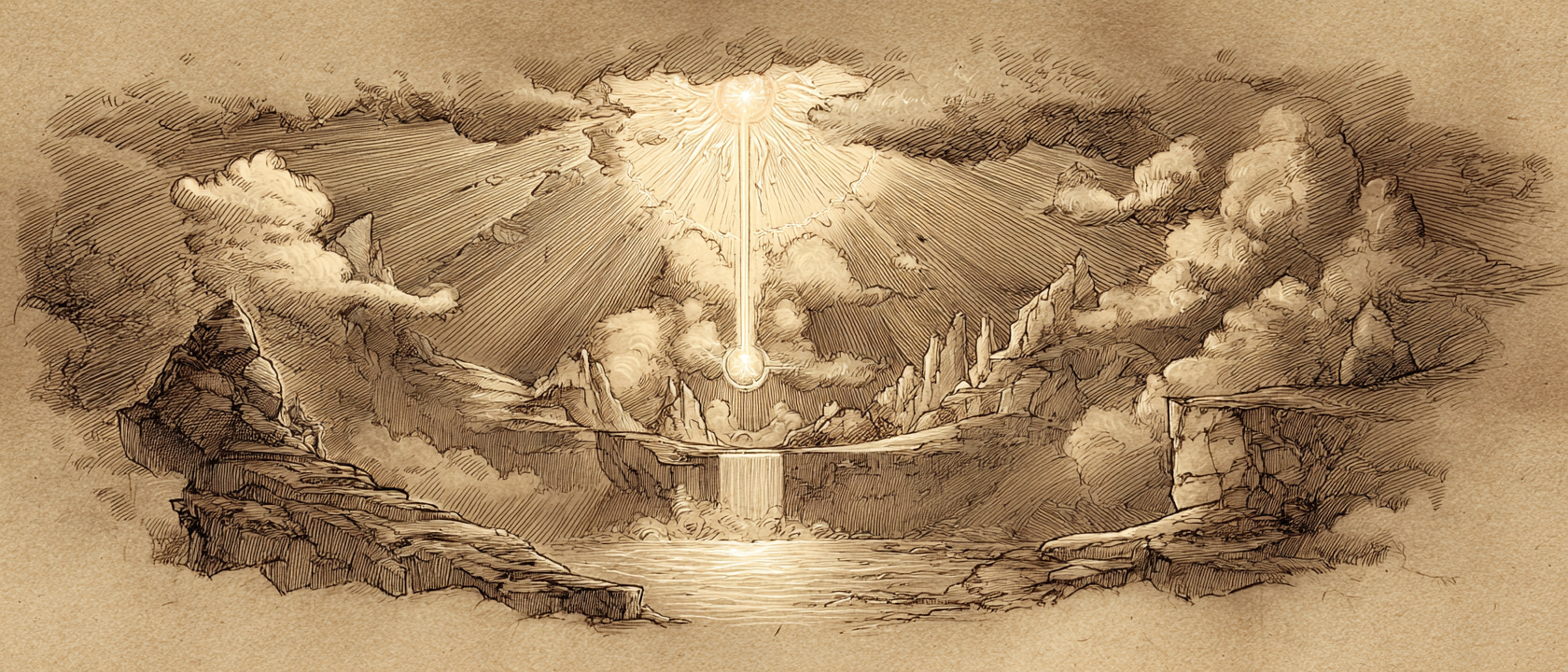
Nesmerleth, the Inevitable Queen
There are gods who inspire love, gods who stir courage, gods who promise beauty, harvest, victory, or wonder. Nesmerleth promises none of these things. She promises something older and more certain.
She is the Inevitable Queen, ruler of the underworld, goddess of death, and the hand of justice. She sits upon her throne of mist and pale stone with her great scale at her left hand and her terrible sword across her lap, pondering the deeds of mortals and the weight they have made of themselves. None escape her in the end. Kings go to her. Beggars go to her. Saints and murderers, oathkeepers and traitors, the beloved and the forgotten, all come at last before her judgment.
For this reason, she is feared, but not hated. Even those who tremble at her name understand the necessity of her office. Death is not, in the eyes of her faithful, a cruelty. It is a gate that cannot remain unguarded. Judgment is not malice. Where other gods may offer comfort, correction, mercy, or trial, Nesmerleth offers the last reckoning. She is the stillness after struggle. She is the stern answer to all excuses. She is the certainty waiting at the edge of the fog.
Her displeasure is most often drawn by violations of the proper boundary between life and death. Necromancy that raises the body is regarded as a lesser offense, vulgar and disrespectful, but still principally an insult to the dead shell rather than a theft of what truly belongs to her. Far worse are those arts that ensnare, shackle, twist, consume, or deny the soul. Such acts are not merely impious. They are rebellion against her authority, and she answers them with terrible clarity.
The mist is sacred to her. Folk say it is a veil between the living world and the lands beneath her rule, and many believe that when the fog lies heavy on field or graveyard, the Queen is nearer than usual. Most days she remains in her own dominion, patient and assured, for time itself serves her cause. Yet there are moments when some grave wickedness, some offense too cruel or defiant to be left to ordinary endings, stirs her wrath. Then the old stories say she rises from her throne, scale in one hand and sword in the other, and descends in judgment so swift that no plea has time to form.
To stand in the gaze of Nesmerleth is not to be debated with. It is to be known.
The faithful of Nesmerleth are called the Scalebearers, though they are also known in more formal speech as the Order of the Inevitable Queen or Nesmerleth’s Scales. Where the servants of some gods are wanderers, healers, celebrants, or visionaries, the Scalebearers are keepers of solemn things. They tend the dead, preserve the law, weigh wrongdoing, and stand watch against those who would profane the natural order.
They are found wherever death must be faced plainly. In cities, they maintain formal temples, oversee graveyards, conduct funerary rites, and advise magistrates or rulers in matters of justice. In villages and rural places, they often serve more humbly but no less importantly as judges, gravediggers, burial wardens, mourners for the unclaimed dead, and the first line of defense against restless corpses, soul-theft, and Titan-tainted horrors. Many homes keep a small niche, bowl, or household shrine dedicated to the Queen, especially where family dead are remembered carefully and the duties owed to ancestors are still observed with reverence.
Though they are not warm in the fashion of Eanna’s priests, neither are they heartless. The grieving come to them often. They know the shape of loss too well to mock it, and one of their central duties is helping communities endure death without surrendering to despair, hysteria, or desecration. Their comfort is not sentimental. They do not lie and say death is small. They teach instead that sorrow must be borne with dignity, and that the dead are best honored through rightful rites, rightful memory, and rightful conduct among the living.
The Scalebearers are respected in part because they ask for very little admiration. They do not need to be loved. It is enough that they are obeyed when the hour requires it.
The central truth of Nesmerleth’s faith is that all things are weighed.
No life passes without measure. No deed vanishes merely because it is hidden. No cruelty becomes harmless because time has softened memory. The Queen’s scales do not forget, and they are not impressed by mortal rank, beauty, power, or excuses. The faithful therefore teach that justice is not a human invention, nor a convenience of rulers, nor a passion to be indulged when useful. It is a law older than kingdoms, reflected dimly in mortal courts and fulfilled perfectly only in the underworld.
From this follow several other principles.
The first is that death must be respected. The dead are not refuse, not trophies, not tools. Their bodies must be treated with proper care and their souls left free to pass to the judgment appointed them.
The second is that mercy without truth is corruption. Nesmerleth’s clergy do not reject mercy outright, but they do distrust the kind that asks no accounting. To forgive what has not been honestly faced is, in their eyes, only another form of disorder.
The third is that justice must outlast emotion. Rage, grief, affection, fear, and pity all cloud the scale if left unchecked. The faithful are trained to listen, to mourn, and even to understand, but never to let these feelings override what is due.
This places them in a quiet but enduring philosophical tension with the worship of Eanna. The Sun Goddess is beloved precisely because she offers warmth, life, generosity, and hope. To the Scalebearers, however, her faithful can seem too ready to trust freedom, too willing to believe that grace will accomplish what discipline and reckoning have not. In turn, many who love Eanna find the Queen’s servants rigid, austere, and too cold in matters where the heart cries out for gentleness.
The tension rarely breaks into open hostility. The world has too many larger enemies for that. Still, it is felt.
The Order of the Inevitable Queen is disciplined, formal, and old. Its hierarchy is clear, though local temples and grave orders retain a measure of autonomy necessary to govern their own dead and their own disputes.
At its head stands the High Justiciar, supreme voice of the order in the mortal world. Beneath that office are the Justiciars, who oversee major temples, regions, or important burial grounds. Below them are the common Scalebearers, full members entrusted with law, funerary duty, and ritual judgment, followed by the Mistwardens, who serve as protectors, grave-watchers, escorts of the dead, and hunters of necromantic or Titan-born threats. At the foundation of the order are the Acolytes, who learn ritual law, burial custom, record-keeping, combat discipline, and the first prayers of weighing.
Among the faithful, true clerics of the Queen are often called Princes and Princesses of the Queen, a title not of worldly nobility but of sacred office, indicating that they serve directly beneath her unseen sovereignty. Their numbers are not vast, but neither are they vanishingly rare. They are spread across the world with greatest concentrations near major cities, old battlefields, vast grave complexes, and those scars left behind by the wars against the Titan where death came so violently and in such number that the land itself remembers.
Nearly all members of the order are trained in some combination of combat, law, burial rite, and warding prayer. The dead are not always quiet. The wicked do not always submit. A priest of Nesmerleth who cannot defend a grave or survive a night among the tombs is seldom a priest for long.
The temples of Nesmerleth are formal places, built not to dazzle but to endure. Pale stone, grey veils, silver lamps, still pools, carved scales, and broad floor spaces for processions or hearings are common features. Many are attached to or overlook graveyards, catacombs, cremation halls, mausoleums, or judicial chambers. Their beauty, where it exists, is severe. Even the richest among them prefer restraint over luxury.
Graveyards under the Queen’s protection are considered sacred precincts. To disturb them without cause is a crime. To defile them is sacrilege. Scalebearers tend such places with meticulous care, maintaining stones and markers, recording names, seeing to the poor dead as carefully as the honored, and ensuring that no restless influence roots itself among them.
In ordinary homes, devotion to Nesmerleth is usually modest. A bowl of still water, a small set of scales, a strip of grey cloth, a candle burned on the anniversary of a death, a family book of names, these are common household signs of reverence. People do not usually invite her presence for festivity. They call upon her for funerals, oaths, final blessings, protection against the unquiet dead, and the hard courage to do what justice requires when affection would rather look away.
The best known rites of the order are the Weighing Rites, which may be public or private depending on circumstance.
For the dead, these rites commend the departed soul to Nesmerleth’s judgment, asking not indulgence, but fairness. The priest names the dead, recalls the duties and bonds that shaped their life, speaks any known virtues and transgressions, and entrusts the final measure to the Queen whose scales cannot be deceived. Families are encouraged to speak truthfully in these ceremonies. Empty praise is considered a kind of insult. Better an honest farewell than a flattering lie spoken over the grave.
For the living, Weighing Rites may be used in disputes, accusations, oaths, confessions, and moments when ordinary testimony is not enough to settle a matter of grave consequence. Such rites are never casual. To submit oneself to weighing is to accept that one may be found wanting.
These ceremonies have given the Scalebearers much of their reputation as judges. They are not rulers in most lands, but many rulers gladly borrow their authority when the burden of final adjudication grows too heavy to bear alone.
Though much of the Queen’s faith is quiet, patient, and ceremonial, there is another face to it.
When grave injustice is done, when murderers shelter behind influence, when soul-thieves or necromancers profane the dead, when entire communities are broken by treachery or monstrous corruption, the order may declare a Descent. This is not war in the ordinary sense, nor a crusade stirred by passion. It is retribution in the image of the goddess herself: cold, deliberate, inexorable.
The rituals preceding such an action are known collectively as the Retribution Vigil. Lamps are hooded. Names are spoken. Charges are recorded. Swords are blessed. Witnesses are heard. The order fasts, prays, and strips the matter of all vanity until only the offense and its due remain. Then the Scalebearers descend upon the guilty with terrifying discipline.
This is the side of the faith most feared in story and song. When it comes, it is as inevitable as death.
All faiths that respect the natural order abhor certain forms of necromancy, but the servants of Nesmerleth oppose them with special zeal. Their distinction between lesser and greater offenses is well known.
The manipulation of dead flesh, though offensive, is treated as a desecration of the body. It is contemptible, but not the darkest possible crime. Far worse are those magics and creatures that interfere with the soul itself. Vampires who bind the dead into hunger, sorcerers who imprison spirits, occultists who devour the essence of the dying, grave-cults that twist memory or prevent passage, these are enemies of the Queen in the fullest sense.
The Scalebearers hunt such beings relentlessly. Their grave-watchers learn the signs of soul-disturbance. Their judges memorize old funerary law. Their warriors are trained to fight in crypt, marsh, battlefield ruin, and fog. Their temples maintain records of bloodlines, burial customs, hauntings, disappearances, and death omens, for to know how the dead ought to behave is often the first step in recognizing what has gone wrong.
They are equally vigilant against the Exos Umbros and other Titan-tainted things, whose very existence often blurs the line between life, death, corruption, and unmaking. To the order, such creatures are not merely monstrous. They are insults against rightful endings.
The Scalebearers dress plainly, but never carelessly. Grey, mist-white, ash, pale stone, and muted silver dominate their clothing. Robes are common in temple life, often marked with embroidered scales across the breast or cuffs, but field vestments may include layered leathers, cloaks, grave-ward sashes, gauntlets, and armor worn beneath ceremonial cloth. Their appearance reflects their god’s nature: restrained, clear, and difficult to mistake.
They favor the greatsword, not because it is elegant, but because it suits the imagery of the Queen’s terrible blade. In ritual iconography, the sword is not merely a weapon. It is the severing of falsehood from truth, of life from death, of innocence from guilt, of delay from final judgment. Many temple swords are older than the kingdoms around them, carried in processions, laid beside the dead, or drawn only when some true abomination must be answered.
A priest of Nesmerleth is expected to carry themselves with gravity. Disorderly display, careless laughter in sacred contexts, drunkenness on duty, and theatrical piety are all strongly discouraged. The Queen has no need of performers.
At the head of the order stands High Justiciar Nerissa Vaux, a woman whose reputation has grown nearly as austere as the office she holds.
She is tall, silver-haired, and of mixed human and elven blood, with calm eyes so unreadable that many who speak to her leave feeling more exposed than before they began. She carries a small balance scale wherever she goes and a sheathed sword that never leaves her side. It is often said that she has never once raised her voice in council, and that those who mistake her composure for softness seldom make the error twice.
Under her leadership, the order has tightened its records, strengthened its anti-necromantic patrols, and reasserted temple authority in regions where law had grown lax around the treatment of the dead. She is respected even by many outside the faith, though not often loved. Her judgments are said to be exacting, and there are those who quietly wonder whether she leaves enough room for human frailty.
Those within the order who admire her say that frailty has already been given all the room it can safely bear.
The closest and most complicated relationship maintained by the Scalebearers is with the servants of Settraes. The bond between the Queen and her brother is woven deeply into both priesthoods. His faithful labor to turn souls toward honesty, endurance, and atonement before death. Hers receive those souls when all chances to change have ended. The relationship is ancient, practical, and usually sincere, though not without disagreement. The Redeemers often hold hope longer than the Scalebearers find wise.
The order also maintains a close, if sometimes strained, alliance with the Mothers of the Ardent Dawn. Both faiths care deeply for the suffering of the living, but they differ in method and temperament. One side tends to lead with warmth and restoration, the other with truth and necessary order. In times of plague, war, or catastrophe, however, they often stand side by side with remarkable effectiveness.
Their relations with harsher or more vengeful powers are worse. In particular, the faithful of the Grey Vigil are viewed with profound unease. To the servants of Nesmerleth, blind vengeance is not justice sharpened, but justice corrupted. Rage that cannot weigh, hear, or distinguish innocence from guilt has already fallen off the balance.
This does not prevent temporary alliances against darker threats, but it ensures they remain uneasy ones.
To those outside the faith, Nesmerleth is often imagined as wholly cold. Her faithful would not entirely deny this, but they would say the matter is misunderstood.
She is not merciful in the tender or indulgent sense. She does not bend because mortals weep. She does not lighten guilt because life was difficult. Yet neither is she arbitrary, cruel, or eager for condemnation. What the Queen offers is something sterner and, in its own way, more merciful than favoritism: she judges truly.
This is why her priests can comfort the grieving even while speaking so often of scales and swords. They believe the dead are not abandoned to chaos. They are received. Measured. Set in their rightful place. The wicked do not finally escape. The wronged are not forever forgotten. The losses and crimes of the world are not swallowed meaninglessly into dark silence. Someone waits beyond death who knows what was done.
For many, that is terror.
For many others, it is peace.
She is the Inevitable Queen, ruler of the underworld, goddess of death, and the hand of justice. She sits upon her throne of mist and pale stone with her great scale at her left hand and her terrible sword across her lap, pondering the deeds of mortals and the weight they have made of themselves. None escape her in the end. Kings go to her. Beggars go to her. Saints and murderers, oathkeepers and traitors, the beloved and the forgotten, all come at last before her judgment.
For this reason, she is feared, but not hated. Even those who tremble at her name understand the necessity of her office. Death is not, in the eyes of her faithful, a cruelty. It is a gate that cannot remain unguarded. Judgment is not malice. Where other gods may offer comfort, correction, mercy, or trial, Nesmerleth offers the last reckoning. She is the stillness after struggle. She is the stern answer to all excuses. She is the certainty waiting at the edge of the fog.
Her displeasure is most often drawn by violations of the proper boundary between life and death. Necromancy that raises the body is regarded as a lesser offense, vulgar and disrespectful, but still principally an insult to the dead shell rather than a theft of what truly belongs to her. Far worse are those arts that ensnare, shackle, twist, consume, or deny the soul. Such acts are not merely impious. They are rebellion against her authority, and she answers them with terrible clarity.
The mist is sacred to her. Folk say it is a veil between the living world and the lands beneath her rule, and many believe that when the fog lies heavy on field or graveyard, the Queen is nearer than usual. Most days she remains in her own dominion, patient and assured, for time itself serves her cause. Yet there are moments when some grave wickedness, some offense too cruel or defiant to be left to ordinary endings, stirs her wrath. Then the old stories say she rises from her throne, scale in one hand and sword in the other, and descends in judgment so swift that no plea has time to form.
To stand in the gaze of Nesmerleth is not to be debated with. It is to be known.
The Scalebearers
The faithful of Nesmerleth are called the Scalebearers, though they are also known in more formal speech as the Order of the Inevitable Queen or Nesmerleth’s Scales. Where the servants of some gods are wanderers, healers, celebrants, or visionaries, the Scalebearers are keepers of solemn things. They tend the dead, preserve the law, weigh wrongdoing, and stand watch against those who would profane the natural order.
They are found wherever death must be faced plainly. In cities, they maintain formal temples, oversee graveyards, conduct funerary rites, and advise magistrates or rulers in matters of justice. In villages and rural places, they often serve more humbly but no less importantly as judges, gravediggers, burial wardens, mourners for the unclaimed dead, and the first line of defense against restless corpses, soul-theft, and Titan-tainted horrors. Many homes keep a small niche, bowl, or household shrine dedicated to the Queen, especially where family dead are remembered carefully and the duties owed to ancestors are still observed with reverence.
Though they are not warm in the fashion of Eanna’s priests, neither are they heartless. The grieving come to them often. They know the shape of loss too well to mock it, and one of their central duties is helping communities endure death without surrendering to despair, hysteria, or desecration. Their comfort is not sentimental. They do not lie and say death is small. They teach instead that sorrow must be borne with dignity, and that the dead are best honored through rightful rites, rightful memory, and rightful conduct among the living.
The Scalebearers are respected in part because they ask for very little admiration. They do not need to be loved. It is enough that they are obeyed when the hour requires it.
Beliefs and Doctrine
The central truth of Nesmerleth’s faith is that all things are weighed.
No life passes without measure. No deed vanishes merely because it is hidden. No cruelty becomes harmless because time has softened memory. The Queen’s scales do not forget, and they are not impressed by mortal rank, beauty, power, or excuses. The faithful therefore teach that justice is not a human invention, nor a convenience of rulers, nor a passion to be indulged when useful. It is a law older than kingdoms, reflected dimly in mortal courts and fulfilled perfectly only in the underworld.
From this follow several other principles.
The first is that death must be respected. The dead are not refuse, not trophies, not tools. Their bodies must be treated with proper care and their souls left free to pass to the judgment appointed them.
The second is that mercy without truth is corruption. Nesmerleth’s clergy do not reject mercy outright, but they do distrust the kind that asks no accounting. To forgive what has not been honestly faced is, in their eyes, only another form of disorder.
The third is that justice must outlast emotion. Rage, grief, affection, fear, and pity all cloud the scale if left unchecked. The faithful are trained to listen, to mourn, and even to understand, but never to let these feelings override what is due.
This places them in a quiet but enduring philosophical tension with the worship of Eanna. The Sun Goddess is beloved precisely because she offers warmth, life, generosity, and hope. To the Scalebearers, however, her faithful can seem too ready to trust freedom, too willing to believe that grace will accomplish what discipline and reckoning have not. In turn, many who love Eanna find the Queen’s servants rigid, austere, and too cold in matters where the heart cries out for gentleness.
The tension rarely breaks into open hostility. The world has too many larger enemies for that. Still, it is felt.
The Shape of the Order
The Order of the Inevitable Queen is disciplined, formal, and old. Its hierarchy is clear, though local temples and grave orders retain a measure of autonomy necessary to govern their own dead and their own disputes.
At its head stands the High Justiciar, supreme voice of the order in the mortal world. Beneath that office are the Justiciars, who oversee major temples, regions, or important burial grounds. Below them are the common Scalebearers, full members entrusted with law, funerary duty, and ritual judgment, followed by the Mistwardens, who serve as protectors, grave-watchers, escorts of the dead, and hunters of necromantic or Titan-born threats. At the foundation of the order are the Acolytes, who learn ritual law, burial custom, record-keeping, combat discipline, and the first prayers of weighing.
Among the faithful, true clerics of the Queen are often called Princes and Princesses of the Queen, a title not of worldly nobility but of sacred office, indicating that they serve directly beneath her unseen sovereignty. Their numbers are not vast, but neither are they vanishingly rare. They are spread across the world with greatest concentrations near major cities, old battlefields, vast grave complexes, and those scars left behind by the wars against the Titan where death came so violently and in such number that the land itself remembers.
Nearly all members of the order are trained in some combination of combat, law, burial rite, and warding prayer. The dead are not always quiet. The wicked do not always submit. A priest of Nesmerleth who cannot defend a grave or survive a night among the tombs is seldom a priest for long.
Temples, Graveyards, and Household Shrines
The temples of Nesmerleth are formal places, built not to dazzle but to endure. Pale stone, grey veils, silver lamps, still pools, carved scales, and broad floor spaces for processions or hearings are common features. Many are attached to or overlook graveyards, catacombs, cremation halls, mausoleums, or judicial chambers. Their beauty, where it exists, is severe. Even the richest among them prefer restraint over luxury.
Graveyards under the Queen’s protection are considered sacred precincts. To disturb them without cause is a crime. To defile them is sacrilege. Scalebearers tend such places with meticulous care, maintaining stones and markers, recording names, seeing to the poor dead as carefully as the honored, and ensuring that no restless influence roots itself among them.
In ordinary homes, devotion to Nesmerleth is usually modest. A bowl of still water, a small set of scales, a strip of grey cloth, a candle burned on the anniversary of a death, a family book of names, these are common household signs of reverence. People do not usually invite her presence for festivity. They call upon her for funerals, oaths, final blessings, protection against the unquiet dead, and the hard courage to do what justice requires when affection would rather look away.
The Weighing Rites
The best known rites of the order are the Weighing Rites, which may be public or private depending on circumstance.
For the dead, these rites commend the departed soul to Nesmerleth’s judgment, asking not indulgence, but fairness. The priest names the dead, recalls the duties and bonds that shaped their life, speaks any known virtues and transgressions, and entrusts the final measure to the Queen whose scales cannot be deceived. Families are encouraged to speak truthfully in these ceremonies. Empty praise is considered a kind of insult. Better an honest farewell than a flattering lie spoken over the grave.
For the living, Weighing Rites may be used in disputes, accusations, oaths, confessions, and moments when ordinary testimony is not enough to settle a matter of grave consequence. Such rites are never casual. To submit oneself to weighing is to accept that one may be found wanting.
These ceremonies have given the Scalebearers much of their reputation as judges. They are not rulers in most lands, but many rulers gladly borrow their authority when the burden of final adjudication grows too heavy to bear alone.
Retribution and the Descent
Though much of the Queen’s faith is quiet, patient, and ceremonial, there is another face to it.
When grave injustice is done, when murderers shelter behind influence, when soul-thieves or necromancers profane the dead, when entire communities are broken by treachery or monstrous corruption, the order may declare a Descent. This is not war in the ordinary sense, nor a crusade stirred by passion. It is retribution in the image of the goddess herself: cold, deliberate, inexorable.
The rituals preceding such an action are known collectively as the Retribution Vigil. Lamps are hooded. Names are spoken. Charges are recorded. Swords are blessed. Witnesses are heard. The order fasts, prays, and strips the matter of all vanity until only the offense and its due remain. Then the Scalebearers descend upon the guilty with terrifying discipline.
This is the side of the faith most feared in story and song. When it comes, it is as inevitable as death.
The War Against Necromancy
All faiths that respect the natural order abhor certain forms of necromancy, but the servants of Nesmerleth oppose them with special zeal. Their distinction between lesser and greater offenses is well known.
The manipulation of dead flesh, though offensive, is treated as a desecration of the body. It is contemptible, but not the darkest possible crime. Far worse are those magics and creatures that interfere with the soul itself. Vampires who bind the dead into hunger, sorcerers who imprison spirits, occultists who devour the essence of the dying, grave-cults that twist memory or prevent passage, these are enemies of the Queen in the fullest sense.
The Scalebearers hunt such beings relentlessly. Their grave-watchers learn the signs of soul-disturbance. Their judges memorize old funerary law. Their warriors are trained to fight in crypt, marsh, battlefield ruin, and fog. Their temples maintain records of bloodlines, burial customs, hauntings, disappearances, and death omens, for to know how the dead ought to behave is often the first step in recognizing what has gone wrong.
They are equally vigilant against the Exos Umbros and other Titan-tainted things, whose very existence often blurs the line between life, death, corruption, and unmaking. To the order, such creatures are not merely monstrous. They are insults against rightful endings.
Vestments and Bearing
The Scalebearers dress plainly, but never carelessly. Grey, mist-white, ash, pale stone, and muted silver dominate their clothing. Robes are common in temple life, often marked with embroidered scales across the breast or cuffs, but field vestments may include layered leathers, cloaks, grave-ward sashes, gauntlets, and armor worn beneath ceremonial cloth. Their appearance reflects their god’s nature: restrained, clear, and difficult to mistake.
They favor the greatsword, not because it is elegant, but because it suits the imagery of the Queen’s terrible blade. In ritual iconography, the sword is not merely a weapon. It is the severing of falsehood from truth, of life from death, of innocence from guilt, of delay from final judgment. Many temple swords are older than the kingdoms around them, carried in processions, laid beside the dead, or drawn only when some true abomination must be answered.
A priest of Nesmerleth is expected to carry themselves with gravity. Disorderly display, careless laughter in sacred contexts, drunkenness on duty, and theatrical piety are all strongly discouraged. The Queen has no need of performers.
High Justiciar Nerissa Vaux
At the head of the order stands High Justiciar Nerissa Vaux, a woman whose reputation has grown nearly as austere as the office she holds.
She is tall, silver-haired, and of mixed human and elven blood, with calm eyes so unreadable that many who speak to her leave feeling more exposed than before they began. She carries a small balance scale wherever she goes and a sheathed sword that never leaves her side. It is often said that she has never once raised her voice in council, and that those who mistake her composure for softness seldom make the error twice.
Under her leadership, the order has tightened its records, strengthened its anti-necromantic patrols, and reasserted temple authority in regions where law had grown lax around the treatment of the dead. She is respected even by many outside the faith, though not often loved. Her judgments are said to be exacting, and there are those who quietly wonder whether she leaves enough room for human frailty.
Those within the order who admire her say that frailty has already been given all the room it can safely bear.
Relations with Other Faiths
The closest and most complicated relationship maintained by the Scalebearers is with the servants of Settraes. The bond between the Queen and her brother is woven deeply into both priesthoods. His faithful labor to turn souls toward honesty, endurance, and atonement before death. Hers receive those souls when all chances to change have ended. The relationship is ancient, practical, and usually sincere, though not without disagreement. The Redeemers often hold hope longer than the Scalebearers find wise.
The order also maintains a close, if sometimes strained, alliance with the Mothers of the Ardent Dawn. Both faiths care deeply for the suffering of the living, but they differ in method and temperament. One side tends to lead with warmth and restoration, the other with truth and necessary order. In times of plague, war, or catastrophe, however, they often stand side by side with remarkable effectiveness.
Their relations with harsher or more vengeful powers are worse. In particular, the faithful of the Grey Vigil are viewed with profound unease. To the servants of Nesmerleth, blind vengeance is not justice sharpened, but justice corrupted. Rage that cannot weigh, hear, or distinguish innocence from guilt has already fallen off the balance.
This does not prevent temporary alliances against darker threats, but it ensures they remain uneasy ones.
The Queen’s Silence and the Queen’s Mercy
To those outside the faith, Nesmerleth is often imagined as wholly cold. Her faithful would not entirely deny this, but they would say the matter is misunderstood.
She is not merciful in the tender or indulgent sense. She does not bend because mortals weep. She does not lighten guilt because life was difficult. Yet neither is she arbitrary, cruel, or eager for condemnation. What the Queen offers is something sterner and, in its own way, more merciful than favoritism: she judges truly.
This is why her priests can comfort the grieving even while speaking so often of scales and swords. They believe the dead are not abandoned to chaos. They are received. Measured. Set in their rightful place. The wicked do not finally escape. The wronged are not forever forgotten. The losses and crimes of the world are not swallowed meaninglessly into dark silence. Someone waits beyond death who knows what was done.
For many, that is terror.
For many others, it is peace.
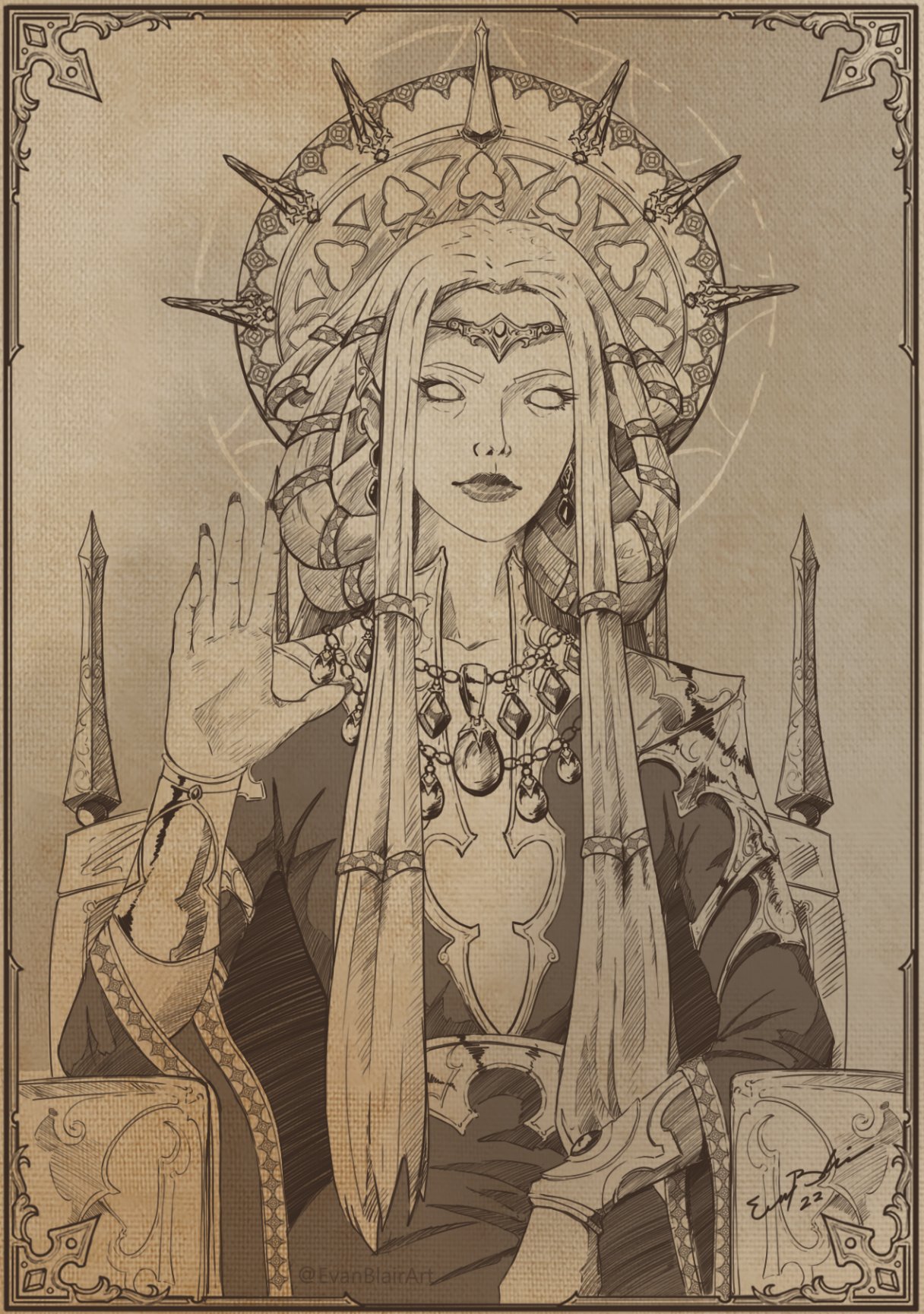
Divine Title: Nesmerleth, the Inevitable Queen, Lady of the Underworld, the Hand of Justice
Alignment: Lawful Good
Portfolio: Death, judgment, justice, rightful burial, final reckoning, the underworld
Favored Weapon: Greatsword
Domains: Death, Glory, Good, Law, Repose, Rune, Judgement
Primary Worshippers: Judges, gravekeepers, mourners, executioners, burial priests, lawkeepers, those who have lost the dead, communities haunted by undeath
Major Order: The Scalebearers, also called the Order of the Inevitable Queen or Nesmerleth’s Scales
Common Symbols: Silver scales, a sword laid across pale stone, mist veils, still water, grave lamps
Sacred Sites: Formal temples, graveyards, mausoleums, catacombs, household shrines for the dead
Sacred Virtues: Justice, dignity, restraint, truth, reverence for the dead, rightful order
Alignment: Lawful Good
Portfolio: Death, judgment, justice, rightful burial, final reckoning, the underworld
Favored Weapon: Greatsword
Domains: Death, Glory, Good, Law, Repose, Rune, Judgement
Primary Worshippers: Judges, gravekeepers, mourners, executioners, burial priests, lawkeepers, those who have lost the dead, communities haunted by undeath
Major Order: The Scalebearers, also called the Order of the Inevitable Queen or Nesmerleth’s Scales
Common Symbols: Silver scales, a sword laid across pale stone, mist veils, still water, grave lamps
Sacred Sites: Formal temples, graveyards, mausoleums, catacombs, household shrines for the dead
Sacred Virtues: Justice, dignity, restraint, truth, reverence for the dead, rightful order
Children


Comments