
Gwyfyn, She Who Watches
Not every god wishes to be understood.
Some declare themselves in fire, harvest, or open judgment. Gwyfyn lingers in thresholds and half-light, in women’s whispered lore, in herbs drying from rafters, in the changing face of a rune when candlelight crosses it. White moths are her heralds. Their sudden appearance is never taken lightly: a warning, a witness, or an invitation, depending on who sees them and what burdens they carry.
She is called the Crone and the Moth Mother. Witches, spies, diviners, hedge-healers, hidden teachers, and those who traffic in dangerous truths speak her name softly. She watches over every facet of womanhood with ancient temperance, fertility and barrenness, childbirth and blood, widowhood and the authority of those who have outlived illusion. Truth, in her domain, is rarely clean. It can heal. It can deform. It can ripen in silence for years until it must be spoken or else poison everything it touches.
Gwyfyn troubles the neat-minded. No one can give a simple, satisfying account of where she came from. Some say she was already old when the younger gods first raised their voices. Others claim she grew in power while brighter divinities drew mortal eyes. Still others whisper that she belongs to a deeper layer of the world, something the Titan remembers but will none else. She aided the gods when it suited her and withheld herself when it did not. She whispered the truth of the Titan to Eanna at the final battle, a revelation that broke the Sun Goddess into uncontrollable tears. She helped trick the Sidhe into binding themselves to this realm. These secrets are borne in silence.
Gwyfyn is less the warmth of the hearth and more the lamp in the back room where dangerous things are studied by careful, steady hands.
They are called the Mothmarked, the Crone’s Veil, Gwyfyn’s Whisper, or the Hidden Weave. They form no grand order with banners and thrones. They are a living web of circles, covens, teachers, spies, and arcane guardians who recognize one another through subtle signs, shared debts, coded phrases, and the long memory of favors given in darkness.
Their creed is simple: Watch. Weave. Teach.
Those who come to Gwyfyn seek difficult births, dangerous books, dreams that will not release them, curses braided into bloodlines, herbs that can save or ruin depending on the hand, and truths too sharp for brighter altars. They come because something hidden has begun to stir beneath the visible world, and only her people will admit that such things happen.
The Mothmarked guard the most perilous truths in Ior. They train mages in the wilder, more dangerous applications of Eanna’s gift. They delve into ruined places and ley-line scars to uncover threats before they bloom. They offer quiet aid, healing herbs that mend more than flesh, runes that hide villages from raiders, crystals that reveal corruption, help that is rarely loud or heroic, but always timely.
There is no single high priestess. A handful of respected Elder Crones coordinate between distant circles, but the network survives by dispersal. One hidden school may burn, while three others continue unseen. Roughly one hundred to one hundred and eighty true clerics walk the world at any time. Far more hedge-witches, rune-carvers, and crystal-seers move quietly among ordinary folk.
They dress plainly in earth-toned robes or cloaks embroidered with faint moth-wing patterns, shifting runes, or crystal shards. Many live as eccentric healers, traveling scholars, or reclusive teachers. Their power is wild and multifaceted: swarms of moths for spying or obscuring sight, runes whose meaning changes with the light, crystals that store power or grant visions, herbal brews that heal, curse, or reveal.
Few places carry deeper rumor than the White Tower, a pearlescent spire upon a mist-shrouded island that refuses to remain in one place. It appears in different lakes and foggy waters across Ior, reachable only through chains of omens or at great personal cost. Legends say it is Gwyfyn’s own sanctum or a Sidhe realm. To the Mothmarked it is the true heart of their tradition: a place of revelations too heavy for ordinary teaching, where the Language of the Moths is spoken in full and new Elder Crones receive their final revelations.
Plain speech is a luxury few Mothmarked can afford. They speak instead in layered symbols, light and shadow, coded embroidery, shifting runes, shadow gestures, and phrases that reveal different meanings according to who hears them and when. A lantern in a window may carry one warning to the ignorant and another to the initiated. A lullaby may contain route markers. A mourning veil may signal that someone has been hidden or marked for protection.
To rigid minds this is dishonesty. To the Mothmarked, it is the hidden thread that binds or alters mortal fates.
They keep truths too harsh for brighter altars: the secrets of the Titan, the binding of the Sidhe, the deeper mechanics of wild magic, and older bargains whose full weight few could bear. Some knowledge they teach carefully while some they veil forever. This tension has produced two quiet factions: the Deep Veil, who believe certain truths must remain hidden to protect mortals, and the Open Weave, who argue that controlled sharing is necessary for the world to survive.
One of the most respected living figures is Elder Crone Brenna Sylvin, said to maintain a hidden school in the Silver Mist Hills. Silver-haired, with eyes that seem to hold shifting shadows, she is rumored to have reached the White Tower more times than any other in living memory. She is patient until she is not. Gentle until crossed. Many of Ior’s finest mages owe their deepest knowledge to her, though few would admit it openly.
The Mothmarked share their warmest alliance with the Mothers of the Ardent Dawn, especially in matters of healing, midwifery, and the guidance of gifted children. The Windstriders also move easily among them, carrying messages and songs between hidden circles.
The Scalebearers and Stone Oathkeepers remain wary; open law and veiled knowledge rarely sit comfortably together. With the Thornclaws they share a cooler, instinctive respect in the wild places. Most other orders view them with unease. The Mothmarked know too much, and they teach power that can easily turn dangerous.
She is rarely felt as certainty.
She is the white moth in the wrong season. The pattern noticed only on the second glance. The bitter tea that heals the body while loosening truths in the mind. The symbol understood years later, when it is already too late to remain unchanged.
She is the thing seen from the corner of the eye, and the quiet, irreversible alteration that follows.
Some declare themselves in fire, harvest, or open judgment. Gwyfyn lingers in thresholds and half-light, in women’s whispered lore, in herbs drying from rafters, in the changing face of a rune when candlelight crosses it. White moths are her heralds. Their sudden appearance is never taken lightly: a warning, a witness, or an invitation, depending on who sees them and what burdens they carry.
She is called the Crone and the Moth Mother. Witches, spies, diviners, hedge-healers, hidden teachers, and those who traffic in dangerous truths speak her name softly. She watches over every facet of womanhood with ancient temperance, fertility and barrenness, childbirth and blood, widowhood and the authority of those who have outlived illusion. Truth, in her domain, is rarely clean. It can heal. It can deform. It can ripen in silence for years until it must be spoken or else poison everything it touches.
Gwyfyn troubles the neat-minded. No one can give a simple, satisfying account of where she came from. Some say she was already old when the younger gods first raised their voices. Others claim she grew in power while brighter divinities drew mortal eyes. Still others whisper that she belongs to a deeper layer of the world, something the Titan remembers but will none else. She aided the gods when it suited her and withheld herself when it did not. She whispered the truth of the Titan to Eanna at the final battle, a revelation that broke the Sun Goddess into uncontrollable tears. She helped trick the Sidhe into binding themselves to this realm. These secrets are borne in silence.
Gwyfyn is less the warmth of the hearth and more the lamp in the back room where dangerous things are studied by careful, steady hands.
The Mothmarked
They are called the Mothmarked, the Crone’s Veil, Gwyfyn’s Whisper, or the Hidden Weave. They form no grand order with banners and thrones. They are a living web of circles, covens, teachers, spies, and arcane guardians who recognize one another through subtle signs, shared debts, coded phrases, and the long memory of favors given in darkness.
Their creed is simple: Watch. Weave. Teach.
Those who come to Gwyfyn seek difficult births, dangerous books, dreams that will not release them, curses braided into bloodlines, herbs that can save or ruin depending on the hand, and truths too sharp for brighter altars. They come because something hidden has begun to stir beneath the visible world, and only her people will admit that such things happen.
The Mothmarked guard the most perilous truths in Ior. They train mages in the wilder, more dangerous applications of Eanna’s gift. They delve into ruined places and ley-line scars to uncover threats before they bloom. They offer quiet aid, healing herbs that mend more than flesh, runes that hide villages from raiders, crystals that reveal corruption, help that is rarely loud or heroic, but always timely.
There is no single high priestess. A handful of respected Elder Crones coordinate between distant circles, but the network survives by dispersal. One hidden school may burn, while three others continue unseen. Roughly one hundred to one hundred and eighty true clerics walk the world at any time. Far more hedge-witches, rune-carvers, and crystal-seers move quietly among ordinary folk.
They dress plainly in earth-toned robes or cloaks embroidered with faint moth-wing patterns, shifting runes, or crystal shards. Many live as eccentric healers, traveling scholars, or reclusive teachers. Their power is wild and multifaceted: swarms of moths for spying or obscuring sight, runes whose meaning changes with the light, crystals that store power or grant visions, herbal brews that heal, curse, or reveal.
The White Tower
Few places carry deeper rumor than the White Tower, a pearlescent spire upon a mist-shrouded island that refuses to remain in one place. It appears in different lakes and foggy waters across Ior, reachable only through chains of omens or at great personal cost. Legends say it is Gwyfyn’s own sanctum or a Sidhe realm. To the Mothmarked it is the true heart of their tradition: a place of revelations too heavy for ordinary teaching, where the Language of the Moths is spoken in full and new Elder Crones receive their final revelations.
The Language of the Moths
Plain speech is a luxury few Mothmarked can afford. They speak instead in layered symbols, light and shadow, coded embroidery, shifting runes, shadow gestures, and phrases that reveal different meanings according to who hears them and when. A lantern in a window may carry one warning to the ignorant and another to the initiated. A lullaby may contain route markers. A mourning veil may signal that someone has been hidden or marked for protection.
To rigid minds this is dishonesty. To the Mothmarked, it is the hidden thread that binds or alters mortal fates.
What They Guard
They keep truths too harsh for brighter altars: the secrets of the Titan, the binding of the Sidhe, the deeper mechanics of wild magic, and older bargains whose full weight few could bear. Some knowledge they teach carefully while some they veil forever. This tension has produced two quiet factions: the Deep Veil, who believe certain truths must remain hidden to protect mortals, and the Open Weave, who argue that controlled sharing is necessary for the world to survive.
Elder Crone Brenna Sylvin
One of the most respected living figures is Elder Crone Brenna Sylvin, said to maintain a hidden school in the Silver Mist Hills. Silver-haired, with eyes that seem to hold shifting shadows, she is rumored to have reached the White Tower more times than any other in living memory. She is patient until she is not. Gentle until crossed. Many of Ior’s finest mages owe their deepest knowledge to her, though few would admit it openly.
Relations with Other Faiths
The Mothmarked share their warmest alliance with the Mothers of the Ardent Dawn, especially in matters of healing, midwifery, and the guidance of gifted children. The Windstriders also move easily among them, carrying messages and songs between hidden circles.
The Scalebearers and Stone Oathkeepers remain wary; open law and veiled knowledge rarely sit comfortably together. With the Thornclaws they share a cooler, instinctive respect in the wild places. Most other orders view them with unease. The Mothmarked know too much, and they teach power that can easily turn dangerous.
When Gwyfyn Draws Near
She is rarely felt as certainty.
She is the white moth in the wrong season. The pattern noticed only on the second glance. The bitter tea that heals the body while loosening truths in the mind. The symbol understood years later, when it is already too late to remain unchanged.
She is the thing seen from the corner of the eye, and the quiet, irreversible alteration that follows.
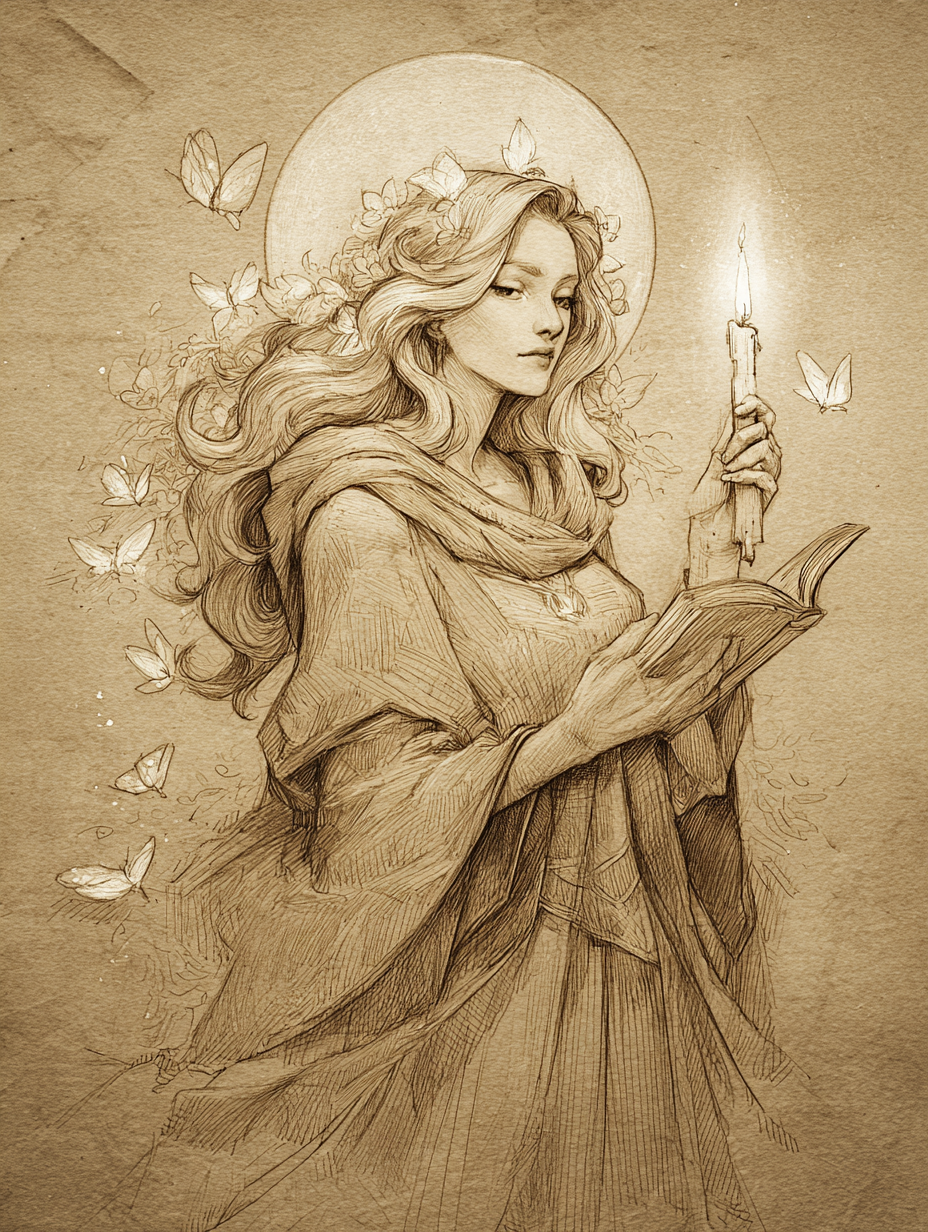
Divine Title: Gwyfyn, the Crone, the Moth Mother, She Who Watches
Alignment: Commonly understood as Chaotic Neutral
Favored Weapon: None
Domains: Magic, Mystery, Luck, Knowledge, Rune, Trickery
Followers: Spies, witches, healers, lore keepers, rune-workers, knowledge seekers, mages, secret-bearers
Primary Tradition: The Mothmarked, also called the Crone’s Veil, Gwyfyn’s Whisper, or the Hidden Weave
Common Signs: White moths, layered runes, crystal shards, veilwork, hidden scripts, herb bundles
Sacred Places: Hidden libraries, coven houses, remote schools, apothecaries, mist groves, the White Tower
Sacred Virtues: Discernment, patience, secrecy, wisdom, subtlety, careful teaching, reverence for mystery
Alignment: Commonly understood as Chaotic Neutral
Favored Weapon: None
Domains: Magic, Mystery, Luck, Knowledge, Rune, Trickery
Followers: Spies, witches, healers, lore keepers, rune-workers, knowledge seekers, mages, secret-bearers
Primary Tradition: The Mothmarked, also called the Crone’s Veil, Gwyfyn’s Whisper, or the Hidden Weave
Common Signs: White moths, layered runes, crystal shards, veilwork, hidden scripts, herb bundles
Sacred Places: Hidden libraries, coven houses, remote schools, apothecaries, mist groves, the White Tower
Sacred Virtues: Discernment, patience, secrecy, wisdom, subtlety, careful teaching, reverence for mystery
Children


Comments