
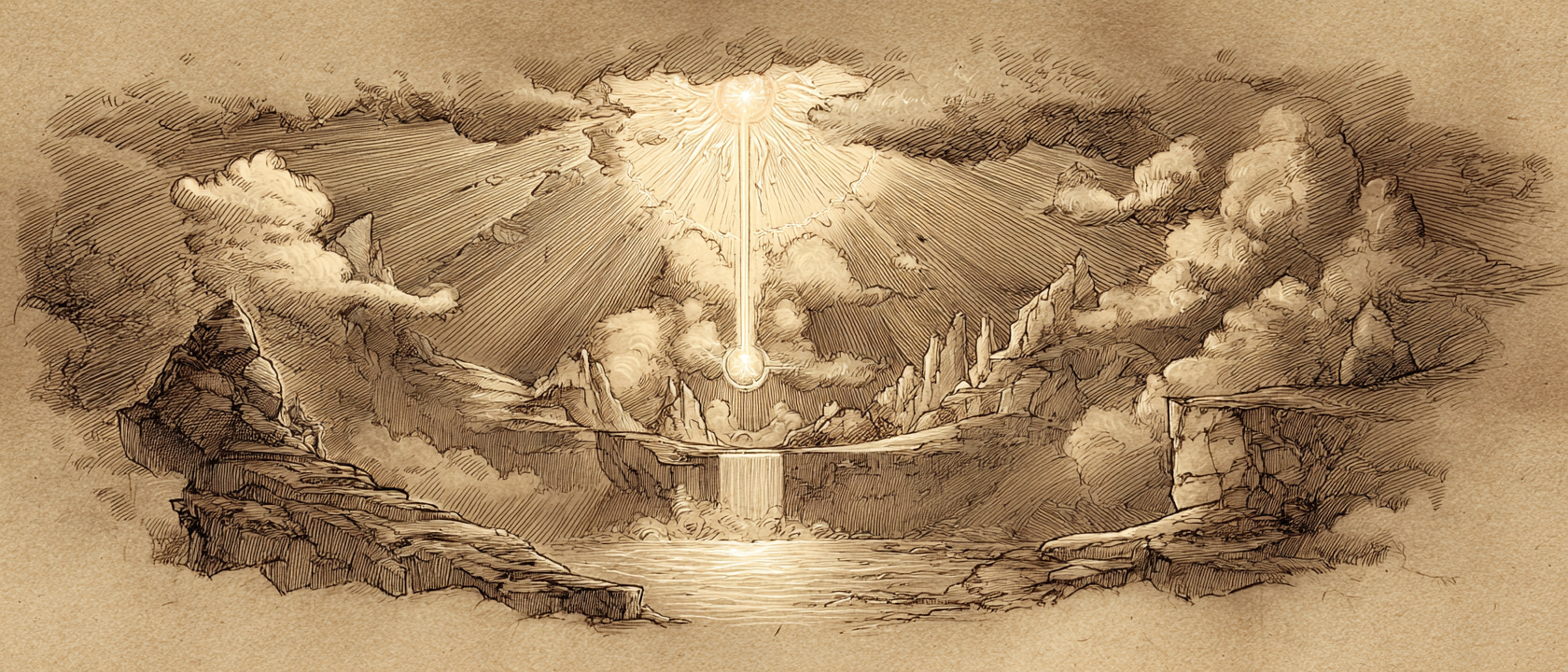
Finumeyn, Lord of the Unbound Sky
Some gods are honored in silence. Some are approached with bowed heads, weighed words, and careful offerings. Finumeyn is not often worshipped so solemnly.
He is the youngest child of Eanna and Aldanoc, god of the sky, the open plains, the wind between distant places, and all things that run or fly because the world is too wide to remain still within it. He is patron of music, storytelling, revelry, and those bright acts of making which remind mortals they are alive. His flute is said to carry over grasslands for miles without losing its sweetness, and the old tales claim that even Shirtheri, who gives so little of herself to the world, has felt her frozen heart stir at the sound of it.
Finumeyn is not a god of walls, still water, or settled certainty. He belongs to horizons. To roads that are little more than rumor in the grass. To the first clear note struck beneath an evening sky. To the rider who keeps going because there may yet be something beautiful over the next rise. He is the freedom to move, to speak, to sing, to laugh in the face of fear, and to carry one’s soul lightly enough that despair cannot quite close its hand around it.
For this reason, his faithful teach that joy is not frivolous. It is resistance. In a wounded world, in lands still scarred by the Titan’s shadow, to sing loudly, dance openly, tell the truth from village to village, and refuse to let terror become the only language people remember, these things are sacred. The Windstriders do not mistake delight for ignorance. They know grief well. They have crossed too many lonely places and brought too much bad news not to. But they hold that beauty, merriment, and shared stories are among the oldest proofs that darkness has not won.
He is especially loved in the plains, among wandering folk, scouts, performers, couriers, horse clans, gryphon riders, and those communities so far apart that a traveler bearing songs and warnings may matter as much as any soldier. Finumeyn’s worship tends to gather where the land is broad and the sky seems to make liars of all cages.
The primary faithful of Finumeyn are called the Windstriders, though they are just as often known as the Free Choir or the Sky Revelers, depending on region and custom.
They are not a priesthood in the formal sense favored by judges, temple-keepers, or kings. They are troupes, circles, camp-followers, song-bearers, mounted messengers, sky-watchers, dancers, wandering teachers, and riders with packs full of letters, gossip, warnings, instruments, and stories. They are as likely to arrive in a village square with a tune, a storm warning, and three pieces of scandal from two hundred miles away as they are with a sermon.
Their common saying is:
Run free, sing loud, carry word.
That single line contains most of their theology. Freedom is sacred. Song is medicine. Information binds the world together. To live well is not merely to survive, but to remain open, expressive, and connected. In a realm broken by distance, old disasters, and dangerous wilds, the carrying of news becomes something near holy. The Windstriders believe that when people are cut off from one another, fear thickens in the silence. Tyrants flourish. Rumors poison judgment. Villages die alone. To bring word across the empty places is therefore an act of joy and an act of defense all at once.
This has made the order welcome almost everywhere, even among those who find them exasperating. A Windstrider may be too loud, too bright, too quick with a grin in solemn company, but very few settlements turn away a rider who arrives with letters, warnings of raiders, news of a washed-out road, and songs the children have never heard before.
The faith of Finumeyn resists rigid doctrine more than most, but several shared truths still shape it.
The first is that freedom is holy. Not mere disorder, nor selfish indulgence, but the right and necessity of movement, expression, choice, and breath. A bird in a cage may still sing, but the song is no longer honest. The Windstriders therefore hate confinement in all its forms, whether literal tyranny, oppressive custom, spiritual despair, or the slow shrinking of the soul that comes when fear teaches a people not to speak.
The second is that joy is strength. Celebration is not denial of suffering. It is refusal to let suffering dictate the whole shape of existence. A feast after hardship, a song during the march, acrobatics in a town still rebuilding its walls, these things are not trivial to Finumeyn’s faithful. They are a way of saying that life remains larger than ruin.
The third is that the telling of truth matters. Stories can uplift, but they can also warn, preserve memory, and move people to action. The Windstriders place enormous value on songs of old battles, satirical ballads that shame petty tyrants, children’s rhymes that conceal travel lore, and long recitations that preserve histories no library would ever hold. Their faith treats memory as something meant to move through the world, not gather dust in one guarded room.
The fourth is that beauty should be shared. A melody kept to oneself, a joke never told, a warning never delivered, a road not marked for those who follow, these all represent missed chances to knit the world closer together.
Because of this, the Windstriders are unusually difficult to separate into clerics, artists, couriers, scouts, and wanderers. In their own eyes, these roles are barely distinct.
The Windstriders are among the most decentralized of the divine orders.
They technically acknowledge a High Reveler, but the office carries more influence than command. Finumeyn’s faithful do not love chains, even gilded ones, and most troupes or wandering circles retain near-complete independence so long as they uphold the core duties of the faith. A capable messenger-singer in a frontier circuit may matter far more in practical terms than any distant ceremonial leader.
Members are commonly called Striders, Revelers, or Sky-Singers, depending on their local custom and personal bent. Some are easily recognized as holy folk. Others are indistinguishable at first glance from actors, scouts, caravan outriders, traveling tutors, musicians, trick riders, map-makers, or charming troublemakers with very good boots.
This looseness does not mean the order lacks standards. Windstriders are expected to keep moving, keep listening, keep carrying word, and keep their gifts in service to life rather than vanity alone. A singer who uses their craft only to flatter nobles for comfort may be admired, but not deeply respected. A courier who withholds vital news for private advantage is looked upon as having betrayed more than a duty.
Their clergy tend to gather most thickly in the open plains and especially in the Gryphon Runs, where land, sky, speed, and distance all lend themselves naturally to Finumeyn’s character. Yet they are found nearly everywhere roads stretch thin and people begin to feel forgotten.
Unlike the temple faiths, the Windstriders do not prefer fixed sacred architecture. Their worship lives most naturally in the open.
A Finumeyn gathering might take place around wagon circles lit by lanterns, beneath long festival ribbons snapping in the wind, on a hilltop where musicians face the plains, inside a market square transformed by banners and dance fires, or in a roadside camp where one tired rider finally reaches another fire before midnight. The god does not require carved stone to hear him. He is present wherever voices rise freely beneath the sky.
That said, the Windstriders do keep certain favored sites. Amphitheater-like circles in the grass, painted standing stones used as way markers, hilltop shrines with weather bells, cliffside pavilions, messenger posts, and seasonal camps that return year after year all serve as places of devotion. Many settlements also keep a small shrine to Finumeyn near gates, stables, courier houses, or public squares, especially where news from afar is precious.
What the faith lacks in permanence of structure, it makes up for in visibility. Where the Windstriders pass, there is usually color, sound, and motion left behind.
Of all their callings, none is more distinctive than their devotion to carrying word.
Other orders will bear messages when need or convenience demands it. The Windstriders treat it as sacred labor. They go out of their way to carry letters, warnings, songs, proclamations, personal messages, rumors worth checking, tidings of weddings and deaths, calls for aid, changes in road conditions, and all the fragile strands by which scattered communities remain something more than lonely dots on a map.
This is not merely practical service to them. It is theology enacted. Finumeyn rules the wide spaces between people, and his faithful believe those spaces should not become gulfs of silence. The road between villages is not empty. It is alive with relation, provided someone is willing to cross it.
For this reason, Windstriders are often the first to know when a frontier hamlet has gone too quiet, when a plague is moving faster than rumor, when a petty lord has started taking too much in tax, or when a distant order will need to muster soon. They are not spies in the sinister sense, though some do gather information with considerable skill. They simply understand that in a fractured world, news itself may save lives.
Songs are part of this same duty. A Windstrider carrying a new ballad to an isolated valley is not only entertaining the people there. They are reminding them that the wider world still exists, and that they remain part of it.
The most beloved public expressions of the faith are the Sky Revels.
These are gatherings of music, dance, storytelling, racing, acrobatics, courtship, feasting, games, recitation, and open-hearted disorder kept just shy of true chaos by the better instincts of those present. At their best, they are an answer to the world’s weariness. Children race under ribbons. Elders tell old tales. Riders show off impossible stunts. Poets mock lords who deserve it. Musicians trade melodies until dawn and no one quite agrees when the formal celebration ended.
Many revels also include Freedom Songs, performances meant to stir courage, keep memory alive, and openly defy oppression or despair. These songs can be playful, mocking, mournful, or thunderous, but they nearly always contain some note of refusal. Refusal to bow. Refusal to forget. Refusal to let darkness define the full story.
These songs are especially important in places recovering from occupation, disaster, or spiritual exhaustion. It is one thing to feed a town after loss. It is another to teach it to sing again.
For all their bright reputation, the Windstriders are not merely celebrants. They are workers of a lighter but no less meaningful kind.
They escort vulnerable travelers, especially those who could not easily afford sterner protection. They teach songs, stories, instruments, and basic arts to children in isolated regions. They help organize communal festivals after hard winters or raids. They bring letters to the dying and carry final messages from them in turn. They comfort by drawing people into shared life rather than private silence.
This has made them deeply valuable after catastrophe. Where other orders bring food, law, healing, or armed defense, the Windstriders often bring the first return of ordinary human texture. Music in a place that has known only orders shouted in fear. Dancing where people have forgotten their own bodies except as instruments of labor or pain. News from beyond the valley. A joke. A banner. A chorus.
It is difficult to measure this sort of aid. It is also very hard to replace once it is gone.
The present nominal head of the order is High Reveler Katerina Crowe, a Veylori elf whose name is known far beyond the circles of the faithful.
Katerina is charismatic even by the standards of a faith not short on charm. Stories describe her as someone who can walk into a village preparing for siege and have its people singing before the walls are fully manned, not because she is frivolous, but because she understands morale as both art and weapon. She is famed for composing songs that travel almost faster than she does, and several frontier communities credit one or another of her ballads with rallying them to stand, flee in time, or hold together when they might otherwise have collapsed into despair.
As High Reveler, she has very little coercive authority, but considerable influence. Her preferences have nudged the order toward stronger messenger circuits, better coordination with other faiths during crises, and a renewed emphasis on preserving regional songs and oral histories before they are swallowed by war or distance. She is admired broadly, though some among the more duty-minded Striders find her too fond of celebration and spectacle.
Those who know her best usually answer that spectacle, in the right hands, is simply courage made visible.
The Windstriders are usually on warm terms with the Mothers of the Ardent Dawn, whose compassion and care for ordinary life accord naturally with Finumeyn’s delight in shared joy. They also work easily with the Red Road Pilgrims, whose openness to wandering, hospitality, and human transformation suits the Striders’ own restless spirit.
Their partnership with the Lunar Wardens is especially strong in practical matters. The two orders share the road well. Wardens bring discipline, defense, and reliability in dangerous stretches. Windstriders bring speed, communication, morale, and local knowledge. During the Night’s Sun Festival, this relationship is particularly visible, as the Windstriders help create the joy the Wardens guard.
Relations with more rigid faiths are respectful, but not always easy. The Stone Oathkeepers and Scalebearers often find the Windstriders undisciplined, irreverent, or exasperatingly loose in matters of form. The Striders, in turn, may see such orders as too heavy, too cautious, or too in love with rules that should have learned when to bend.
Their attitude toward Shirtheri’s faithful is marked by fascination, affection, and a kind of old hopeful courtship. Finumeyn’s mythology already binds him to the elusive goddess in song and longing, and many of his worshippers consciously try to build bridges through music, performance, gifts, and careful patience. Sometimes these efforts are welcomed. Sometimes they are met with cool silence. The Windstriders persist anyway.
The Windstriders are the brightest dressed of the major orders, though even they know when to mute themselves for weather or danger. Sky blues, grass greens, sunlit golds, white, copper, and cloud-soft greys are common, often in layered, flowing garments meant to move beautifully in the wind. Scarves, ribbons, bells, talisman cords, bird feathers, painted leather, and embroidered hems all appear frequently, though style varies wildly by region and troupe.
Finumeyn has no favored weapon, which suits both his temperament and his teachings. His faithful are not unarmed, but they are seldom defined by one sacred instrument of violence. Many carry practical sidearms, bows, staves, slings, knives, or whatever suits their travels. Others defend themselves more readily with speed, wits, mounts, terrain, charm, or the simple usefulness of being beloved in many places. This lack is itself meaningful. The god’s most sacred tools are voice, message, motion, and spirit.
In manner, the Windstriders tend toward openness, improvisation, teasing warmth, and quick responsiveness. Yet the best of them are not shallow. Beneath the laughter and movement there is often a remarkable seriousness about what keeps people human.
Finumeyn’s power is usually felt as something light, quick, and delighted by its own motion.
A breeze carrying a warning farther than it should. A melody that lifts a frightened crowd out of silence and into courage. The sudden ease of a leap that ought to have failed. Clouds parting just long enough for a traveler to find direction. Words arriving with perfect timing. Luck that seems to favor the bold, provided their boldness serves more than vanity.
His greater miracles may resemble playful sky magic, bright air, songs that seem to travel on the wind, or moments of impossible lightness, but most of his faithful live in smaller graces. A camp that laughs despite the danger. A message delivered in time. A frightened child smiling again. A village square filling with dancers after a year of mourning.
He is the breath drawn before the chorus begins, the rider cresting the hill, the banner snapping free, the story carried onward because the world is still wide enough to hear it.
He is the youngest child of Eanna and Aldanoc, god of the sky, the open plains, the wind between distant places, and all things that run or fly because the world is too wide to remain still within it. He is patron of music, storytelling, revelry, and those bright acts of making which remind mortals they are alive. His flute is said to carry over grasslands for miles without losing its sweetness, and the old tales claim that even Shirtheri, who gives so little of herself to the world, has felt her frozen heart stir at the sound of it.
Finumeyn is not a god of walls, still water, or settled certainty. He belongs to horizons. To roads that are little more than rumor in the grass. To the first clear note struck beneath an evening sky. To the rider who keeps going because there may yet be something beautiful over the next rise. He is the freedom to move, to speak, to sing, to laugh in the face of fear, and to carry one’s soul lightly enough that despair cannot quite close its hand around it.
For this reason, his faithful teach that joy is not frivolous. It is resistance. In a wounded world, in lands still scarred by the Titan’s shadow, to sing loudly, dance openly, tell the truth from village to village, and refuse to let terror become the only language people remember, these things are sacred. The Windstriders do not mistake delight for ignorance. They know grief well. They have crossed too many lonely places and brought too much bad news not to. But they hold that beauty, merriment, and shared stories are among the oldest proofs that darkness has not won.
He is especially loved in the plains, among wandering folk, scouts, performers, couriers, horse clans, gryphon riders, and those communities so far apart that a traveler bearing songs and warnings may matter as much as any soldier. Finumeyn’s worship tends to gather where the land is broad and the sky seems to make liars of all cages.
The Windstriders
The primary faithful of Finumeyn are called the Windstriders, though they are just as often known as the Free Choir or the Sky Revelers, depending on region and custom.
They are not a priesthood in the formal sense favored by judges, temple-keepers, or kings. They are troupes, circles, camp-followers, song-bearers, mounted messengers, sky-watchers, dancers, wandering teachers, and riders with packs full of letters, gossip, warnings, instruments, and stories. They are as likely to arrive in a village square with a tune, a storm warning, and three pieces of scandal from two hundred miles away as they are with a sermon.
Their common saying is:
Run free, sing loud, carry word.
That single line contains most of their theology. Freedom is sacred. Song is medicine. Information binds the world together. To live well is not merely to survive, but to remain open, expressive, and connected. In a realm broken by distance, old disasters, and dangerous wilds, the carrying of news becomes something near holy. The Windstriders believe that when people are cut off from one another, fear thickens in the silence. Tyrants flourish. Rumors poison judgment. Villages die alone. To bring word across the empty places is therefore an act of joy and an act of defense all at once.
This has made the order welcome almost everywhere, even among those who find them exasperating. A Windstrider may be too loud, too bright, too quick with a grin in solemn company, but very few settlements turn away a rider who arrives with letters, warnings of raiders, news of a washed-out road, and songs the children have never heard before.
Beliefs and Doctrine
The faith of Finumeyn resists rigid doctrine more than most, but several shared truths still shape it.
The first is that freedom is holy. Not mere disorder, nor selfish indulgence, but the right and necessity of movement, expression, choice, and breath. A bird in a cage may still sing, but the song is no longer honest. The Windstriders therefore hate confinement in all its forms, whether literal tyranny, oppressive custom, spiritual despair, or the slow shrinking of the soul that comes when fear teaches a people not to speak.
The second is that joy is strength. Celebration is not denial of suffering. It is refusal to let suffering dictate the whole shape of existence. A feast after hardship, a song during the march, acrobatics in a town still rebuilding its walls, these things are not trivial to Finumeyn’s faithful. They are a way of saying that life remains larger than ruin.
The third is that the telling of truth matters. Stories can uplift, but they can also warn, preserve memory, and move people to action. The Windstriders place enormous value on songs of old battles, satirical ballads that shame petty tyrants, children’s rhymes that conceal travel lore, and long recitations that preserve histories no library would ever hold. Their faith treats memory as something meant to move through the world, not gather dust in one guarded room.
The fourth is that beauty should be shared. A melody kept to oneself, a joke never told, a warning never delivered, a road not marked for those who follow, these all represent missed chances to knit the world closer together.
Because of this, the Windstriders are unusually difficult to separate into clerics, artists, couriers, scouts, and wanderers. In their own eyes, these roles are barely distinct.
The Shape of the Order
The Windstriders are among the most decentralized of the divine orders.
They technically acknowledge a High Reveler, but the office carries more influence than command. Finumeyn’s faithful do not love chains, even gilded ones, and most troupes or wandering circles retain near-complete independence so long as they uphold the core duties of the faith. A capable messenger-singer in a frontier circuit may matter far more in practical terms than any distant ceremonial leader.
Members are commonly called Striders, Revelers, or Sky-Singers, depending on their local custom and personal bent. Some are easily recognized as holy folk. Others are indistinguishable at first glance from actors, scouts, caravan outriders, traveling tutors, musicians, trick riders, map-makers, or charming troublemakers with very good boots.
This looseness does not mean the order lacks standards. Windstriders are expected to keep moving, keep listening, keep carrying word, and keep their gifts in service to life rather than vanity alone. A singer who uses their craft only to flatter nobles for comfort may be admired, but not deeply respected. A courier who withholds vital news for private advantage is looked upon as having betrayed more than a duty.
Their clergy tend to gather most thickly in the open plains and especially in the Gryphon Runs, where land, sky, speed, and distance all lend themselves naturally to Finumeyn’s character. Yet they are found nearly everywhere roads stretch thin and people begin to feel forgotten.
Revels, Camps, and Open-Sky Worship
Unlike the temple faiths, the Windstriders do not prefer fixed sacred architecture. Their worship lives most naturally in the open.
A Finumeyn gathering might take place around wagon circles lit by lanterns, beneath long festival ribbons snapping in the wind, on a hilltop where musicians face the plains, inside a market square transformed by banners and dance fires, or in a roadside camp where one tired rider finally reaches another fire before midnight. The god does not require carved stone to hear him. He is present wherever voices rise freely beneath the sky.
That said, the Windstriders do keep certain favored sites. Amphitheater-like circles in the grass, painted standing stones used as way markers, hilltop shrines with weather bells, cliffside pavilions, messenger posts, and seasonal camps that return year after year all serve as places of devotion. Many settlements also keep a small shrine to Finumeyn near gates, stables, courier houses, or public squares, especially where news from afar is precious.
What the faith lacks in permanence of structure, it makes up for in visibility. Where the Windstriders pass, there is usually color, sound, and motion left behind.
Messenger Duty and the Binding of Distant Places
Of all their callings, none is more distinctive than their devotion to carrying word.
Other orders will bear messages when need or convenience demands it. The Windstriders treat it as sacred labor. They go out of their way to carry letters, warnings, songs, proclamations, personal messages, rumors worth checking, tidings of weddings and deaths, calls for aid, changes in road conditions, and all the fragile strands by which scattered communities remain something more than lonely dots on a map.
This is not merely practical service to them. It is theology enacted. Finumeyn rules the wide spaces between people, and his faithful believe those spaces should not become gulfs of silence. The road between villages is not empty. It is alive with relation, provided someone is willing to cross it.
For this reason, Windstriders are often the first to know when a frontier hamlet has gone too quiet, when a plague is moving faster than rumor, when a petty lord has started taking too much in tax, or when a distant order will need to muster soon. They are not spies in the sinister sense, though some do gather information with considerable skill. They simply understand that in a fractured world, news itself may save lives.
Songs are part of this same duty. A Windstrider carrying a new ballad to an isolated valley is not only entertaining the people there. They are reminding them that the wider world still exists, and that they remain part of it.
Sky Revels and Freedom Songs
The most beloved public expressions of the faith are the Sky Revels.
These are gatherings of music, dance, storytelling, racing, acrobatics, courtship, feasting, games, recitation, and open-hearted disorder kept just shy of true chaos by the better instincts of those present. At their best, they are an answer to the world’s weariness. Children race under ribbons. Elders tell old tales. Riders show off impossible stunts. Poets mock lords who deserve it. Musicians trade melodies until dawn and no one quite agrees when the formal celebration ended.
Many revels also include Freedom Songs, performances meant to stir courage, keep memory alive, and openly defy oppression or despair. These songs can be playful, mocking, mournful, or thunderous, but they nearly always contain some note of refusal. Refusal to bow. Refusal to forget. Refusal to let darkness define the full story.
These songs are especially important in places recovering from occupation, disaster, or spiritual exhaustion. It is one thing to feed a town after loss. It is another to teach it to sing again.
Wandering Aid
For all their bright reputation, the Windstriders are not merely celebrants. They are workers of a lighter but no less meaningful kind.
They escort vulnerable travelers, especially those who could not easily afford sterner protection. They teach songs, stories, instruments, and basic arts to children in isolated regions. They help organize communal festivals after hard winters or raids. They bring letters to the dying and carry final messages from them in turn. They comfort by drawing people into shared life rather than private silence.
This has made them deeply valuable after catastrophe. Where other orders bring food, law, healing, or armed defense, the Windstriders often bring the first return of ordinary human texture. Music in a place that has known only orders shouted in fear. Dancing where people have forgotten their own bodies except as instruments of labor or pain. News from beyond the valley. A joke. A banner. A chorus.
It is difficult to measure this sort of aid. It is also very hard to replace once it is gone.
High Reveler Katerina Crowe
The present nominal head of the order is High Reveler Katerina Crowe, a Veylori elf whose name is known far beyond the circles of the faithful.
Katerina is charismatic even by the standards of a faith not short on charm. Stories describe her as someone who can walk into a village preparing for siege and have its people singing before the walls are fully manned, not because she is frivolous, but because she understands morale as both art and weapon. She is famed for composing songs that travel almost faster than she does, and several frontier communities credit one or another of her ballads with rallying them to stand, flee in time, or hold together when they might otherwise have collapsed into despair.
As High Reveler, she has very little coercive authority, but considerable influence. Her preferences have nudged the order toward stronger messenger circuits, better coordination with other faiths during crises, and a renewed emphasis on preserving regional songs and oral histories before they are swallowed by war or distance. She is admired broadly, though some among the more duty-minded Striders find her too fond of celebration and spectacle.
Those who know her best usually answer that spectacle, in the right hands, is simply courage made visible.
Relations with Other Faiths
The Windstriders are usually on warm terms with the Mothers of the Ardent Dawn, whose compassion and care for ordinary life accord naturally with Finumeyn’s delight in shared joy. They also work easily with the Red Road Pilgrims, whose openness to wandering, hospitality, and human transformation suits the Striders’ own restless spirit.
Their partnership with the Lunar Wardens is especially strong in practical matters. The two orders share the road well. Wardens bring discipline, defense, and reliability in dangerous stretches. Windstriders bring speed, communication, morale, and local knowledge. During the Night’s Sun Festival, this relationship is particularly visible, as the Windstriders help create the joy the Wardens guard.
Relations with more rigid faiths are respectful, but not always easy. The Stone Oathkeepers and Scalebearers often find the Windstriders undisciplined, irreverent, or exasperatingly loose in matters of form. The Striders, in turn, may see such orders as too heavy, too cautious, or too in love with rules that should have learned when to bend.
Their attitude toward Shirtheri’s faithful is marked by fascination, affection, and a kind of old hopeful courtship. Finumeyn’s mythology already binds him to the elusive goddess in song and longing, and many of his worshippers consciously try to build bridges through music, performance, gifts, and careful patience. Sometimes these efforts are welcomed. Sometimes they are met with cool silence. The Windstriders persist anyway.
Vestments, Tokens, and Bearing
The Windstriders are the brightest dressed of the major orders, though even they know when to mute themselves for weather or danger. Sky blues, grass greens, sunlit golds, white, copper, and cloud-soft greys are common, often in layered, flowing garments meant to move beautifully in the wind. Scarves, ribbons, bells, talisman cords, bird feathers, painted leather, and embroidered hems all appear frequently, though style varies wildly by region and troupe.
Finumeyn has no favored weapon, which suits both his temperament and his teachings. His faithful are not unarmed, but they are seldom defined by one sacred instrument of violence. Many carry practical sidearms, bows, staves, slings, knives, or whatever suits their travels. Others defend themselves more readily with speed, wits, mounts, terrain, charm, or the simple usefulness of being beloved in many places. This lack is itself meaningful. The god’s most sacred tools are voice, message, motion, and spirit.
In manner, the Windstriders tend toward openness, improvisation, teasing warmth, and quick responsiveness. Yet the best of them are not shallow. Beneath the laughter and movement there is often a remarkable seriousness about what keeps people human.
The Grace of Finumeyn
Finumeyn’s power is usually felt as something light, quick, and delighted by its own motion.
A breeze carrying a warning farther than it should. A melody that lifts a frightened crowd out of silence and into courage. The sudden ease of a leap that ought to have failed. Clouds parting just long enough for a traveler to find direction. Words arriving with perfect timing. Luck that seems to favor the bold, provided their boldness serves more than vanity.
His greater miracles may resemble playful sky magic, bright air, songs that seem to travel on the wind, or moments of impossible lightness, but most of his faithful live in smaller graces. A camp that laughs despite the danger. A message delivered in time. A frightened child smiling again. A village square filling with dancers after a year of mourning.
He is the breath drawn before the chorus begins, the rider cresting the hill, the banner snapping free, the story carried onward because the world is still wide enough to hear it.
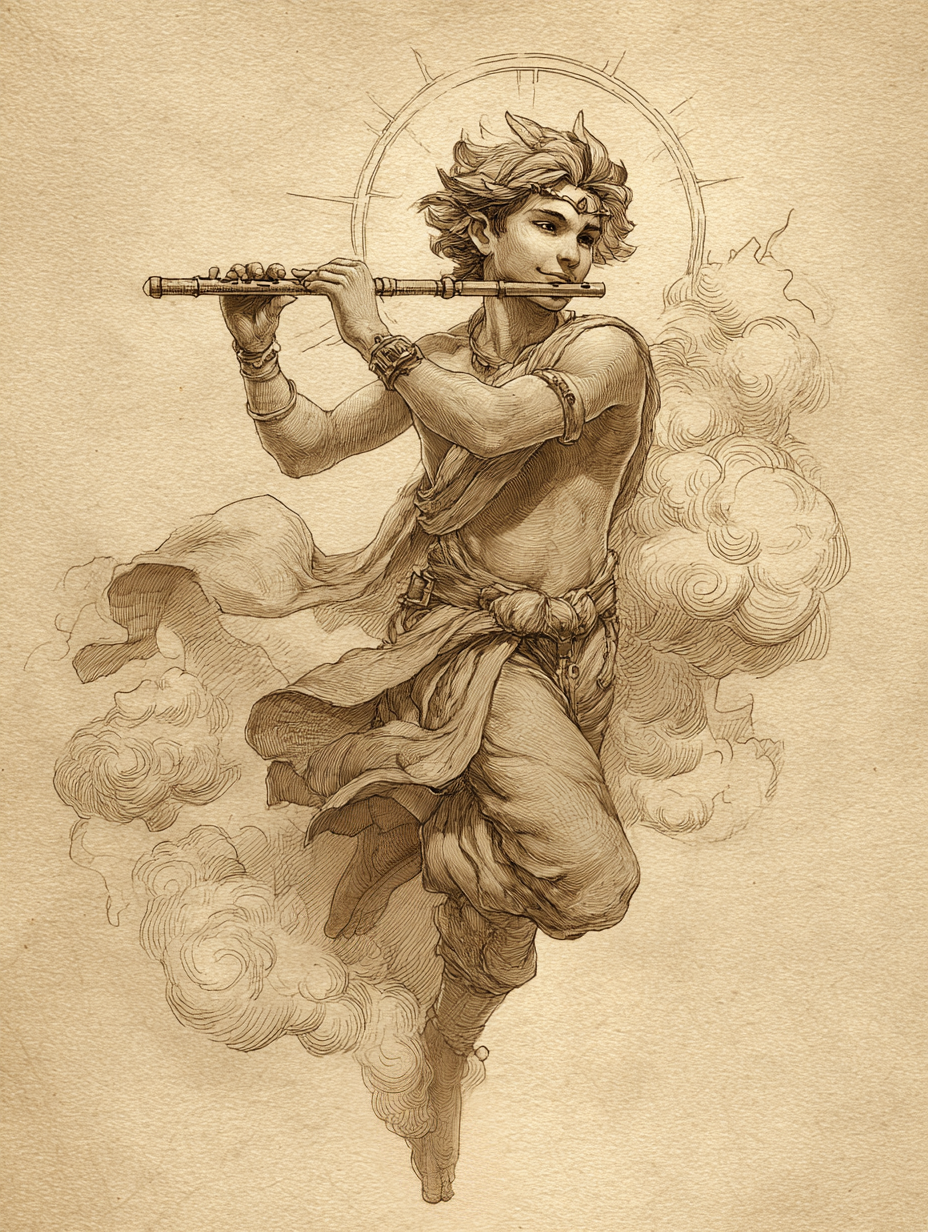
Divine Title: Finumeyn, Lord of the Unbound Sky, the Free Song, the Young Wind
Alignment: Chaotic Good
Portfolio: Sky, open plains, freedom, music, storytelling, celebration, movement, messengers
Favored Weapon: None
Domains: Air, Artifice, Chaos, Charm, Good, Knowledge, Liberation, Luck, Trickery
Primary Worshippers: Bards, messengers, scouts, riders, performers, couriers, wanderers, plainsfolk, gryphon riders
Major Order: The Windstriders, also called the Free Choir or the Sky Revelers
Common Symbols: Flute motifs, wind ribbons, birds in flight, open hands, streaming banners, sun breaking through cloud
Sacred Sites: Open-air revel grounds, hilltop shrines, messenger posts, seasonal camps, roadside stages, standing stones on the plains
Sacred Virtues: Freedom, joy, connection, courage, creativity, movement, truth carried openly
Alignment: Chaotic Good
Portfolio: Sky, open plains, freedom, music, storytelling, celebration, movement, messengers
Favored Weapon: None
Domains: Air, Artifice, Chaos, Charm, Good, Knowledge, Liberation, Luck, Trickery
Primary Worshippers: Bards, messengers, scouts, riders, performers, couriers, wanderers, plainsfolk, gryphon riders
Major Order: The Windstriders, also called the Free Choir or the Sky Revelers
Common Symbols: Flute motifs, wind ribbons, birds in flight, open hands, streaming banners, sun breaking through cloud
Sacred Sites: Open-air revel grounds, hilltop shrines, messenger posts, seasonal camps, roadside stages, standing stones on the plains
Sacred Virtues: Freedom, joy, connection, courage, creativity, movement, truth carried openly
Children


Comments