

Eanna, Lady of the Sacred Light
If Aldanoc is the wall against the dark and Nesmerleth the still hand of judgment, then Eanna is the reason the world is worth defending at all.
She is the Sun, supreme ruler of the heavens, wife of Aldanoc, mother of the world’s warmth, and the most beloved of the gods among mortals, especially humankind. She is life in its generous abundance. She is the fire first given into mortal hands. She is the harvest ripening in gold beneath an open sky, the soft radiance in temple glass, the sudden inspiration that turns despair into song or struggle into discovery. It was Eanna who armed the mortal races with fire in the dawn ages, and Eanna who marked wizards and sorcerers with the gift of arcane power.
Yet she is not merely a goddess of comfort. The warmth of the sun is not weakness, and the hand that tends the field can also lift the blade. In the oldest stories she appears not as softness without strength, but as the protecting mother in her fullest form, the one who nourishes because she loves and fights because she must. During the Titan War, when shadow and ruin threatened to devour all living things, she did not abandon mercy even then. Her faithful say this is one of her most divine qualities: not simply that she can destroy evil, but that she can look even upon what was born crooked in darkness and still make room for the possibility of choice.
This belief lies at the center of her worship. Life, light, and free will are sacred. To exist is already a kind of blessing, but to choose one’s path within that life, to rise above fear, blood, inheritance, or old corruption, that is the higher miracle. Eanna’s followers therefore speak often of redemption, but not with Settraes’ language of long trial or Nesmerleth’s language of final balance. Hers is a more immediate mercy. She is the hand held out before the last collapse. The breath that says rise. The fire kept alive in the hearth so there is still somewhere to return to.
Because of this, she is loved in nearly every land. Her shrines stand in manor chapels and peasant kitchens, in marble temple courts and poor farming villages, in orphanages, hospitals, kitchens, birthing rooms, and the roadside sanctuaries of those who care first for the living. Where people pray for healing, for children, for a safe birth, for a good growing season, for courage, for hope, or simply for the strength to continue loving a wounded world, it is often Eanna they call upon.
The greatest order devoted to Eanna is known as the Mothers of the Ardent Dawn, though in some regions they are also called the Order of the Sacred Light.
They are one of the most visible and beloved religious bodies in the world, not because they seek prominence, but because they are almost always found where need is sharpest. The Mothers run sanctuaries, orphanages, healing houses, way stations, food stores, birthing chambers, schools of practical magic, and defended temple compounds for the vulnerable. In war, they become shield and surgeon both. In famine, they ration grain and bless seed. In plague, they remain after others flee. In times of peace, they are midwives, tutors, healers, counselors, and keepers of everyday mercies that hold communities together.
Their ideal is often spoken of as sword and cradle.
This is not a contradiction to them, but a complete vision of what protection means. It is not enough to slay the wolf. One must also feed the child. Not enough to denounce evil. One must preserve life in its wake. Not enough to win. One must help others go on living after the danger has passed.
This has made the order both revered and quietly formidable. Outsiders sometimes mistake them for gentle temple women until they witness how quickly a sanctuary can be transformed into a disciplined redoubt, or how calmly a Mother may move from delivering a child to organizing an evacuation or taking up arms beside her Sisters.
Eanna’s faith is broad and compassionate, but it is not vague. It rests on several convictions that shape all her orders and all her rites.
The first is that life is holy. Not only in the abstract, but in the ordinary and unadorned forms most easily overlooked. The hungry child. The tired mother. The field that must yield grain. The old man whose body is failing. The lonely apprentice whose gift has frightened everyone around her. To preserve and foster life in all these forms is sacred labor.
The second is that light must be shared. Knowledge, warmth, education, healing, fire, protection, inspiration, and comfort are not treasures to be hoarded by the worthy. They are gifts meant to pass outward.
The third is that mercy is strength. Eanna’s faithful reject the notion that compassion is weakness or that kindness belongs only to those too timid for harsher work. In their teaching, true mercy requires courage, discipline, and a willingness to remain open-hearted in a world that often rewards cruelty.
The fourth is that free will is worth defending. The ability to choose goodness, even against one’s origin, temptation, fear, or nature, is considered one of the most profound signs of divine dignity. This is why Eanna’s worship has long held a special place for those born under ominous signs, touched by darkness, or feared for what they might become. The Sun does not deny what they are. It insists they are not only that.
Finally, the Mothers teach that inspiration itself is sacred. Art, learning, invention, magic, courage, and moments of clear inner fire are all understood as forms of Eanna’s touch. To create, heal, teach, or awaken hope in another person is to reflect her light in miniature.
The Mothers of the Ardent Dawn are hierarchical, disciplined, and widespread, though their presence shifts greatly from region to region.
At the head of the order stands the Divine Mother, spiritual and practical authority over the whole body. Beneath her are the High Mothers, who oversee major temple complexes, cities, regions, or especially important sacred institutions. Below them are the order’s full Clerics and Priestesses, followed by initiates known as Sisters. Rare men who enter the order are called Brothers, though the order remains overwhelmingly female in character and custom. Children born within the order, or taken in through its orphanages and sanctuaries, are fully raised among its houses and often become part of its extended spiritual family whether or not they later take vows.
The Mothers are famous for the breadth of their training. Every member is taught some combination of combat, defense, practical magic, diplomacy, herbal healing, household management, religious instruction, and midwifery. Their gifts are not siloed neatly. A village Mother may bless a field at dawn, negotiate a truce at noon, deliver twins by lamplight, and help defend the settlement at dusk.
True clerics of full divine potency are extraordinarily rare. Most members serve through a mixture of Eanna’s general blessing, learned skill, inherited arcane aptitude, and temple discipline. This has given the order a reputation for practicality. They are miracle-workers only occasionally. They are tireless servants almost always.
The worship of Eanna takes on different forms depending on place, but all of them share a sense of light, care, and cultivated life.
In great cities, her temples are among the most beautiful sacred structures in the world. They often feature pale marble, broad courtyards, reflecting pools, warm candles burning in great number, sunlit cloisters, medicinal gardens, open halls for instruction, and sanctums designed to gather the changing light of day into a single radiant center. The great Temple of Sacred Light in Balonnor is perhaps the most famous of these, centered around the vast reflecting pool called Eanna’s Reflection, with an inner sanctum whose central statue depicts the goddess as mother, surrounded by her children, while Aldanoc’s shadowed hand clasps hers. It is less a monument to royal grandeur than to divine tenderness made solemn.
In rural regions, however, her houses are much simpler. Whitewashed walls, herb gardens, sun-bleached robes, grain lofts, birthing rooms, little shrines in fieldstone chapels, and attached kitchens or refuges are more common than elaborate architecture. In such places the Mothers serve as village protectors, healers, midwives, crop blessers, and local anchors of calm. Their holiness is seen not in grandeur, but in the steadiness with which they keep a place alive.
Wherever the order is found, there is usually some provision made for the vulnerable. A bed kept ready. Bread stored aside. A kettle always hanging. A corner for foundlings. A room for laboring mothers. A walled garden. A place to sit and cry without being hurried.
Among all the order’s callings, none is more beloved or more storied than their work as midwives.
Throughout the world it is said that when a woman is in desperate need during childbirth, a Mother often appears as if sent by Eanna herself. Whether by coincidence, good intelligence, disciplined readiness, or something holier, these stories are numerous enough that even those outside the faith repeat them with conviction. The Mothers are considered the finest midwives in Ior, not only because of their medical knowledge, but because they bring with them composure, prayer, practical skill, and a profound reverence for both mother and child.
Birth, in Eanna’s theology, is one of the clearest moments in which mortal life brushes the divine mystery. It is pain, danger, blood, terror, hope, and wonder all at once. The Mothers treat it accordingly. They bless birthing rooms, tend the laboring, guard the threshold, and often remain after the child is born to ensure the household is properly supported.
This duty shapes the whole order’s reputation. Even its warlike members are seen through the lens of this care. A people who know your priests as those who helped bring their children safely into the world are unlikely to mistake your faith for mere abstraction.
Eanna’s order is equally known for its sanctuaries.
These may be orphanages, temple refuges, farmstead havens, women’s houses, healing halls, or mixed-use compounds where food, instruction, medicine, and protection are all offered together. Some are permanent institutions with dozens of residents. Others are small places maintained by only a handful of Sisters. In either form, they are among the great quiet supports of civilization.
The Mothers take in the abandoned, the widowed, the war-displaced, the sick, the shamed, the magically gifted but fearful, and those who would otherwise be cast aside as burdens. This does not mean they are without rules. Their houses can be disciplined, demanding, and orderly. But they are built on the conviction that vulnerability is not a disgrace.
In hard times these sanctuaries become triage centers, fortified refuges, kitchens, and command posts for relief. It is often said that when cities fail their people, the Mothers begin trying to gather them again.
Eanna’s relationship to fire and arcane magic gives her order a character unlike purely martial or purely healing faiths.
She was the one who armed mortals with fire and who marks out sorcerers and wizards with their gift. Because of this, the Mothers have long regarded arcane talent not as something suspect in itself, but as one more expression of sacred potential, provided it is governed well. Their houses often serve as the first safe place where a frightened child with uncontrolled magic can be taught, steadied, and protected from both self-destruction and persecution.
In ritual terms, fire under Eanna is not chiefly destructive. It is hearth-fire, forge-fire, candle flame, ceremonial brazier, signal flame, the warming and illuminating force that allows mortal life to flourish. Yet when necessary, it becomes purifying wrath. Her miracles often mingle heat and radiance with courage, clarity, or healing.
This same theology extends to inspiration. The sudden right word, the song that helps a village endure, the spell discovered in a moment of grace, the plan that saves a sanctuary during siege, all are considered forms of the Sun’s blessing.
At the head of the order stands Divine Mother Meredith, a woman who has become almost inseparable in the public mind from the order’s highest ideals.
She is stoic and severe, with white hair worn in a tight braid, smooth bronze skin, and sharp grey eyes that seem to miss very little. Those who expect warmth in the casual sense are often startled by her. She is not a smiling grandmotherly figure nor a soft, ornamental symbol. She is maternal in a sterner and older way. Protective, disciplined, relentlessly composed, and dangerous to anything that threatens those beneath her care.
This has made her both deeply respected and somewhat daunting, which suits the order well. Under her leadership the Mothers have maintained their sanctuaries through war, strengthened their rural houses, and continued to cultivate the difficult union of mercy and readiness that defines Eanna’s service. She is one of the vanishingly few known to wield full divine power, and her presence alone is enough to make many believers feel they stand briefly nearer to the Sun than they were meant to.
The Mothers are broadly allied with most benevolent orders, though the nature of those alliances differs.
They are especially warm with the Windstriders, whose love of inspiration, celebration, and life’s brightness harmonizes naturally with Eanna’s own generosity. They also maintain close ties with the Red Road Pilgrims, particularly in the protection of refugees, the tending of way stations, and the care of those passing through hardship.
Their philosophical tension with the Scalebearers is old and well known. The servants of Nesmerleth often regard Eanna as too willing to forgive, too quick to trust that freedom and mercy may produce repentance or transformation. The Mothers, in turn, can see the Queen’s followers as overly rigid, too suspicious of human frailty, and too ready to substitute judgment for restoration. Yet these disagreements rarely become enmity. Both orders know too much about suffering to indulge easy contempt.
With the Lunar Wardens, their relationship is marked by deep mutual respect, both because of Eanna’s marriage to Aldanoc and because the two orders so often complement one another in crisis. Where the Wardens hold the perimeter, the Mothers preserve what lies within it. Where the Wardens are wall and watchfire, the Mothers are hearth and dawn.
Among the relics and remains of the dead gods, few are used so consistently by Eanna’s faithful as Eryndor’s dawn tears.
These are treasured by the Mothers as vessels of inspiration and radiant comfort, especially in grim times. Whether set into lamps, worked into ritual implements, held during prayer, or used in sacred healing, they are believed to strengthen light-based magic and bring hope where despair has begun to settle too deeply. The order is careful with them, not only because they are powerful, but because they are remnants of a lost divinity and thus carry both sorrow and reverence in equal measure.
The Mothers do not use such things for display. They use them to keep courage alive.
The vestments of Eanna’s faithful vary widely by setting, but always carry some sense of sunlight, warmth, and cultivated dignity. In great temples, robes of white, gold, saffron, pale rose, and warm bronze are common, often layered and elegant without becoming ostentatious. In humbler houses, garments are simpler: sun-bleached cloth, practical wraps, working aprons, traveling mantles, and temple veils suited to labor rather than ceremony.
Eanna has no favored weapon, and this too is meaningful. Her order is trained to fight, but it is not defined by a single sacred arm in the way of more martial faiths. The Mother with a spear in one village, a staff in another, and only a kitchen blade at hand in a third is no less Eanna’s servant for it. What matters is not the weapon, but the will to defend life with whatever lies nearest.
Their bearing tends toward calm competence. They are rarely flashy. They move like people accustomed to being needed. Their authority is often maternal, but not always soft. A Mother’s disapproval can be more bracing than a captain’s rebuke, and many dangerous men have learned too late that kindness and helplessness are not kin.
Eanna’s blessings are usually described in the language of warmth and dawning.
A room that feels brighter the moment prayer is spoken. Healing that carries the scent of sun-warmed grain, herbs, or summer earth. Courage arriving not as hard fury, but as a steady inward light. Inspiration flashing with such force that exhaustion momentarily falls away. Fire that comforts the innocent and scorches corruption without spreading beyond its due.
Her greater miracles are radiant, but most of her faithful live on smaller mercies. A healthy birth after a terrible labor. A sanctuary holding one more week than it should have. A frightened child with magic in her blood finding guidance instead of exile. The first green blade after famine. A woman too tired to go on discovering that she can.
Eanna is adored not because she denies the world’s suffering, but because she meets it with open hands.
She is the lamp in the birthing room, the sun on the ripened field, the hand that steadies the gifted and the grieving alike, the mother who does not look away when darkness comes for her children.
She is the Sun, supreme ruler of the heavens, wife of Aldanoc, mother of the world’s warmth, and the most beloved of the gods among mortals, especially humankind. She is life in its generous abundance. She is the fire first given into mortal hands. She is the harvest ripening in gold beneath an open sky, the soft radiance in temple glass, the sudden inspiration that turns despair into song or struggle into discovery. It was Eanna who armed the mortal races with fire in the dawn ages, and Eanna who marked wizards and sorcerers with the gift of arcane power.
Yet she is not merely a goddess of comfort. The warmth of the sun is not weakness, and the hand that tends the field can also lift the blade. In the oldest stories she appears not as softness without strength, but as the protecting mother in her fullest form, the one who nourishes because she loves and fights because she must. During the Titan War, when shadow and ruin threatened to devour all living things, she did not abandon mercy even then. Her faithful say this is one of her most divine qualities: not simply that she can destroy evil, but that she can look even upon what was born crooked in darkness and still make room for the possibility of choice.
This belief lies at the center of her worship. Life, light, and free will are sacred. To exist is already a kind of blessing, but to choose one’s path within that life, to rise above fear, blood, inheritance, or old corruption, that is the higher miracle. Eanna’s followers therefore speak often of redemption, but not with Settraes’ language of long trial or Nesmerleth’s language of final balance. Hers is a more immediate mercy. She is the hand held out before the last collapse. The breath that says rise. The fire kept alive in the hearth so there is still somewhere to return to.
Because of this, she is loved in nearly every land. Her shrines stand in manor chapels and peasant kitchens, in marble temple courts and poor farming villages, in orphanages, hospitals, kitchens, birthing rooms, and the roadside sanctuaries of those who care first for the living. Where people pray for healing, for children, for a safe birth, for a good growing season, for courage, for hope, or simply for the strength to continue loving a wounded world, it is often Eanna they call upon.
The Mothers of the Ardent Dawn
The greatest order devoted to Eanna is known as the Mothers of the Ardent Dawn, though in some regions they are also called the Order of the Sacred Light.
They are one of the most visible and beloved religious bodies in the world, not because they seek prominence, but because they are almost always found where need is sharpest. The Mothers run sanctuaries, orphanages, healing houses, way stations, food stores, birthing chambers, schools of practical magic, and defended temple compounds for the vulnerable. In war, they become shield and surgeon both. In famine, they ration grain and bless seed. In plague, they remain after others flee. In times of peace, they are midwives, tutors, healers, counselors, and keepers of everyday mercies that hold communities together.
Their ideal is often spoken of as sword and cradle.
This is not a contradiction to them, but a complete vision of what protection means. It is not enough to slay the wolf. One must also feed the child. Not enough to denounce evil. One must preserve life in its wake. Not enough to win. One must help others go on living after the danger has passed.
This has made the order both revered and quietly formidable. Outsiders sometimes mistake them for gentle temple women until they witness how quickly a sanctuary can be transformed into a disciplined redoubt, or how calmly a Mother may move from delivering a child to organizing an evacuation or taking up arms beside her Sisters.
Beliefs and Doctrine
Eanna’s faith is broad and compassionate, but it is not vague. It rests on several convictions that shape all her orders and all her rites.
The first is that life is holy. Not only in the abstract, but in the ordinary and unadorned forms most easily overlooked. The hungry child. The tired mother. The field that must yield grain. The old man whose body is failing. The lonely apprentice whose gift has frightened everyone around her. To preserve and foster life in all these forms is sacred labor.
The second is that light must be shared. Knowledge, warmth, education, healing, fire, protection, inspiration, and comfort are not treasures to be hoarded by the worthy. They are gifts meant to pass outward.
The third is that mercy is strength. Eanna’s faithful reject the notion that compassion is weakness or that kindness belongs only to those too timid for harsher work. In their teaching, true mercy requires courage, discipline, and a willingness to remain open-hearted in a world that often rewards cruelty.
The fourth is that free will is worth defending. The ability to choose goodness, even against one’s origin, temptation, fear, or nature, is considered one of the most profound signs of divine dignity. This is why Eanna’s worship has long held a special place for those born under ominous signs, touched by darkness, or feared for what they might become. The Sun does not deny what they are. It insists they are not only that.
Finally, the Mothers teach that inspiration itself is sacred. Art, learning, invention, magic, courage, and moments of clear inner fire are all understood as forms of Eanna’s touch. To create, heal, teach, or awaken hope in another person is to reflect her light in miniature.
The Shape of the Order
The Mothers of the Ardent Dawn are hierarchical, disciplined, and widespread, though their presence shifts greatly from region to region.
At the head of the order stands the Divine Mother, spiritual and practical authority over the whole body. Beneath her are the High Mothers, who oversee major temple complexes, cities, regions, or especially important sacred institutions. Below them are the order’s full Clerics and Priestesses, followed by initiates known as Sisters. Rare men who enter the order are called Brothers, though the order remains overwhelmingly female in character and custom. Children born within the order, or taken in through its orphanages and sanctuaries, are fully raised among its houses and often become part of its extended spiritual family whether or not they later take vows.
The Mothers are famous for the breadth of their training. Every member is taught some combination of combat, defense, practical magic, diplomacy, herbal healing, household management, religious instruction, and midwifery. Their gifts are not siloed neatly. A village Mother may bless a field at dawn, negotiate a truce at noon, deliver twins by lamplight, and help defend the settlement at dusk.
True clerics of full divine potency are extraordinarily rare. Most members serve through a mixture of Eanna’s general blessing, learned skill, inherited arcane aptitude, and temple discipline. This has given the order a reputation for practicality. They are miracle-workers only occasionally. They are tireless servants almost always.
Temples, Sanctuaries, and Rural Houses
The worship of Eanna takes on different forms depending on place, but all of them share a sense of light, care, and cultivated life.
In great cities, her temples are among the most beautiful sacred structures in the world. They often feature pale marble, broad courtyards, reflecting pools, warm candles burning in great number, sunlit cloisters, medicinal gardens, open halls for instruction, and sanctums designed to gather the changing light of day into a single radiant center. The great Temple of Sacred Light in Balonnor is perhaps the most famous of these, centered around the vast reflecting pool called Eanna’s Reflection, with an inner sanctum whose central statue depicts the goddess as mother, surrounded by her children, while Aldanoc’s shadowed hand clasps hers. It is less a monument to royal grandeur than to divine tenderness made solemn.
In rural regions, however, her houses are much simpler. Whitewashed walls, herb gardens, sun-bleached robes, grain lofts, birthing rooms, little shrines in fieldstone chapels, and attached kitchens or refuges are more common than elaborate architecture. In such places the Mothers serve as village protectors, healers, midwives, crop blessers, and local anchors of calm. Their holiness is seen not in grandeur, but in the steadiness with which they keep a place alive.
Wherever the order is found, there is usually some provision made for the vulnerable. A bed kept ready. Bread stored aside. A kettle always hanging. A corner for foundlings. A room for laboring mothers. A walled garden. A place to sit and cry without being hurried.
Midwives of the Sacred Light
Among all the order’s callings, none is more beloved or more storied than their work as midwives.
Throughout the world it is said that when a woman is in desperate need during childbirth, a Mother often appears as if sent by Eanna herself. Whether by coincidence, good intelligence, disciplined readiness, or something holier, these stories are numerous enough that even those outside the faith repeat them with conviction. The Mothers are considered the finest midwives in Ior, not only because of their medical knowledge, but because they bring with them composure, prayer, practical skill, and a profound reverence for both mother and child.
Birth, in Eanna’s theology, is one of the clearest moments in which mortal life brushes the divine mystery. It is pain, danger, blood, terror, hope, and wonder all at once. The Mothers treat it accordingly. They bless birthing rooms, tend the laboring, guard the threshold, and often remain after the child is born to ensure the household is properly supported.
This duty shapes the whole order’s reputation. Even its warlike members are seen through the lens of this care. A people who know your priests as those who helped bring their children safely into the world are unlikely to mistake your faith for mere abstraction.
Sanctuaries and the Care of the Vulnerable
Eanna’s order is equally known for its sanctuaries.
These may be orphanages, temple refuges, farmstead havens, women’s houses, healing halls, or mixed-use compounds where food, instruction, medicine, and protection are all offered together. Some are permanent institutions with dozens of residents. Others are small places maintained by only a handful of Sisters. In either form, they are among the great quiet supports of civilization.
The Mothers take in the abandoned, the widowed, the war-displaced, the sick, the shamed, the magically gifted but fearful, and those who would otherwise be cast aside as burdens. This does not mean they are without rules. Their houses can be disciplined, demanding, and orderly. But they are built on the conviction that vulnerability is not a disgrace.
In hard times these sanctuaries become triage centers, fortified refuges, kitchens, and command posts for relief. It is often said that when cities fail their people, the Mothers begin trying to gather them again.
Fire, Arcana, and Inspiration
Eanna’s relationship to fire and arcane magic gives her order a character unlike purely martial or purely healing faiths.
She was the one who armed mortals with fire and who marks out sorcerers and wizards with their gift. Because of this, the Mothers have long regarded arcane talent not as something suspect in itself, but as one more expression of sacred potential, provided it is governed well. Their houses often serve as the first safe place where a frightened child with uncontrolled magic can be taught, steadied, and protected from both self-destruction and persecution.
In ritual terms, fire under Eanna is not chiefly destructive. It is hearth-fire, forge-fire, candle flame, ceremonial brazier, signal flame, the warming and illuminating force that allows mortal life to flourish. Yet when necessary, it becomes purifying wrath. Her miracles often mingle heat and radiance with courage, clarity, or healing.
This same theology extends to inspiration. The sudden right word, the song that helps a village endure, the spell discovered in a moment of grace, the plan that saves a sanctuary during siege, all are considered forms of the Sun’s blessing.
Divine Mother Meredith
At the head of the order stands Divine Mother Meredith, a woman who has become almost inseparable in the public mind from the order’s highest ideals.
She is stoic and severe, with white hair worn in a tight braid, smooth bronze skin, and sharp grey eyes that seem to miss very little. Those who expect warmth in the casual sense are often startled by her. She is not a smiling grandmotherly figure nor a soft, ornamental symbol. She is maternal in a sterner and older way. Protective, disciplined, relentlessly composed, and dangerous to anything that threatens those beneath her care.
This has made her both deeply respected and somewhat daunting, which suits the order well. Under her leadership the Mothers have maintained their sanctuaries through war, strengthened their rural houses, and continued to cultivate the difficult union of mercy and readiness that defines Eanna’s service. She is one of the vanishingly few known to wield full divine power, and her presence alone is enough to make many believers feel they stand briefly nearer to the Sun than they were meant to.
Relations with Other Orders
The Mothers are broadly allied with most benevolent orders, though the nature of those alliances differs.
They are especially warm with the Windstriders, whose love of inspiration, celebration, and life’s brightness harmonizes naturally with Eanna’s own generosity. They also maintain close ties with the Red Road Pilgrims, particularly in the protection of refugees, the tending of way stations, and the care of those passing through hardship.
Their philosophical tension with the Scalebearers is old and well known. The servants of Nesmerleth often regard Eanna as too willing to forgive, too quick to trust that freedom and mercy may produce repentance or transformation. The Mothers, in turn, can see the Queen’s followers as overly rigid, too suspicious of human frailty, and too ready to substitute judgment for restoration. Yet these disagreements rarely become enmity. Both orders know too much about suffering to indulge easy contempt.
With the Lunar Wardens, their relationship is marked by deep mutual respect, both because of Eanna’s marriage to Aldanoc and because the two orders so often complement one another in crisis. Where the Wardens hold the perimeter, the Mothers preserve what lies within it. Where the Wardens are wall and watchfire, the Mothers are hearth and dawn.
Eryndor’s Dawn Tears
Among the relics and remains of the dead gods, few are used so consistently by Eanna’s faithful as Eryndor’s dawn tears.
These are treasured by the Mothers as vessels of inspiration and radiant comfort, especially in grim times. Whether set into lamps, worked into ritual implements, held during prayer, or used in sacred healing, they are believed to strengthen light-based magic and bring hope where despair has begun to settle too deeply. The order is careful with them, not only because they are powerful, but because they are remnants of a lost divinity and thus carry both sorrow and reverence in equal measure.
The Mothers do not use such things for display. They use them to keep courage alive.
Vestments and Bearing
The vestments of Eanna’s faithful vary widely by setting, but always carry some sense of sunlight, warmth, and cultivated dignity. In great temples, robes of white, gold, saffron, pale rose, and warm bronze are common, often layered and elegant without becoming ostentatious. In humbler houses, garments are simpler: sun-bleached cloth, practical wraps, working aprons, traveling mantles, and temple veils suited to labor rather than ceremony.
Eanna has no favored weapon, and this too is meaningful. Her order is trained to fight, but it is not defined by a single sacred arm in the way of more martial faiths. The Mother with a spear in one village, a staff in another, and only a kitchen blade at hand in a third is no less Eanna’s servant for it. What matters is not the weapon, but the will to defend life with whatever lies nearest.
Their bearing tends toward calm competence. They are rarely flashy. They move like people accustomed to being needed. Their authority is often maternal, but not always soft. A Mother’s disapproval can be more bracing than a captain’s rebuke, and many dangerous men have learned too late that kindness and helplessness are not kin.
The Grace of Eanna
Eanna’s blessings are usually described in the language of warmth and dawning.
A room that feels brighter the moment prayer is spoken. Healing that carries the scent of sun-warmed grain, herbs, or summer earth. Courage arriving not as hard fury, but as a steady inward light. Inspiration flashing with such force that exhaustion momentarily falls away. Fire that comforts the innocent and scorches corruption without spreading beyond its due.
Her greater miracles are radiant, but most of her faithful live on smaller mercies. A healthy birth after a terrible labor. A sanctuary holding one more week than it should have. A frightened child with magic in her blood finding guidance instead of exile. The first green blade after famine. A woman too tired to go on discovering that she can.
Eanna is adored not because she denies the world’s suffering, but because she meets it with open hands.
She is the lamp in the birthing room, the sun on the ripened field, the hand that steadies the gifted and the grieving alike, the mother who does not look away when darkness comes for her children.
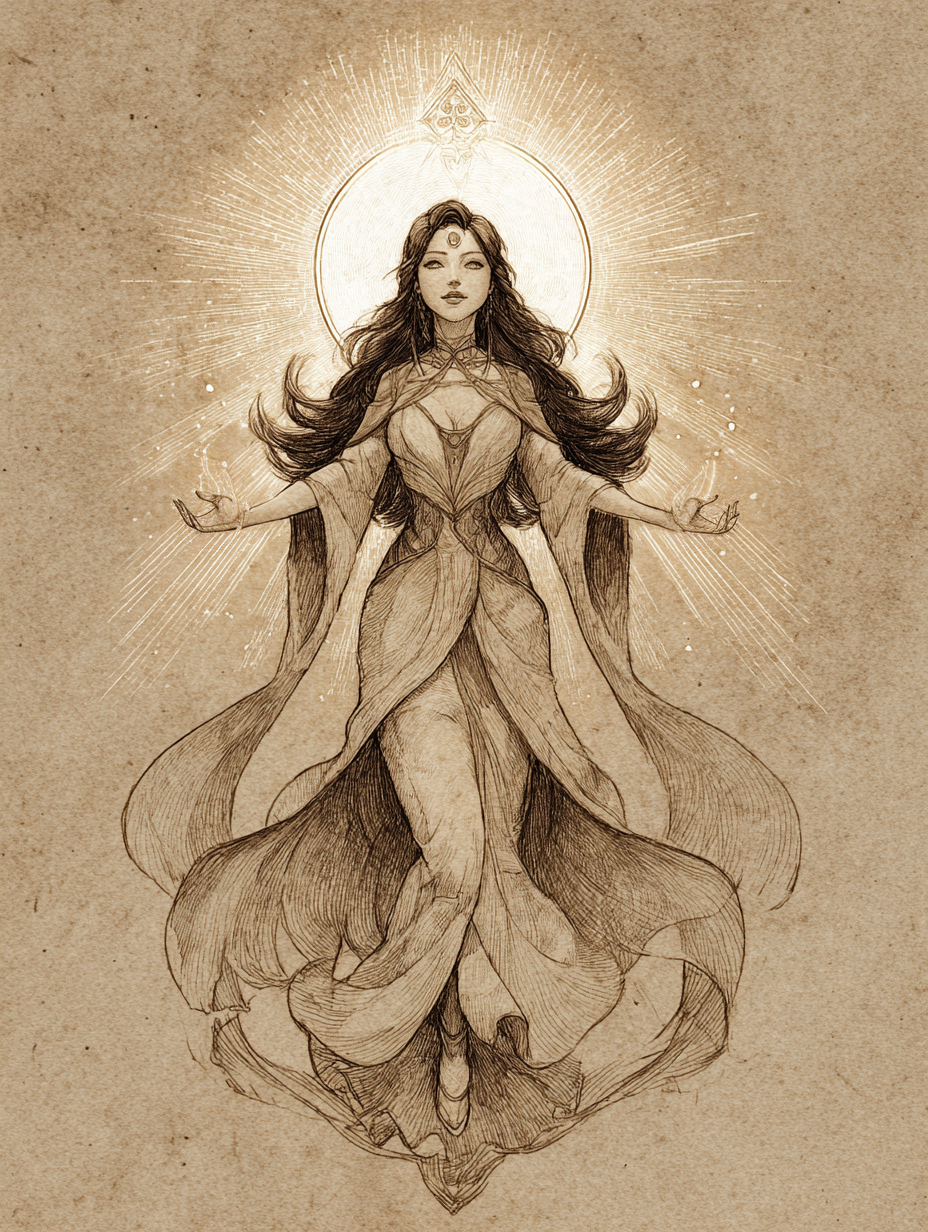
Divine Title: Eanna, Lady of the Sacred Light, Mother of the World
Alignment: Neutral Good
Portfolio: Sun, life, harvest, light, inspiration, healing, free will, arcane gift
Favored Weapon: None
Domains: Community, Fire, Glory, Good, Healing, Liberation, Magic, Protection, Plant, Sun
Primary Worshippers: Mothers, healers, farmers, midwives, mages, orphans, caregivers, teachers, those seeking hope or healing
Major Order: The Mothers of the Ardent Dawn, also called the Order of the Sacred Light
Common Symbols: Solar discs, open hands, flame over grain, a mother with child, candles reflected in still water
Sacred Sites: Great marble temples, rural sanctuaries, orphanages, birthing houses, healing halls, kitchen shrines, herb gardens, reflecting pools
Sacred Virtues: Mercy, protection, nurture, courage, generosity, inspiration, steadfast love
Alignment: Neutral Good
Portfolio: Sun, life, harvest, light, inspiration, healing, free will, arcane gift
Favored Weapon: None
Domains: Community, Fire, Glory, Good, Healing, Liberation, Magic, Protection, Plant, Sun
Primary Worshippers: Mothers, healers, farmers, midwives, mages, orphans, caregivers, teachers, those seeking hope or healing
Major Order: The Mothers of the Ardent Dawn, also called the Order of the Sacred Light
Common Symbols: Solar discs, open hands, flame over grain, a mother with child, candles reflected in still water
Sacred Sites: Great marble temples, rural sanctuaries, orphanages, birthing houses, healing halls, kitchen shrines, herb gardens, reflecting pools
Sacred Virtues: Mercy, protection, nurture, courage, generosity, inspiration, steadfast love
Children


Comments