
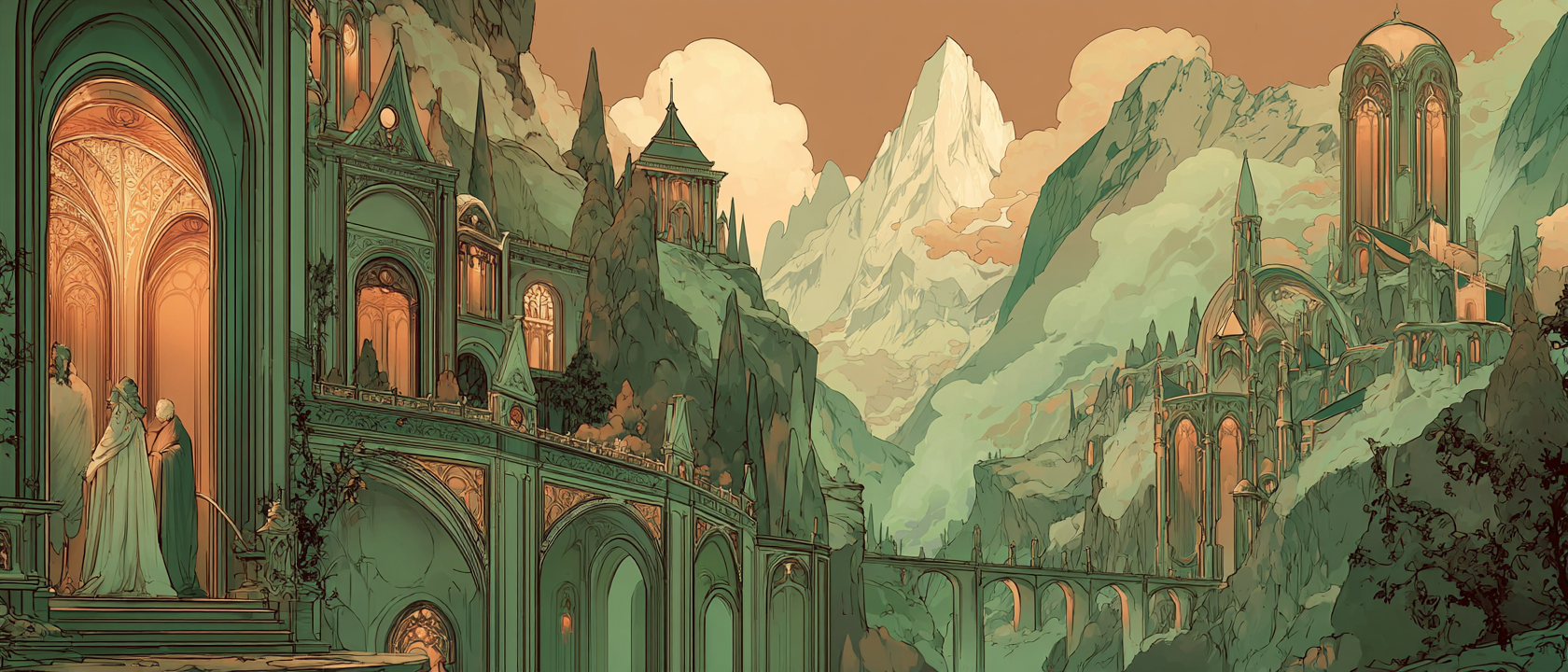
Dwarves; Children of Kazan
The dwarves are much like their god, Kazan, in their stubbornness and productiveness. During the Fall, many of their cities were damaged or destroyed, but they combined their efforts to rebuild as much as they could. They have not reclaimed the grandeur of their empires from before, but their mines and fortified cities are still wonders in their own rights. Though primarily craftsmen and tradesmen, there are still many dwarves willing to leave their mountains and hills to explore and settle the world. They are curious by nature and can often be found exploring the world.
Overview
The dwarves of Ior are the children of Kazan, god of earth, craft, loyalty, and endurance. Like their divine progenitor, they are resolute, industrious, and bound tightly to duty. Where other peoples scatter after catastrophe, the dwarves rebuild.
Before the Fall, dwarven empires stretched beneath vast mountain ranges, their cities threaded together by mines, halls, and arteries of stone. Much of that grandeur was lost when the world broke, but unlike many civilizations, the dwarves did not vanish. They endured.
Today, their holds remain wonders of engineering and defense, though diminished from their ancient heights. Their people are found not only in mountains and hills, but across the world as diplomats, traders, guardians, and explorers. To know the dwarves is to understand that curiosity and stubbornness are not opposites, they are partners.
The Copper King
Thousands of years before the Fall, the dwarves built wonderous cities and mines beneath the expansive mountain regions. It was slow and difficult work, at first, but they soon learned the secrets of metal working. The story of the first Dwarven King tells of how he bonded with an elemental creature of copper and it shared with him the knowledge of smelting and smithing. He learned of alchemy and the properties of stone, and with this knowledge he brought immense prosperity to the children of Kazan.
Yet, he grew old, as all mortals do, though he lived far longer than the average dwarf. The elemental consort that had grown so fond of the king did not want to watch him die. So they fused their lifeforce with the king in a desperate attempt to save him. It was after this fusion that the Heart of the Mountain was discovered and the Copper King vowed to guard it at all costs.
Heart of the Mountain
Deep within the bedrock of the vast mountain hold of the Copper King, the Heart pulses with a measured beat. What these hearts truly are have been lost to time, but they are known to possess the power to fuel wonderous machines and keep the horrors that lurk in the dark below away. With the discovery of the first heart, the dwarves learned to create more. With the founding of each new major city, a new heart would be made. Noble dwarves would sacrifice their entire lives to the creation and maintenance of the hearts, though why that is has been long forgotten.
After the Fall, many of the hearts died with their cities, though there are a few holds which are still protected by the thrumming beat of a still living heart. The dwarves have lost the ability and knowledge required to make more, and some of the old hearts are slowly dying, prompting some dwarves to desperately search for the truth.
Physical Traits
Dwarves are stout, broad, and powerfully built, ranging from approximately 4 feet 5 inches to 5 feet 7 inches in height. Their bodies are dense with muscle and bone, adapted to endurance rather than speed.
They prize athleticism and physical capability. Strength is not merely practical; it is moral. To care for one’s body is to honor Kazan’s gift.
Many dwarves show subtle physical anomalies such as unusual skin tones like greenish or coppery hues, eyes that glitter like gems, and faintly metallic hair and nails.
Alchemy, Stone, and Sustenance
Dwarven culture revolves around alchemy and metallurgy, though much of their understanding is distorted by time.
Dwarves regularly:
- consume heavy metals through oils, tinctures, and powders
- ingest mineral compounds believed to enhance strength
- eat stone fragments as seasoning known as “dwarven spices”
What other races would consider poison strengthens dwarves instead. Generations of adaptation, and ancient elemental fusion, have made their bodies capable of metabolizing substances that would kill others.
Prolonged ingestion often causes skin discolorations, changes in eye color, or even increase resistance to fatigue and injury. They do not fully understand why this works, but it simply always has.
Coming of Age: The Bonding Rite
When a dwarf comes of age, they undergo a sacred alchemical bonding ceremony.
Over several weeks, they are infused with a carefully prepared elemental compound tied to a specific alloy, gemstone, or stone. During this time, many experience vivid visions of ancestors or ancient cities. If the rite succeeds, the dwarf's eyes may take on the qualities of the bonded material. Other physical changes may manifest and the bond persists for life.
If the rite fails, or kills the initiate, it is considered a grave dishonor, though families rarely speak of it openly.
Upon death, the material accumulated in a dwarf’s eyes is reclaimed and forged into weapons, armor, or tools for their descendants.
“May the eyes of the ancestors be upon you” is both a blessing and a literal promise.
Beauty, Art, & Adornment
Dwarven beauty standards emphasize intentional display. Eyeliner is ubiquitous and used to frame and enhance their altered eyes. Tattoos are common, often inked with metallic or gem-infused pigments. Some dwarves even embed small gems or metal studs directly into their skin.
Death & Funerary Traditions
Funeral rites vary by caste and location.
Mountain Holds
Warriors often have their bones or ashes forged into shields or armor, allowing them to continue protecting their people.
Travelers & Expatriates
Dwarves living among other peoples frequently adopt local funerary customs, believing bonds formed in life should be honored in death.
Variants of the Dwarven People
Though all dwarves share a common origin, two major cultural-ancestral paths have emerged since the Fall.
The Gilded
The Gilded openly embrace the ancient alchemical legacy.
- skin often visibly metallic or oxidized
- eyes glow or reflect like polished ore
- heavy use of tinctures, radiation-laced artifacts, and relic technology
Some bond with volatile substances such as radium. These dwarves glow faintly in darkness and often serve as berserk guardians against the lingering shadows of the Titan’s war.
They are revered, and feared, even by their own people.
The Stone
The Stone appear much less overtly affected by the alchemy of their lineage and traditions.
- changes are minimal or internal
- eyes may seem merely unusual in certain light
- their bonds manifest as endurance, resilience, or intuition
They often act as diplomats, traders, and cultural bridges.
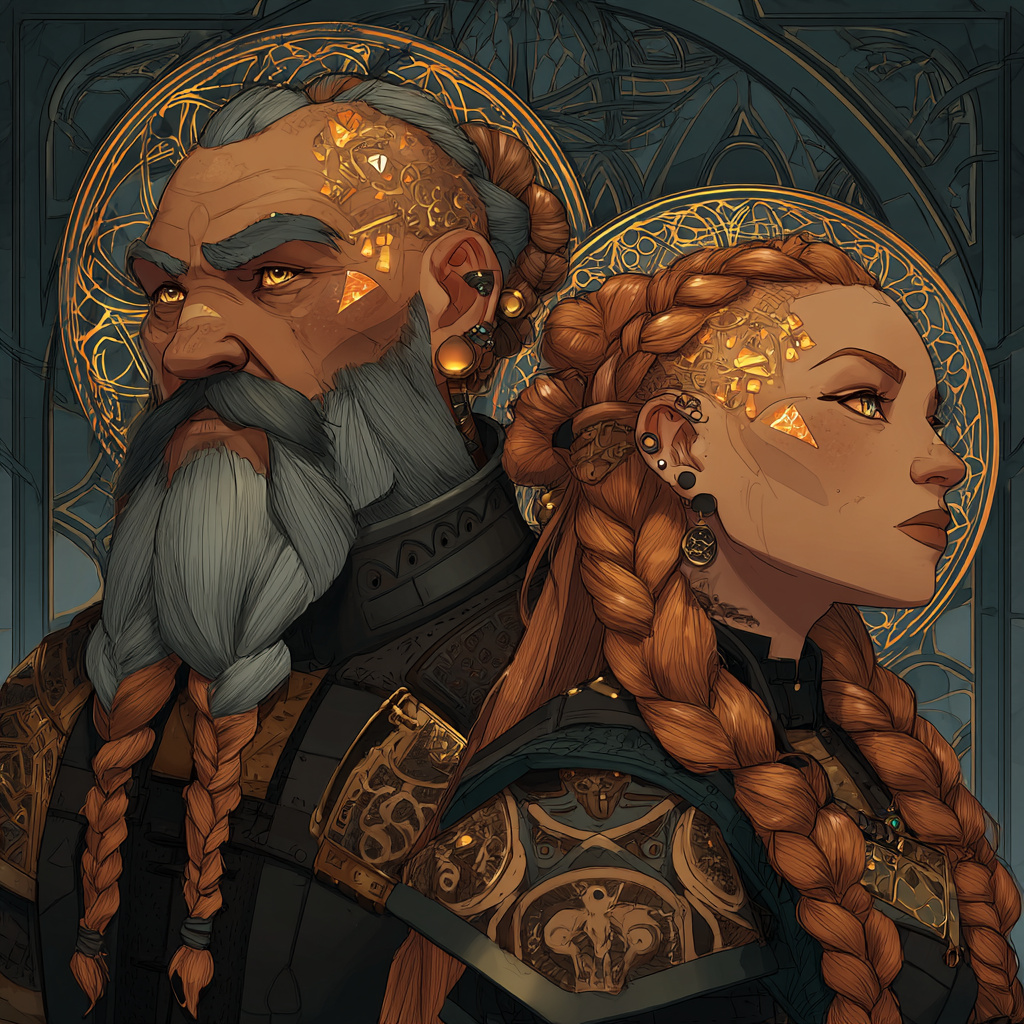
Pathfinder 1e Ancestry: Dwarves of Ior
The dwarves of Ior share a common origin, but generations of alchemical practice and proximity to the Hearts of the Mountain have produced subtle divergences among their people.
All dwarves are Humanoid (dwarf) unless otherwise noted.
Dwarves
These dwarves represent the most widespread and socially integrated children of Kazan, traders, diplomats, craftsmen, and travelers.
Ability Scores:
+2 Constitution, +2 Wisdom, –2 Charisma
Size: Medium
Speed: 20 ft. (not reduced by armor or encumbrance)
Senses: Darkvision 60 ft.
Defensive Traits:
- Hardy: +2 racial bonus on saving throws against poison, spells, and spell-like abilities
- Stability: +4 CMD against bull rush and trip while standing on the ground
Offensive Traits:
- Hatred: +1 racial bonus on attack rolls against aberrations and creatures of the dark below (GM discretion; often applies to Titan-corrupted beings)
Skill Traits:
- Stonecunning: +2 Perception to notice unusual stonework (free check within 10 ft.)
- Greed: +2 Appraise for metal or stone items
- Craft Training: +2 Craft (alchemy) and Craft (metalworking)
Cultural Trait:
- Mineral Tolerance: Common dwarves may ingest substances considered mildly toxic by other races (heavy-metal oils, mineral salts) without ill effect. This has no mechanical penalty but may alarm healers.
Variant: The Gilded
The Gilded bear the most obvious legacy of ancient alchemical bonding. Their bodies show visible signs of adaptation like oxidized skin, glowing eyes, metallic veins, or faint luminescence in darkness.
Ability Scores:
+2 Constitution, +2 Strength, –2 Charisma
Senses:
Darkvision 60 ft.; some Gilded emit faint light (as a candle) at GM discretion
Defensive Traits:
- Radiant Flesh (Ex): Gain +2 racial bonus on saves vs disease and poison
- Stone Endurance (Ex): Once per day, as an immediate action, reduce damage taken by 1d6 + Con modifier
Offensive Traits:
- Elemental Legacy (Ex): +1 damage with melee attacks against constructs, aberrations, and creatures native to the deep earth
Special Trait:
- Volatile Bond: Magical healing effects restore 1 fewer hit point per die (minimum 1). Alchemical healing restores +1 per die instead.
Note:
Some Gilded, particularly those bonded to unstable substances, develop berserk tendencies when wounded or enraged. These dwarves are often placed as guardians of vaults, borders, or ancient sites.
Variant: The Stone
The Stone appear outwardly traditional, but their bond manifests internally through endurance, intuition, and uncanny resilience.
Ability Scores:
+2 Constitution, +2 Wisdom, –2 Dexterity
Skill Traits:
- Inner Compass (Ex): +2 racial bonus on Survival and Sense Motive
- Enduring Frame: +2 racial bonus on Constitution checks and Fortitude saves to resist exhaustion or fatigue
Defensive Traits:
- Quiet Adaptation (Ex): When reduced below half hit points, gain a +1 racial bonus to all saving throws
Cultural Trait:
- Unremarkable Presence: The Stone are often underestimated. They gain a +2 racial bonus on Disguise or Stealth checks.


Comments