

Aldanoc, Shield of the Waning Moon
Aldanoc is the watchful shield in the night.
He is the Moon, the Grand Protector, the bastion raised against the dark when all other lights seem frail. Husband of Eanna and lord of the night’s long war, he faces the darkness without cease, guarding the world while others sleep, feast, love, or mourn. His strength is not the easy splendor of noon, but the colder promise that even when the light has thinned to a sliver, it has not been extinguished. Every month he wanes. Every month the darkness seems near to swallowing him. Every month he returns, and the night remembers whose it truly is.
To his faithful, this is not merely a heavenly cycle. It is doctrine written in silver across the sky. Vigilance is not proven when strength is abundant. It is proven when strength is nearly spent and duty remains. Aldanoc teaches endurance without spectacle, courage without boasting, and hope that does not depend upon comfort. He is the god of those who stand the wall at the worst hour, who keep the watchfire alive in sleet and hunger, who refuse to yield the helpless to fear simply because the dark is old and patient.
The stars are said to be his shieldmaidens, the deadliest warriors in the heavens after their lord, and many of his mortal followers seek to emulate them. To serve Aldanoc is to become a living bulwark, a shield carried not for glory but for the sake of those who cannot defend themselves. His worship is strongest among righteous warriors, frontier guardians, night watchmen, caravan escorts, lighthouse keepers, monster hunters, and all those who know that evil is seldom defeated once and for all, but must be resisted again and again as long as the world endures.
Of all the gods, Aldanoc is among those most sharply defined by the war against the Titan. The darkness is not an abstraction to him. It is the ancient enemy at the threshold of the world. Demons, outsiders, and lesser horrors are dangerous enough, but they are understood by his faithful as fragments of a wider and older threat. To keep watch under the moon is to remember that existence itself remains contested.
And yet Aldanoc is not only a war god. He is husband as well as guardian, and his union with Eanna is one of the sacred harmonies of the heavens. Sun and Moon, warmth and vigilance, abundance and defense, grace and steel, these are not opposites in the old stories, but counterparts. His faithful hold that life flourishes because someone is willing to stand in darkness for it. The harvest ripens because the wall does not fall.
The primary order devoted to Aldanoc is called the Shield of the Waning Moon, though throughout much of the world they are more commonly known as the Lunar Wardens or the Order of the Silver Bastion.
They are protectors first and institution-builders second. Where some faiths anchor themselves in temples, courts, or cities, the Wardens keep their heart on the road, at lonely towers, in mountain outposts, on cliffside watch stations, at harbor lights, and in the hard dark miles between settlements. Their calling is not to be admired in comfort, but to arrive when fear is thickest and stand fast until dawn.
Their great saying is:
The Shield That Never Breaks.
This is less a boast than a vow. The Wardens know well enough that bodies break, walls fall, and even the moon itself seems at times to diminish toward nothing. What they mean is that the duty does not break. One defender may fall, but another takes up the watch. One outpost may burn, but another light is kindled elsewhere. So long as one faithful servant of Aldanoc remains to raise steel against the dark, the shield endures.
For this reason the Lunar Wardens are deeply loved in frontier regions, islands, and isolated roads where formal authority may be distant or unreliable. They are the night watch no one had to hire. They are the escort that appears when a refugee train must cross dangerous ground. They are the riders who answer smoke on the horizon. Their presence often means simple things first: shelter, discipline, a defensible fire, a watch rotation, a blade sharpened in silence. Where they remain longer, they train villagers, build beacon systems, mark safe paths, and teach people how not to die when the night turns hostile.
The faith of Aldanoc is built on several intertwined truths.
The first is that vigilance is holy. Evil does not sleep because good hearts are tired. Darkness is ancient, patient, and always willing to exploit negligence. Therefore watchfulness is not paranoia, but responsibility.
The second is that hope must be defended. The Wardens do not think courage is a feeling. They think it is a practiced act. Light survives not because the world is kind, but because someone bears arms on its behalf.
The third is that free will is sacred. The power to choose the good freely, even under threat, is understood as one of the most precious gifts in the mortal world. This belief gives the order a deep hatred for coercive corruption, possession, enslavement, soul-binding, and all dark influences that seek to turn living minds into mere instruments.
The fourth is that strength exists to shelter, not dominate. Aldanoc’s followers admire discipline, armsmanship, and martial excellence, but these are not ends in themselves. A sword that protects the weak is honorable. A sword that seeks only its own renown has already wandered from his path.
And finally, the Wardens believe that waning is not defeat. This is one of the defining mysteries of their god. To diminish and return is not failure. It is proof that endurance may outlast appearances. Many chapters teach that the darkest phase of a life or kingdom is not necessarily its ending, only the hour in which true character is revealed.
The Shield of the Waning Moon is hierarchical in theory but highly flexible in practice. The demands of frontier service, monster hunting, maritime patrol, and long-distance escort work require small groups to act independently and decisively.
At the head of the order stands the High Warden, who serves as supreme coordinator, spiritual exemplar, and final military voice in times of large-scale mobilization. Beneath that office are the Wardens, senior commanders and temple-captains who oversee regions, major way stations, strongholds, and long patrol routes. Below them stand the order’s main body of sworn warriors, most often called Paladins, Shield-Brothers, and Shield-Sisters, along with the younger Squires who serve, study, train, and prove themselves beneath veteran guidance.
The order is notably balanced in its treatment of men and women. Its elite female warriors proudly bear the title shieldmaidens, echoing the stars of Aldanoc’s own celestial retinue. Their reputation is formidable, and many ballads of last stands, sea watches, and moonlit defenses are centered on them.
True divine casters remain rare, as with many of the older martial orders. Most Wardens rely as much on relentless training, tactical discipline, hardened judgment, and minor blessings as on overt miracles. Even so, their spiritual presence is unmistakable. They are not mercenaries with a moon badge stitched to the cloak. They are servants of a cosmic duty, and they carry themselves accordingly.
The order’s most visible contribution to mortal life is its vast web of way stations.
These outposts take many forms. Some are fortified roadside shelters built around wells and low walls. Some are narrow towers on sea cliffs, their beacon fires watched through the darkest hours. Some are mountain refuges, island keeps, caravan camps with permanent stone hearths, or half-buried frontier bastions overlooking old roads and broken valleys. All are made with the same purpose in mind: to give the vulnerable a defensible place to survive the night.
Any traveler who reaches a Lunar Warden outpost in peace is ordinarily granted shelter, basic healing, and the order’s protection until dawn, so long as they submit to the rules of the station. These are usually simple. Lay down needless quarrels. Obey the watch. Bear a hand in useful labor if able. Do not profane the shrine or threaten fellow guests. In some places, travelers are asked to swear a brief oath of vigilance in return, promising to keep faith with the peace of the outpost while they remain under its guard.
Many such way stations are shared with the faithful of Settraes, creating one of the most natural and long-standing partnerships among the divine orders. Where the Lunar Wardens provide martial defense, patrols, and night watch, Settraes’ faithful tend the weary, guide the lost, hear confessions, and aid those walking roads of hardship or redemption. Together, the two orders have made countless frontiers livable that would otherwise have been abandoned to isolation, predation, and fear.
The Wardens do maintain larger strongholds and fortresses, especially on strategic high ground, at sea approaches, or in regions repeatedly threatened by Titan-tainted incursions. These sites serve as training grounds, repositories for star-forged weapons, archives of patrol charts and enemy records, and rally points for larger campaigns. Even so, they seldom feel like centers of comfort. They are forward-facing places, built as if expecting the next alarm at any hour. The order’s true heart remains in motion, beneath the open sky rather than behind thick permanent walls.
Traveling defense is the order’s ordinary mode of life.
Small squads of Wardens move constantly along roads, coasts, moorlands, island chains, and wild border zones. They escort caravans, answer beacon calls, investigate disappearances, map fresh dangers, and hunt whatever dark thing has begun to stir in abandoned tower, old battlefield, ruined shrine, cave mouth, or drowned inlet. Rarely are they idle. Even those assigned to a specific tower or station typically range outward in measured circuits, maintaining the order’s wider sense of the land.
Because of this, many settlements know individual patrols by sight. Children can name their local moon-riders. Villagers know which Warden prefers to check traps for signs of spoor, which one speaks gently to frightened livestock, which one never sits with his back to the road, which shieldmaiden sharpens blades by the fire while reciting stories of old stands beneath her breath.
This has given the order a deeply human face in many regions. Though solemn, they are often more familiar to rural folk than distant priests or city judges. They are part guardian, part ranger, part knight, part camp elder. Their authority comes not merely from vows, but from repetition. They come back. They keep watch. They remember the names of the dead.
Among the most sacred observances of Aldanoc’s faith are the new moon vigils.
These are held at the month’s darkest turning, when the moon seems absent and the old enemy nearest. The Wardens fast, pray, train, and keep extended watch through the night. Stories of old battles, doomed defenses, steadfast patrols, and miraculous survivals are spoken aloud, not as idle legend, but as instruction. The purpose is remembrance and tempering. The god wanes, yet does not fail. So too must his faithful learn to endure their own lean hours without surrendering discipline.
The vigils are often communal, especially at larger stations or strongholds. Weapons are cleaned and blessed. Watches are doubled. Recruits may be tested. Oaths are renewed. In places near dangerous frontiers, the vigils are not symbolic at all, but intensely practical nights of heightened defense when all know the dark is likely to probe the wall.
The Lunar Wardens are also known for their skill in navigation, mapping, and the reading of the heavens.
This is not simply because travelers and patrol orders require it, though they do. It is also rooted in theology. The stars are Aldanoc’s shieldmaidens, and their courses are read as signs of order, vigilance, and continuity. Many chapters preserve ancient sky-charts, including fragments said to descend from the lore of Vaelor, the dead god whose knowledge of the heavens was never wholly lost.
Wardens use star navigation to guide caravans, chart obscure routes, locate forgotten shrines, and identify patterns in monster movement or Titan-tainted anomalies. A skilled moon-priest or senior Warden may know both the safest pass through a winter range and the omen carried by an unfamiliar break in the usual heavens. This has made the order invaluable not only in war, but in exploration and recovery efforts after catastrophe.
No holy occasion better expresses the union of Eanna and Aldanoc than the Night’s Sun Festival.
On that shared holy night, when light is raised against darkness so the divine couple may know a moment of reprieve and togetherness, the Lunar Wardens play a central role. While towns sing, dance, kindle lanterns, and crowd the streets in celebration, the Wardens stand perimeter watch, escort travelers, patrol the roads, secure festival grounds, and make certain that the people may rejoice without fear. In many places they are as much a part of the celebration as the lanterns themselves, though they stand at its edges rather than its center.
This duty is considered an honor. To guard joy is one of the purest expressions of Aldanoc’s service. His faithful do not resent the laughter of others while they hold the line. They understand precisely what they are defending.
The order’s relationship with minotaurs is respectful, cautious, and often more nuanced than outsiders expect.
Aldanoc’s faithful strongly admire self-mastery, oathkeeping, martial dignity, and the deliberate choosing of restraint over rage. Minotaurs who embody these virtues may earn genuine esteem among the Wardens, and some have been welcomed as sworn Shield-Brothers after long proof of character. Those who receive the silver star brand are recognized as fully trusted members of the order, a distinction that carries great weight.
Even so, the Wardens remain vigilant. The old shadow of Drrakthar’s rage is not taken lightly, and many chapters are careful watchers where minotaurs are concerned, especially in times of heightened stress, magical corruption, or war. This is not simple prejudice, though it can become such in weaker souls. At its best, it is the order’s attempt to balance respect with caution, honor with memory.
Where trust is earned, however, it is often earned deeply.
Like all enduring orders, the Lunar Wardens contain internal disagreements sharpened by long duty.
One of the oldest divides is between those who favor Eternal Vigil and those who speak more often of Lunar Mercy. The first tendency believes darkness must be confronted early, sometimes preemptively, before it gathers enough force to devastate the innocent. They are quicker to act, quicker to intervene, and often more comfortable with hard military measures. The second emphasizes Aldanoc’s own cycle of waning and return, arguing that renewal, patience, and the granting of second chances must not be lost in a faith too eager for iron.
This tension does not usually shatter chapters, but it shapes the temper of local command. One outpost may aggressively scour ruins and root out possible corruption before it ripens. Another may spend more effort trying to reclaim the wayward, restrain escalation, and preserve communities from becoming too militarized by fear.
There is also some friction with the Mothers of the Ardent Dawn. The Wardens can regard them as too nurturing in the face of serious threats, too slow to abandon hope where steel ought to decide the matter. The Mothers, in turn, sometimes see the Wardens as too ready to harden, too willing to turn first to defense and suppression where healing or restoration might yet suffice. Even so, the two orders often cooperate well in practice, particularly during crises that require both compassion and armed discipline.
The Lunar Wardens dress for hardship. Grey-and-silver cloaks are common, worn over serviceable armor that can stand against weather as well as blades. Their symbols are usually subtle: the crescent, the silver star, the shield marked in pale thread, the moon-disc worked into clasps, buckles, or scabbard fittings. Rural and frontier Wardens often appear half soldier, half ranger, with the additional marks of long travel and long weathering.
Their favored weapon is the longsword, a practical and honorable blade suited to mounted defense, close watch work, and disciplined formation fighting alike. Many Wardens also carry shield, spear, bow, or sidearm according to local need, but the longsword remains the most sacred emblem of their office. In stories and iconography, it reflects Aldanoc’s ideal balance of grace, restraint, readiness, and killing force held under strict moral governance.
They are expected to be disciplined without pomposity. Orderly camps, well-kept arms, measured speech, and reliable watches are not small matters to them. A Warden who grows slack in such things is understood to be slipping in spirit as well as conduct.
Those touched by Aldanoc’s blessing often describe it in images of cold clarity.
Moonlight bright enough to show the path between stones. Starlight that seems to gather along a blade’s edge. The strange steadiness that enters the limbs when exhaustion should have won. The sense, in the most dangerous hours, that one is not alone upon the wall. His greater miracles are often described as piercing and silver-white, but most of his faithful live day by day on subtler gifts: discipline that holds, fear mastered before it spreads, a route remembered at the right hour, a hand that does not tremble, a night survived.
He is the Moon, the Grand Protector, the bastion raised against the dark when all other lights seem frail. Husband of Eanna and lord of the night’s long war, he faces the darkness without cease, guarding the world while others sleep, feast, love, or mourn. His strength is not the easy splendor of noon, but the colder promise that even when the light has thinned to a sliver, it has not been extinguished. Every month he wanes. Every month the darkness seems near to swallowing him. Every month he returns, and the night remembers whose it truly is.
To his faithful, this is not merely a heavenly cycle. It is doctrine written in silver across the sky. Vigilance is not proven when strength is abundant. It is proven when strength is nearly spent and duty remains. Aldanoc teaches endurance without spectacle, courage without boasting, and hope that does not depend upon comfort. He is the god of those who stand the wall at the worst hour, who keep the watchfire alive in sleet and hunger, who refuse to yield the helpless to fear simply because the dark is old and patient.
The stars are said to be his shieldmaidens, the deadliest warriors in the heavens after their lord, and many of his mortal followers seek to emulate them. To serve Aldanoc is to become a living bulwark, a shield carried not for glory but for the sake of those who cannot defend themselves. His worship is strongest among righteous warriors, frontier guardians, night watchmen, caravan escorts, lighthouse keepers, monster hunters, and all those who know that evil is seldom defeated once and for all, but must be resisted again and again as long as the world endures.
Of all the gods, Aldanoc is among those most sharply defined by the war against the Titan. The darkness is not an abstraction to him. It is the ancient enemy at the threshold of the world. Demons, outsiders, and lesser horrors are dangerous enough, but they are understood by his faithful as fragments of a wider and older threat. To keep watch under the moon is to remember that existence itself remains contested.
And yet Aldanoc is not only a war god. He is husband as well as guardian, and his union with Eanna is one of the sacred harmonies of the heavens. Sun and Moon, warmth and vigilance, abundance and defense, grace and steel, these are not opposites in the old stories, but counterparts. His faithful hold that life flourishes because someone is willing to stand in darkness for it. The harvest ripens because the wall does not fall.
The Shield of the Waning Moon
The primary order devoted to Aldanoc is called the Shield of the Waning Moon, though throughout much of the world they are more commonly known as the Lunar Wardens or the Order of the Silver Bastion.
They are protectors first and institution-builders second. Where some faiths anchor themselves in temples, courts, or cities, the Wardens keep their heart on the road, at lonely towers, in mountain outposts, on cliffside watch stations, at harbor lights, and in the hard dark miles between settlements. Their calling is not to be admired in comfort, but to arrive when fear is thickest and stand fast until dawn.
Their great saying is:
The Shield That Never Breaks.
This is less a boast than a vow. The Wardens know well enough that bodies break, walls fall, and even the moon itself seems at times to diminish toward nothing. What they mean is that the duty does not break. One defender may fall, but another takes up the watch. One outpost may burn, but another light is kindled elsewhere. So long as one faithful servant of Aldanoc remains to raise steel against the dark, the shield endures.
For this reason the Lunar Wardens are deeply loved in frontier regions, islands, and isolated roads where formal authority may be distant or unreliable. They are the night watch no one had to hire. They are the escort that appears when a refugee train must cross dangerous ground. They are the riders who answer smoke on the horizon. Their presence often means simple things first: shelter, discipline, a defensible fire, a watch rotation, a blade sharpened in silence. Where they remain longer, they train villagers, build beacon systems, mark safe paths, and teach people how not to die when the night turns hostile.
Beliefs and Doctrine
The faith of Aldanoc is built on several intertwined truths.
The first is that vigilance is holy. Evil does not sleep because good hearts are tired. Darkness is ancient, patient, and always willing to exploit negligence. Therefore watchfulness is not paranoia, but responsibility.
The second is that hope must be defended. The Wardens do not think courage is a feeling. They think it is a practiced act. Light survives not because the world is kind, but because someone bears arms on its behalf.
The third is that free will is sacred. The power to choose the good freely, even under threat, is understood as one of the most precious gifts in the mortal world. This belief gives the order a deep hatred for coercive corruption, possession, enslavement, soul-binding, and all dark influences that seek to turn living minds into mere instruments.
The fourth is that strength exists to shelter, not dominate. Aldanoc’s followers admire discipline, armsmanship, and martial excellence, but these are not ends in themselves. A sword that protects the weak is honorable. A sword that seeks only its own renown has already wandered from his path.
And finally, the Wardens believe that waning is not defeat. This is one of the defining mysteries of their god. To diminish and return is not failure. It is proof that endurance may outlast appearances. Many chapters teach that the darkest phase of a life or kingdom is not necessarily its ending, only the hour in which true character is revealed.
The Shape of the Order
The Shield of the Waning Moon is hierarchical in theory but highly flexible in practice. The demands of frontier service, monster hunting, maritime patrol, and long-distance escort work require small groups to act independently and decisively.
At the head of the order stands the High Warden, who serves as supreme coordinator, spiritual exemplar, and final military voice in times of large-scale mobilization. Beneath that office are the Wardens, senior commanders and temple-captains who oversee regions, major way stations, strongholds, and long patrol routes. Below them stand the order’s main body of sworn warriors, most often called Paladins, Shield-Brothers, and Shield-Sisters, along with the younger Squires who serve, study, train, and prove themselves beneath veteran guidance.
The order is notably balanced in its treatment of men and women. Its elite female warriors proudly bear the title shieldmaidens, echoing the stars of Aldanoc’s own celestial retinue. Their reputation is formidable, and many ballads of last stands, sea watches, and moonlit defenses are centered on them.
True divine casters remain rare, as with many of the older martial orders. Most Wardens rely as much on relentless training, tactical discipline, hardened judgment, and minor blessings as on overt miracles. Even so, their spiritual presence is unmistakable. They are not mercenaries with a moon badge stitched to the cloak. They are servants of a cosmic duty, and they carry themselves accordingly.
Way Stations, Towers, and Strongholds
The order’s most visible contribution to mortal life is its vast web of way stations.
These outposts take many forms. Some are fortified roadside shelters built around wells and low walls. Some are narrow towers on sea cliffs, their beacon fires watched through the darkest hours. Some are mountain refuges, island keeps, caravan camps with permanent stone hearths, or half-buried frontier bastions overlooking old roads and broken valleys. All are made with the same purpose in mind: to give the vulnerable a defensible place to survive the night.
Any traveler who reaches a Lunar Warden outpost in peace is ordinarily granted shelter, basic healing, and the order’s protection until dawn, so long as they submit to the rules of the station. These are usually simple. Lay down needless quarrels. Obey the watch. Bear a hand in useful labor if able. Do not profane the shrine or threaten fellow guests. In some places, travelers are asked to swear a brief oath of vigilance in return, promising to keep faith with the peace of the outpost while they remain under its guard.
Many such way stations are shared with the faithful of Settraes, creating one of the most natural and long-standing partnerships among the divine orders. Where the Lunar Wardens provide martial defense, patrols, and night watch, Settraes’ faithful tend the weary, guide the lost, hear confessions, and aid those walking roads of hardship or redemption. Together, the two orders have made countless frontiers livable that would otherwise have been abandoned to isolation, predation, and fear.
The Wardens do maintain larger strongholds and fortresses, especially on strategic high ground, at sea approaches, or in regions repeatedly threatened by Titan-tainted incursions. These sites serve as training grounds, repositories for star-forged weapons, archives of patrol charts and enemy records, and rally points for larger campaigns. Even so, they seldom feel like centers of comfort. They are forward-facing places, built as if expecting the next alarm at any hour. The order’s true heart remains in motion, beneath the open sky rather than behind thick permanent walls.
Patrols and the Moving Wall
Traveling defense is the order’s ordinary mode of life.
Small squads of Wardens move constantly along roads, coasts, moorlands, island chains, and wild border zones. They escort caravans, answer beacon calls, investigate disappearances, map fresh dangers, and hunt whatever dark thing has begun to stir in abandoned tower, old battlefield, ruined shrine, cave mouth, or drowned inlet. Rarely are they idle. Even those assigned to a specific tower or station typically range outward in measured circuits, maintaining the order’s wider sense of the land.
Because of this, many settlements know individual patrols by sight. Children can name their local moon-riders. Villagers know which Warden prefers to check traps for signs of spoor, which one speaks gently to frightened livestock, which one never sits with his back to the road, which shieldmaiden sharpens blades by the fire while reciting stories of old stands beneath her breath.
This has given the order a deeply human face in many regions. Though solemn, they are often more familiar to rural folk than distant priests or city judges. They are part guardian, part ranger, part knight, part camp elder. Their authority comes not merely from vows, but from repetition. They come back. They keep watch. They remember the names of the dead.
New Moon Vigils
Among the most sacred observances of Aldanoc’s faith are the new moon vigils.
These are held at the month’s darkest turning, when the moon seems absent and the old enemy nearest. The Wardens fast, pray, train, and keep extended watch through the night. Stories of old battles, doomed defenses, steadfast patrols, and miraculous survivals are spoken aloud, not as idle legend, but as instruction. The purpose is remembrance and tempering. The god wanes, yet does not fail. So too must his faithful learn to endure their own lean hours without surrendering discipline.
The vigils are often communal, especially at larger stations or strongholds. Weapons are cleaned and blessed. Watches are doubled. Recruits may be tested. Oaths are renewed. In places near dangerous frontiers, the vigils are not symbolic at all, but intensely practical nights of heightened defense when all know the dark is likely to probe the wall.
Star Charts and Sacred Navigation
The Lunar Wardens are also known for their skill in navigation, mapping, and the reading of the heavens.
This is not simply because travelers and patrol orders require it, though they do. It is also rooted in theology. The stars are Aldanoc’s shieldmaidens, and their courses are read as signs of order, vigilance, and continuity. Many chapters preserve ancient sky-charts, including fragments said to descend from the lore of Vaelor, the dead god whose knowledge of the heavens was never wholly lost.
Wardens use star navigation to guide caravans, chart obscure routes, locate forgotten shrines, and identify patterns in monster movement or Titan-tainted anomalies. A skilled moon-priest or senior Warden may know both the safest pass through a winter range and the omen carried by an unfamiliar break in the usual heavens. This has made the order invaluable not only in war, but in exploration and recovery efforts after catastrophe.
The Night’s Sun Festival
No holy occasion better expresses the union of Eanna and Aldanoc than the Night’s Sun Festival.
On that shared holy night, when light is raised against darkness so the divine couple may know a moment of reprieve and togetherness, the Lunar Wardens play a central role. While towns sing, dance, kindle lanterns, and crowd the streets in celebration, the Wardens stand perimeter watch, escort travelers, patrol the roads, secure festival grounds, and make certain that the people may rejoice without fear. In many places they are as much a part of the celebration as the lanterns themselves, though they stand at its edges rather than its center.
This duty is considered an honor. To guard joy is one of the purest expressions of Aldanoc’s service. His faithful do not resent the laughter of others while they hold the line. They understand precisely what they are defending.
Relations with Minotaurs
The order’s relationship with minotaurs is respectful, cautious, and often more nuanced than outsiders expect.
Aldanoc’s faithful strongly admire self-mastery, oathkeeping, martial dignity, and the deliberate choosing of restraint over rage. Minotaurs who embody these virtues may earn genuine esteem among the Wardens, and some have been welcomed as sworn Shield-Brothers after long proof of character. Those who receive the silver star brand are recognized as fully trusted members of the order, a distinction that carries great weight.
Even so, the Wardens remain vigilant. The old shadow of Drrakthar’s rage is not taken lightly, and many chapters are careful watchers where minotaurs are concerned, especially in times of heightened stress, magical corruption, or war. This is not simple prejudice, though it can become such in weaker souls. At its best, it is the order’s attempt to balance respect with caution, honor with memory.
Where trust is earned, however, it is often earned deeply.
Tensions Within the Order
Like all enduring orders, the Lunar Wardens contain internal disagreements sharpened by long duty.
One of the oldest divides is between those who favor Eternal Vigil and those who speak more often of Lunar Mercy. The first tendency believes darkness must be confronted early, sometimes preemptively, before it gathers enough force to devastate the innocent. They are quicker to act, quicker to intervene, and often more comfortable with hard military measures. The second emphasizes Aldanoc’s own cycle of waning and return, arguing that renewal, patience, and the granting of second chances must not be lost in a faith too eager for iron.
This tension does not usually shatter chapters, but it shapes the temper of local command. One outpost may aggressively scour ruins and root out possible corruption before it ripens. Another may spend more effort trying to reclaim the wayward, restrain escalation, and preserve communities from becoming too militarized by fear.
There is also some friction with the Mothers of the Ardent Dawn. The Wardens can regard them as too nurturing in the face of serious threats, too slow to abandon hope where steel ought to decide the matter. The Mothers, in turn, sometimes see the Wardens as too ready to harden, too willing to turn first to defense and suppression where healing or restoration might yet suffice. Even so, the two orders often cooperate well in practice, particularly during crises that require both compassion and armed discipline.
Vestments, Arms, and Bearing
The Lunar Wardens dress for hardship. Grey-and-silver cloaks are common, worn over serviceable armor that can stand against weather as well as blades. Their symbols are usually subtle: the crescent, the silver star, the shield marked in pale thread, the moon-disc worked into clasps, buckles, or scabbard fittings. Rural and frontier Wardens often appear half soldier, half ranger, with the additional marks of long travel and long weathering.
Their favored weapon is the longsword, a practical and honorable blade suited to mounted defense, close watch work, and disciplined formation fighting alike. Many Wardens also carry shield, spear, bow, or sidearm according to local need, but the longsword remains the most sacred emblem of their office. In stories and iconography, it reflects Aldanoc’s ideal balance of grace, restraint, readiness, and killing force held under strict moral governance.
They are expected to be disciplined without pomposity. Orderly camps, well-kept arms, measured speech, and reliable watches are not small matters to them. A Warden who grows slack in such things is understood to be slipping in spirit as well as conduct.
The Nature of Aldanoc’s Grace
Those touched by Aldanoc’s blessing often describe it in images of cold clarity.
Moonlight bright enough to show the path between stones. Starlight that seems to gather along a blade’s edge. The strange steadiness that enters the limbs when exhaustion should have won. The sense, in the most dangerous hours, that one is not alone upon the wall. His greater miracles are often described as piercing and silver-white, but most of his faithful live day by day on subtler gifts: discipline that holds, fear mastered before it spreads, a route remembered at the right hour, a hand that does not tremble, a night survived.
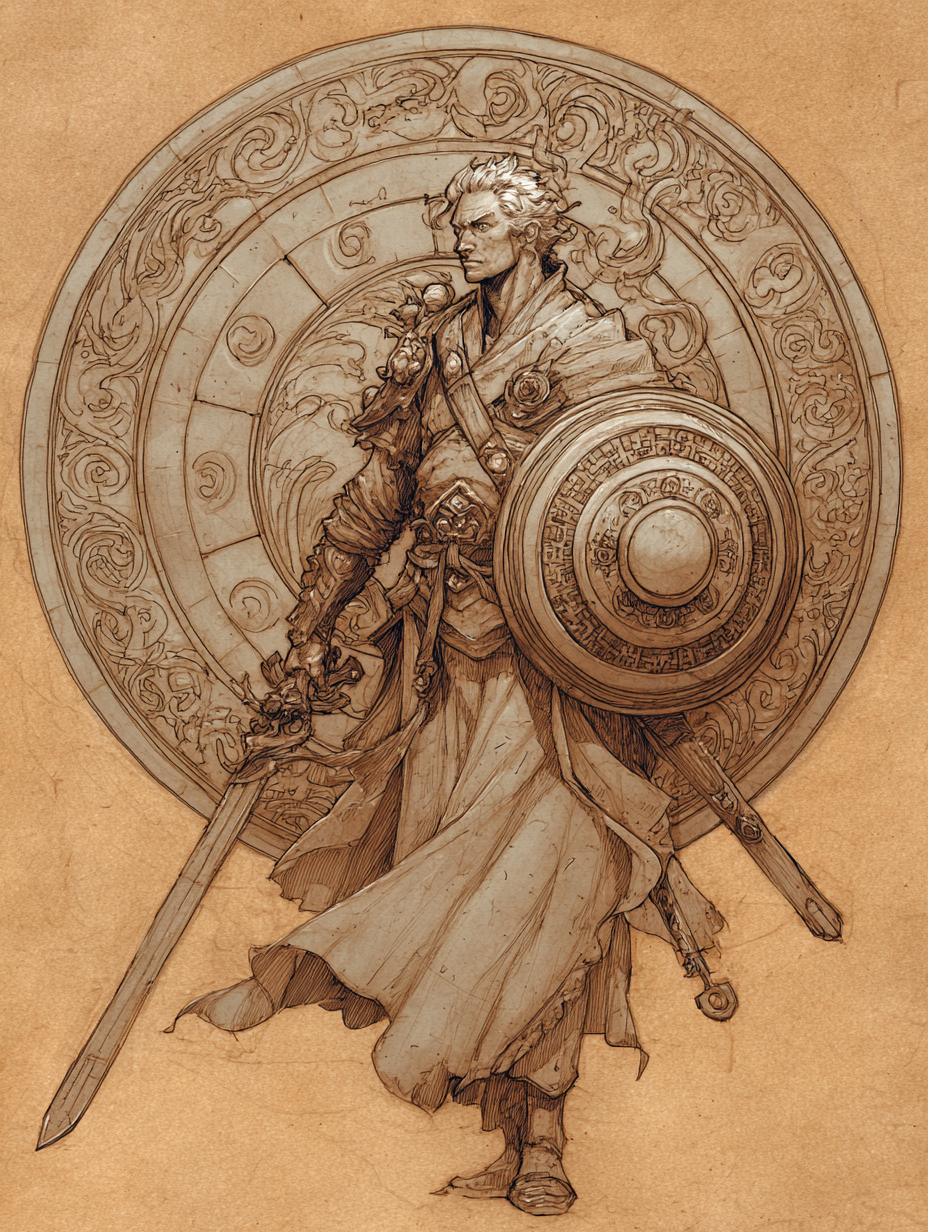
Divine Title: Aldanoc, Shield of the Waning Moon, the Grand Protector, Lord of the Silver Bastion
Alignment: Lawful Good
Portfolio: Moon, protection, vigilance, righteous war, guardianship, endurance, sacred watchfulness
Favored Weapon: Longsword Domains: Community, Good, Law, Nobility, Protection, Strength, War
Primary Worshippers: Paladins, frontier guards, lighthouse keepers, caravan escorts, night watchmen, righteous warriors, defenders of isolated settlements
Major Order: The Shield of the Waning Moon, also called the Lunar Wardens or Order of the Silver Bastion
Common Symbols: Crescent moon, silver star, moonlit shield, star-forged blade, watchfire under open sky
Sacred Sites: Way stations, watchtowers, lighthouse keeps, roadside shrines, fortified frontier outposts, high strongholds
Sacred Virtues: Vigilance, endurance, disciplined courage, guardianship, self-mastery, faithful service
Alignment: Lawful Good
Portfolio: Moon, protection, vigilance, righteous war, guardianship, endurance, sacred watchfulness
Favored Weapon: Longsword Domains: Community, Good, Law, Nobility, Protection, Strength, War
Primary Worshippers: Paladins, frontier guards, lighthouse keepers, caravan escorts, night watchmen, righteous warriors, defenders of isolated settlements
Major Order: The Shield of the Waning Moon, also called the Lunar Wardens or Order of the Silver Bastion
Common Symbols: Crescent moon, silver star, moonlit shield, star-forged blade, watchfire under open sky
Sacred Sites: Way stations, watchtowers, lighthouse keeps, roadside shrines, fortified frontier outposts, high strongholds
Sacred Virtues: Vigilance, endurance, disciplined courage, guardianship, self-mastery, faithful service
Children


Comments