




Artificer in Dungeons & Dragons 2024 (D&D)

Eberron: Forge of the Artificer
Artificer
Core Artificer Traits
| Primary Ability | Intelligence |
|---|---|
| Hit Point Die | D8 |
| Saving Throw Proficiencies | Constitution and Intelligence |
| Skill Proficiencies | Choose 2: Arcana, History, Investigation, Medicine, Nature, Perception, or Sleight of Hand |
| Weapon Proficiencies | Simple weapons |
| Tool Proficiencies | Thieves’ Tools, Tinker’s Tools, and one type of Artisan’s Tools of your choice |
| Armor Training | Light and Medium armor and Shields |
| Starting Equipment | Choose A or B: (A) Studded Leather Armor, Dagger, Thieves’ Tools, Tinker’s Tools, Dungeoneer’s Pack, and 16 GP; or (B) 150 GP |
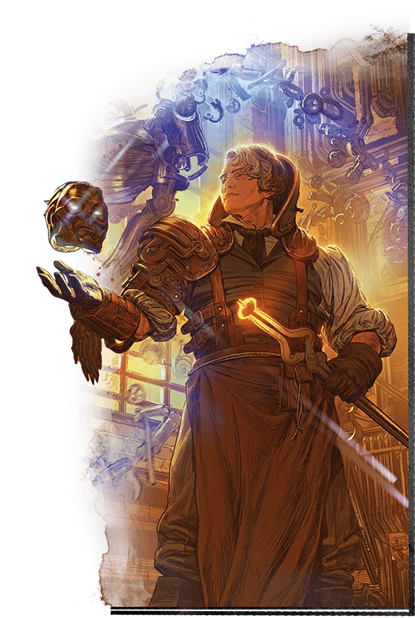
Masters of invention, Artificers use ingenuity and magic to unlock extraordinary capabilities in objects. They see magic as a complex system waiting to be decoded and then harnessed in their spells and inventions.
Becoming a Artificer...
As a Level 1 Character:
- Gain all the traits in the Core Artificer Traits table.
- Gain the Artificer’s level 1 features, which are listed in the Artificer Features table.
As a Multiclass Character:
- Gain the following traits from the Core Artificer Traits table: Hit Point Die, proficiency with Tinker’s Tools, proficiency in one skill of your choice from the Artificer’s skill list, and training with Light and Medium armor and Shields.
- Gain the Artificer’s level 1 features, which are listed in the Artificer Features table. See the multiclassing rules in the Player’s Handbook to determine your available spell slots, adding half your Artificer levels (round up). ]
Class Features
| Level | Proficiency Bonus | Class Features | Plans Known | Magic Items | Cantrips | Prepared Spells | 1 | 2 | 3 | 4 | 5 |
|---|---|---|---|---|---|---|---|---|---|---|---|
| 1 | +2 | Spellcasting, Tinker’s Magic | — | — | 2 | 2 | 2 | — | — | — | — |
| 2 | +2 | Replicate Magic Item | 4 | 2 | 2 | 3 | 2 | — | — | — | — |
| 3 | +2 | Artificer Subclass | 4 | 2 | 2 | 4 | 3 | — | — | — | — |
| 4 | +2 | Ability Score Improvement | 4 | 2 | 2 | 5 | 3 | — | — | — | — |
| 5 | +3 | Subclass feature | 4 | 2 | 2 | 6 | 4 | 2 | — | — | — |
| 6 | +3 | Magic Item Tinker | 5 | 3 | 2 | 6 | 4 | 2 | — | — | — |
| 7 | +3 | Flash of Genius | 5 | 3 | 2 | 7 | 4 | 3 | — | — | — |
| 8 | +3 | Ability Score Improvement | 5 | 3 | 2 | 7 | 4 | 3 | — | — | — |
| 9 | +4 | Subclass feature | 5 | 3 | 2 | 9 | 4 | 3 | 2 | — | — |
| 10 | +4 | Magic Item Adept | 6 | 4 | 3 | 9 | 4 | 3 | 2 | — | — |
| 11 | +4 | Spell-Storing Item | 6 | 4 | 3 | 10 | 4 | 3 | 3 | — | — |
| 12 | +4 | Ability Score Improvement | 6 | 4 | 3 | 10 | 4 | 3 | 3 | — | — |
| 13 | +5 | — | 6 | 4 | 3 | 11 | 4 | 3 | 3 | 1 | — |
| 14 | +5 | Advanced Artifice | 7 | 5 | 4 | 11 | 4 | 3 | 3 | 1 | — |
| 15 | +5 | Subclass feature | 7 | 5 | 4 | 12 | 4 | 3 | 3 | 2 | — |
| 16 | +5 | Ability Score Improvement | 7 | 5 | 4 | 12 | 4 | 3 | 3 | 2 | — |
| 17 | +6 | — | 7 | 5 | 4 | 14 | 4 | 3 | 3 | 3 | 1 |
| 18 | +6 | Magic Item Master | 8 | 6 | 4 | 14 | 4 | 3 | 3 | 3 | 1 |
| 19 | +6 | Epic Boon | 8 | 6 | 4 | 15 | 4 | 3 | 3 | 3 | 2 |
| 20 | +6 | Soul of Artifice | 8 | 6 | 4 | 15 | 4 | 3 | 3 | 3 | 2 |
Level 1: Spellcasting
You have learned how to channel magical energy through objects. See the Player’s Handbook for the rules on spellcasting. The information below details how you use those rules with Artificer spells, which appear in the Artificer spell list later in the class’s description. Tools Required. You produce your Artificer spells through tools. You can use Thieves’ Tools, Tinker’s Tools, or another kind of Artisan’s Tools with which you have proficiency as a Spellcasting Focus, and you must have one of those focuses in hand when you cast an Artificer spell (meaning the spell has an M component when you cast it). Cantrips. You know two Artificer cantrips of your choice. Acid Splash and Prestidigitation are recommended. Whenever you finish a Long Rest, you can replace one of your cantrips from this feature with another Artificer cantrip of your choice. When you reach Artificer levels 10 and 14, you learn another Artificer cantrip of your choice, as shown in the Cantrips column of the Artificer Features table. Spell Slots. The Artificer Features table shows how many spell slots you have to cast your level 1+ spells. You regain all expended slots when you finish a Long Rest. Prepared Spells of Level 1+. You prepare the list of level 1+ spells that are available for you to cast with this feature. To start, choose two level 1 Artificer spells. Cure Wounds and Grease are recommended. The number of spells on your list increases as you gain Artificer levels, as shown in the Prepared Spells column of the Artificer Features table. Whenever that number increases, choose additional Artificer spells until the number of spells on your list matches the number on the table. The chosen spells must be of a level for which you have spell slots. For example, if you’re a level 5 Artificer, your list of prepared spells can include six Artificer spells of levels 1 and 2 in any combination. If another Artificer feature gives you spells that you always have prepared, those don’t count against the number of spells you can prepare with this feature, but those spells otherwise count as Artificer spells for you. Changing Your Prepared Spells. Whenever you finish a Long Rest, you can change your list of prepared spells, replacing any of the spells there with other Artificer spells for which you have spell slots. Spellcasting Ability. Intelligence is your spellcasting ability for your Artificer spells. Level 1: Tinker’s Magic
You know the Mending cantrip. As a Magic action while holding Tinker’s Tools, you can create one item in an unoccupied space within 5 feet of yourself, choosing the item from the following list:
See the rules for the item in the Player’s Handbook. The item lasts until you finish a Long Rest, at which point it vanishes.
You can use this feature a number of times equal to your Intelligence modifier (minimum of once), and you regain all expended uses when you finish a Long Rest.
Level 2: Replicate Magic Item
You have learned arcane plans that you use to make magic items. Plans Known. When you gain this feature, choose four plans to learn from the Magic Item Plans (Artificer Level 2+) table (see the Dungeon Master’s Guide for the items’ descriptions). Bag of Holding, Cap of Water Breathing, Sending Stones, and Wand of the War Mage are recommended. Whenever you gain an Artificer level, you can replace one of the plans you know with a new plan for which you qualify. You learn another plan of your choice when you reach certain Artificer levels, as shown in the Plans Known column of the Artificer Features table. When you choose a plan to learn, you choose it from any Magic Item Plans table for which you qualify; your qualification is based on your Artificer level. Creating an Item. When you finish a Long Rest, you can create one or two different magic items if you have Tinker’s Tools in hand. Each item is based on one of the plans you know for this feature. If a created item requires Attunement, you can attune yourself to it the instant you create it. If you decide to attune to the item later, you must do so using the normal process for Attunement. When you reach certain Artificer levels specified in the Magic Items column of the Artificer Features table, the number of magic items you can create at the end of a Long Rest increases. Each item you create must be based on a different plan you know. You can’t have more magic items from this feature than the number shown in the Magic Items column of the Artificer Features table for your level. If you try to exceed your maximum number of magic items for this feature, the oldest item vanishes, and then the new item appears. Duration. A magic item created by this feature functions as the normal magic item, except its magic isn’t permanent; when you die, the magic item vanishes after 1d4 days. If you replace a plan you know with a new plan, any magic item created with the replaced plan immediately vanishes. If an item that you created with this feature is a container, such as a Bag of Holding , and it vanishes, its contents harmlessly appear in and around its space. Spellcasting Focus. You can use any Wand or Weapon created by this feature as a Spellcasting Focus in lieu of using a set of Artisan’s Tools. Magic Item Plans (Artificer Level 2+)
*You can learn this option multiple times and must select a different item each time; each item selected counts as a different plan.
† See the appendix.
Magic Item Plans (Artificer Level 6+)
† See the appendix.
Magic Item Plans (Artificer Level 10+)
*You can learn this option multiple times and must select a different item each time; each item selected counts as a different plan.
Magic Item Plans (Artificer Level 14+)
*You can learn this option multiple times and must select a different item each time; each item selected counts as a different plan.
Level 3: Artificer Subclass
You gain an Artificer subclass of your choice. A subclass is a specialization that grants you features at certain Artificer levels. For the rest of your career, you gain each of your subclass’s features that are of your Artificer level or lower. Level 4: Ability Score Improvement
You gain the Ability Score Improvement feat or another feat of your choice for which you qualify. You gain this feature again at Artificer levels 8, 12, and 16. Level 6: Magic Item Tinker
Your Replicate Magic Item feature gains the following options. Charge Magic Item. As a Bonus Action, you can touch a magic item within 5 feet of yourself that you created with Replicate Magic Item and that uses charges. You expend a level 1+ spell slot and recharge the item. The number of charges the item regains is equal to the level of spell slot expended. Drain Magic Item. As a Bonus Action, you can touch a magic item within 5 feet of yourself that you created with Replicate Magic Item and cause the item to vanish, converting its magical energy into a spell slot. The slot is level 1 if the item is Common or level 2 if the item is Uncommon or Rare. Once you use this feature, you can’t do so again until you finish a Long Rest. Any spell slot you create with this feature vanishes when you finish a Long Rest. Transmute Magic Item. As a Magic action, you can touch one magic item within 5 feet of yourself that you created with Replicate Magic Item and transform it into a different magic item. The resulting item must be based on a magic item plan you know. Once you use this feature, you can’t do so again until you finish a Long Rest. Level 7: Flash of Genius
When you or a creature you can see within 30 feet of you fails an ability check or a saving throw, you can take a Reaction to add a bonus to the roll, potentially causing it to succeed. The bonus equals your Intelligence modifier (minimum of +1). You can take this Reaction a number of times equal to your Intelligence modifier (minimum of once). You regain all expended uses when you finish a Long Rest. Level 10: Magic Item Adept
You can now attune to up to four magic items at once. Level 11: Spell-Storing Item
Whenever you finish a Long Rest, you can touch one Simple or Martial weapon or one item that you can use as a Spellcasting Focus, and you store a spell in it, choosing a level 1, 2, or 3 Artificer spell that has a casting time of an action and doesn’t require a Material component that is consumed by the spell (you needn’t have the spell prepared). While holding the object, a creature can take a Magic action to produce the spell’s effect from it, using your spellcasting ability modifier. If the spell requires Concentration, the creature must concentrate. Once a creature has used the object to produce the spell’s effect, the object can’t be used this way again until the start of the creature’s next turn. The spell stays in the object until it’s been used a number of times equal to twice your Intelligence modifier (minimum of twice) or until you use this feature again to store a spell in an object. Level 14: Advanced Artifice
You gain the following benefits. Magic Item Savant. You can now attune to up to five magic items at once. Refreshed Genius. When you finish a Short Rest, you regain one expended use of your Flash of Genius feature. Level 18: Magic Item Master
You can now attune to up to six magic items at once. Level 19: Epic Boon
You gain an Epic Boon feat or another feat of your choice for which you qualify. Boon of Energy Resistance is recommended. Level 20: Soul of Artifice
You have developed a mystical connection to your magic items, which you can draw on for aid. You gain the following benefits. Cheat Death. If you’re reduced to 0 Hit Points but not killed outright, you can disintegrate any number of Uncommon or Rare magic items created by your Replicate Magic Item feature. If you do so, your Hit Points instead change to a number equal to 20 times the number of magic items disintegrated. Magical Guidance. When you finish a Short Rest, you regain all expended uses of your Flash of Genius if you have Attunement to at least one magic item.
You have learned how to channel magical energy through objects. See the Player’s Handbook for the rules on spellcasting. The information below details how you use those rules with Artificer spells, which appear in the Artificer spell list later in the class’s description. Tools Required. You produce your Artificer spells through tools. You can use Thieves’ Tools, Tinker’s Tools, or another kind of Artisan’s Tools with which you have proficiency as a Spellcasting Focus, and you must have one of those focuses in hand when you cast an Artificer spell (meaning the spell has an M component when you cast it). Cantrips. You know two Artificer cantrips of your choice. Acid Splash and Prestidigitation are recommended. Whenever you finish a Long Rest, you can replace one of your cantrips from this feature with another Artificer cantrip of your choice. When you reach Artificer levels 10 and 14, you learn another Artificer cantrip of your choice, as shown in the Cantrips column of the Artificer Features table. Spell Slots. The Artificer Features table shows how many spell slots you have to cast your level 1+ spells. You regain all expended slots when you finish a Long Rest. Prepared Spells of Level 1+. You prepare the list of level 1+ spells that are available for you to cast with this feature. To start, choose two level 1 Artificer spells. Cure Wounds and Grease are recommended. The number of spells on your list increases as you gain Artificer levels, as shown in the Prepared Spells column of the Artificer Features table. Whenever that number increases, choose additional Artificer spells until the number of spells on your list matches the number on the table. The chosen spells must be of a level for which you have spell slots. For example, if you’re a level 5 Artificer, your list of prepared spells can include six Artificer spells of levels 1 and 2 in any combination. If another Artificer feature gives you spells that you always have prepared, those don’t count against the number of spells you can prepare with this feature, but those spells otherwise count as Artificer spells for you. Changing Your Prepared Spells. Whenever you finish a Long Rest, you can change your list of prepared spells, replacing any of the spells there with other Artificer spells for which you have spell slots. Spellcasting Ability. Intelligence is your spellcasting ability for your Artificer spells. Level 1: Tinker’s Magic
You know the Mending cantrip. As a Magic action while holding Tinker’s Tools, you can create one item in an unoccupied space within 5 feet of yourself, choosing the item from the following list:
| Ball Bearings | Flask | Pouch |
| Basket | Grappling Hook | Rope |
| Bedroll | Hunting Trap | Sack |
| Bell | Jug | Shovel |
| Blanket | Lamp | Spikes, Iron |
| Block and Tackle | Manacles | String |
| Bottle, Glass | Net | Tinderbox |
| Bucket | Oil | Torch |
| Caltrops | Paper | Vial |
| Candle | Parchment | |
| Crowbar | Pole |
You have learned arcane plans that you use to make magic items. Plans Known. When you gain this feature, choose four plans to learn from the Magic Item Plans (Artificer Level 2+) table (see the Dungeon Master’s Guide for the items’ descriptions). Bag of Holding, Cap of Water Breathing, Sending Stones, and Wand of the War Mage are recommended. Whenever you gain an Artificer level, you can replace one of the plans you know with a new plan for which you qualify. You learn another plan of your choice when you reach certain Artificer levels, as shown in the Plans Known column of the Artificer Features table. When you choose a plan to learn, you choose it from any Magic Item Plans table for which you qualify; your qualification is based on your Artificer level. Creating an Item. When you finish a Long Rest, you can create one or two different magic items if you have Tinker’s Tools in hand. Each item is based on one of the plans you know for this feature. If a created item requires Attunement, you can attune yourself to it the instant you create it. If you decide to attune to the item later, you must do so using the normal process for Attunement. When you reach certain Artificer levels specified in the Magic Items column of the Artificer Features table, the number of magic items you can create at the end of a Long Rest increases. Each item you create must be based on a different plan you know. You can’t have more magic items from this feature than the number shown in the Magic Items column of the Artificer Features table for your level. If you try to exceed your maximum number of magic items for this feature, the oldest item vanishes, and then the new item appears. Duration. A magic item created by this feature functions as the normal magic item, except its magic isn’t permanent; when you die, the magic item vanishes after 1d4 days. If you replace a plan you know with a new plan, any magic item created with the replaced plan immediately vanishes. If an item that you created with this feature is a container, such as a Bag of Holding , and it vanishes, its contents harmlessly appear in and around its space. Spellcasting Focus. You can use any Wand or Weapon created by this feature as a Spellcasting Focus in lieu of using a set of Artisan’s Tools. Magic Item Plans (Artificer Level 2+)
| Magic Item Plan | Attunement |
|---|---|
| Alchemy Jug | No |
| Bag of Holding | No |
| Cap of Water Breathing | No |
| Common magic item that isn’t a Potion, a Scroll, or cursed* | Varies |
| Goggles of Night | No |
| Manifold Tool† | Yes |
| Repeating Shot† | Yes |
| Returning Weapon† | No |
| Rope of Climbing | No |
| Sending Stones | No |
| Shield, +1 | No |
| Wand of Magic Detection | No |
| Wand of Secrets | No |
| Wand of the War Mage, +1 | Yes |
| Weapon, +1 | No |
| Wraps of Unarmed Power, +1 | No |
| Magic Item Plan | Attunement |
|---|---|
| Armor, +1 | No |
| Boots of Elvenkind | No |
| Boots of the Winding Path† | Yes |
| Cloak of Elvenkind | Yes |
| Cloak of the Manta Ray | Yes |
| Dazzling Weapon† | Yes |
| Eyes of Charming | Yes |
| Eyes of Minute Seeing | No |
| Gloves of Thievery | No |
| Helm of Awareness† | No |
| Lantern of Revealing | No |
| Mind Sharpener† | Yes |
| Necklace of Adaptation | Yes |
| Pipes of Haunting | No |
| Repulsion Shield† | No |
| Ring of Swimming | No |
| Ring of Water Walking | No |
| Sentinel Shield | No |
| Spell-Refueling Ring† | Yes |
| Wand of Magic Missiles | No |
| Wand of Web | Yes |
| Weapon of Warning | Yes |
| Magic Item Plan | Attunement |
|---|---|
| Armor of Resistance | Yes |
| Dagger of Venom | No |
| Elven Chain | No |
| Ring of Feather Falling | Yes |
| Ring of Jumping | Yes |
| Ring of Mind Shielding | Yes |
| Shield, +2 | No |
| Uncommon Wondrous Item that isn’t cursed* | Varies |
| Wand of the War Mage, +2 | Yes |
| Weapon, +2 | No |
| Wraps of Unarmed Power, +2 | No |
| Magic Item Plan | Attunement |
|---|---|
| Armor, +2 | No |
| Arrow-Catching Shield | Yes |
| Flame Tongue | Yes |
| Rare Wondrous Item that isn’t cursed* | Varies |
| Ring of Free Action | Yes |
| Ring of Protection | Yes |
| Ring of the Ram | Yes |
You gain an Artificer subclass of your choice. A subclass is a specialization that grants you features at certain Artificer levels. For the rest of your career, you gain each of your subclass’s features that are of your Artificer level or lower. Level 4: Ability Score Improvement
You gain the Ability Score Improvement feat or another feat of your choice for which you qualify. You gain this feature again at Artificer levels 8, 12, and 16. Level 6: Magic Item Tinker
Your Replicate Magic Item feature gains the following options. Charge Magic Item. As a Bonus Action, you can touch a magic item within 5 feet of yourself that you created with Replicate Magic Item and that uses charges. You expend a level 1+ spell slot and recharge the item. The number of charges the item regains is equal to the level of spell slot expended. Drain Magic Item. As a Bonus Action, you can touch a magic item within 5 feet of yourself that you created with Replicate Magic Item and cause the item to vanish, converting its magical energy into a spell slot. The slot is level 1 if the item is Common or level 2 if the item is Uncommon or Rare. Once you use this feature, you can’t do so again until you finish a Long Rest. Any spell slot you create with this feature vanishes when you finish a Long Rest. Transmute Magic Item. As a Magic action, you can touch one magic item within 5 feet of yourself that you created with Replicate Magic Item and transform it into a different magic item. The resulting item must be based on a magic item plan you know. Once you use this feature, you can’t do so again until you finish a Long Rest. Level 7: Flash of Genius
When you or a creature you can see within 30 feet of you fails an ability check or a saving throw, you can take a Reaction to add a bonus to the roll, potentially causing it to succeed. The bonus equals your Intelligence modifier (minimum of +1). You can take this Reaction a number of times equal to your Intelligence modifier (minimum of once). You regain all expended uses when you finish a Long Rest. Level 10: Magic Item Adept
You can now attune to up to four magic items at once. Level 11: Spell-Storing Item
Whenever you finish a Long Rest, you can touch one Simple or Martial weapon or one item that you can use as a Spellcasting Focus, and you store a spell in it, choosing a level 1, 2, or 3 Artificer spell that has a casting time of an action and doesn’t require a Material component that is consumed by the spell (you needn’t have the spell prepared). While holding the object, a creature can take a Magic action to produce the spell’s effect from it, using your spellcasting ability modifier. If the spell requires Concentration, the creature must concentrate. Once a creature has used the object to produce the spell’s effect, the object can’t be used this way again until the start of the creature’s next turn. The spell stays in the object until it’s been used a number of times equal to twice your Intelligence modifier (minimum of twice) or until you use this feature again to store a spell in an object. Level 14: Advanced Artifice
You gain the following benefits. Magic Item Savant. You can now attune to up to five magic items at once. Refreshed Genius. When you finish a Short Rest, you regain one expended use of your Flash of Genius feature. Level 18: Magic Item Master
You can now attune to up to six magic items at once. Level 19: Epic Boon
You gain an Epic Boon feat or another feat of your choice for which you qualify. Boon of Energy Resistance is recommended. Level 20: Soul of Artifice
You have developed a mystical connection to your magic items, which you can draw on for aid. You gain the following benefits. Cheat Death. If you’re reduced to 0 Hit Points but not killed outright, you can disintegrate any number of Uncommon or Rare magic items created by your Replicate Magic Item feature. If you do so, your Hit Points instead change to a number equal to 20 times the number of magic items disintegrated. Magical Guidance. When you finish a Short Rest, you regain all expended uses of your Flash of Genius if you have Attunement to at least one magic item.
Subclasses
World Anvil: The Ultimate Worldbuilding Toolset & RPG Campaign Manager
Created for Dungeon Masters and Game Masters, World Anvil has everything you need to build your own homebrew RPG campaign setting, and run your games, either online or around the table!
- Speed up prep with a whole library of community statblocks you can copy (and edit!)
- Enthrall your players with interactive maps, timelines, and a whole wiki of your world
- Keep track of NPCs, PC character sheets, monster stats, treasure, journals, notes and more
- Quickly look up essential info with session notes, campaign map markers, and bookmarked lore at your fingertips
- Build your own campaign setting, or expand a prewritten campaign, with expertly created worldbuilding templates and prompts
- Control who sees what in your worldbuilding wiki with secrets and subscriber groups
- Collaborate with players and GMs to build the campaign setting of your dreams
- NEVER lose your notes!
GET STARTED TODAY!
Take the first step. Create your account. Your world and characters await!
100+ RPG systems


