
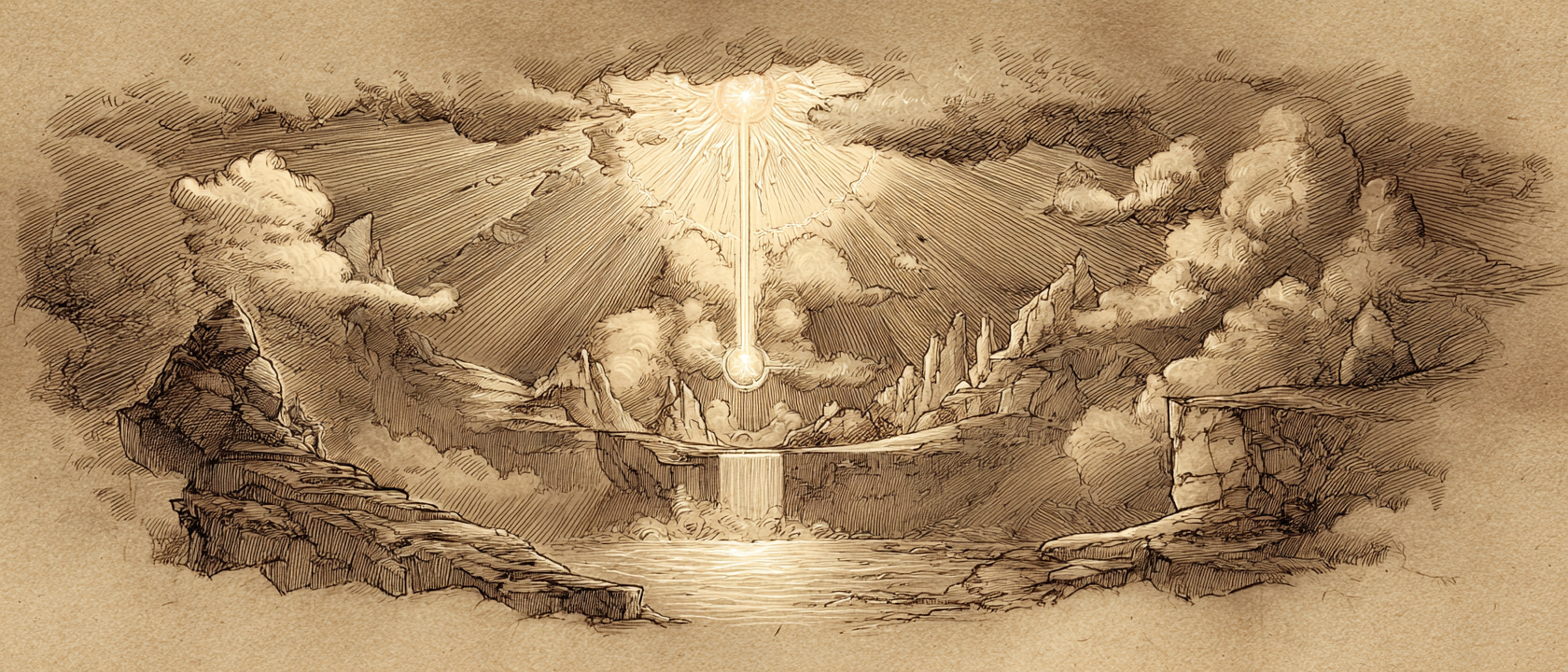
Tarsaralei, Lady of the Tempest Heart
Not all gods are consistent enough to be loved comfortably.
Tarsaralei is prayed to with wet hands, clenched teeth, and eyes fixed on the horizon. She is the middle child of Eanna and Aldanoc, goddess of the sea, storms, wild weather, and the raw force of wind and water when they remember they were never made for mortal convenience. She is not orderly. She is not measured. She does not move with the grave precision of Nesmerleth, nor the stern endurance of Kazan, nor the faithful watchfulness of Aldanoc. She comes on fast. She breaks things. She weeps for it afterward.
This is the shape of her divinity.
Tarsaralei governs the elements in their most untamed state. The gale that snaps a mast clean through. The wave that lifts a ship like a toy and dashes it against black stone. The storm surge that remakes a coastline in a single night. The sudden summer torrent that turns dry earth green by morning. She gives wind and water their force, but not always their restraint. In old stories, she is often described as powerful enough to devastate a kingdom almost by accident, then stricken with remorse so fierce it sends her fleeing to her brothers in shame and grief. Her nature is neither malicious nor safe. She means no harm, but meaning no harm has never kept a village from flooding.
That is why her worship has always been threaded with fear, affection, exasperation, and pity in almost equal measure. Sailors pray to her not because they trust the sea, but because they know the sea has a heart, however changeable, and a heart may sometimes be moved. Fishermen, navigators, wreck-divers, islanders, lighthouse keepers, and storm-battered coastfolk all speak to her as one might speak to a dangerous beloved thing: with praise, with offerings, with careful flattery, and sometimes with angry familiarity. Her faithful do not pretend she is mild. They love her as she is.
Some even say that this is why she deserves love more than certain calmer gods do. It is easy to revere perfection. Harder to remain tender toward a power that can wound, regret, and wound again.
She is also associated in some traditions with the manticore, a beast many believe reflects something of her own terrible beauty: volatile, magnificent, destructive, and difficult to hate even when it kills. For this reason, hunters who slay a manticore will often loudly praise its strength and splendor over the corpse, hoping to soothe any wrath or grief Tarsaralei may feel at the creature’s death.
The principal order devoted to Tarsaralei is known as the Tempest Wardens, though elsewhere they are called the Stormcallers or, more poetically and sometimes mockingly, the Remorseful Tide.
They are a strange order by the standards of the more disciplined faiths. Capable of frightening violence, startling tenderness, practical seamanship, half-superstitious ritual, and acts of self-reproach so sincere they can border on the theatrical, all within the same day. They are storm-riders, sea-guides, wreck rescuers, lighthouse keepers, weather-readers, and rebuilders. They do not merely revere the storm. They live inside its contradictions.
A Tempest Warden may spend the morning calling wind against raiders, the afternoon dragging survivors from splintered wreckage, and the evening helping rebuild homes shaken apart by the very power she herself invoked. This is not hypocrisy in their eyes. It is fidelity to the goddess they serve. Power is real. Harm is real. Remorse must be real also.
Their work is therefore divided between fury and repair. They are often the first to answer coastal disaster, shipwreck, tidal damage, storm collapse, and the strange weather wounds left by Titan-stirred upheaval. They know how to read swells, clouds, pressure shifts, broken currents, and the moods of a coast better than almost anyone. More importantly, they know how quickly things can go wrong, and how little pride matters once people are drowning.
For this reason, they are much loved in some places and regarded with exhausted suspicion in others. The Tempest Wardens save lives, but they also remind people of how fragile those lives are.
Tarsaralei’s doctrine is less rigid than that of Kazan or Nesmerleth, and less cleanly hopeful than Eanna’s, but it possesses its own severe honesty.
The sea does not apologize before it breaks a ship. The sky does not ask consent before it turns black. Nature in its deepest forms is not tidy, and to expect it to be tidy is childishness. Tarsaralei’s faithful therefore teach that destruction and creation are often neighbors, and that strength does not always mean opposing force head-on. Sometimes strength lies in yielding, adapting, reading the current correctly, or knowing when to throw cargo overboard so the crew survives.
Yet this is only half the lesson.
The other half is remorse.
To the Tempest Wardens, it is not enough to say harm was unintended. Intent does matter, but it is not everything. If a storm called in battle ruins innocent homes as well as enemy ships, the one who called it bears responsibility afterward. If one’s anger, carelessness, or recklessness harms others, then the answer is not denial, but repair. This is among the most distinctive and strangely beautiful aspects of Tarsaralei’s faith. It does not ask the impossible purity of never causing harm. It asks the harder thing: that one look honestly at the wreckage and then help carry stone, mend nets, bury the lost, and make amends.
In this sense, her followers can be unexpectedly mature. They know what it is to fail while meaning well. They know what it is to be too much. They know what it is to wish, with all sincerity, that one had been gentler.
They also hold strongly to the belief that free will includes the freedom to err and the duty to answer for those errors. Atonement is not reserved for villains. Sometimes it belongs to the foolish, the grieving, the proud, the frightened, and the overzealous.
The Tempest Wardens are decentralized almost by necessity. Sea and weather do not lend themselves easily to fixed central control, and so the order is broad in spirit rather than tight in chain.
At its loose head stands a Stormmother or Stormfather, depending on the current leader. Beneath that are regional Wave Wardens, who oversee stretches of coast, island chains, harbor networks, lighthouse routes, or river mouths. Local chapters then form themselves according to need, often around ships, harbor shrines, rescue houses, cliff temples, or coastal sanctuaries.
Within the order, members are often grouped by temperament and duty more than rank alone. Breakers are the warrior-sailors, storm-fighters, and hard-response specialists who act in battle or in the teeth of violent weather. Calmers tend toward healing, mediation, grief work, and the rites of remorse that follow destruction. Whisperers are those especially gifted at reading weather, praying for the goddess’s attention, sensing dangerous shifts, and navigating the emotional as well as elemental moods of the faith.
These roles bleed into one another often. A Breaker may become a Calmer after enough years and enough funerals. A Whisperer may prove terrifying in battle if pushed. Tarsaralei is not a goddess who keeps neat categories.
Most of her faithful are not great miracle workers. They are sailors, pilots, dockside priests, weather-wise healers, tide readers, harbor defenders, and practical folk who know how to tie knots, read clouds, and drag the living out of floodwater. That practicality is one of the order’s strongest virtues.
Tarsaralei’s temples are not associated with stillness.
Her sacred places tend to be built where weather can be heard. Cliffside shrines lashed by spray. Harbor temples with wide doors thrown open to salt air. Lighthouse chapels. Sea caves marked with old offerings. Pilgrim pools near dangerous coasts. Mooring-post altars where sailors leave knots of ribbon, shell charms, carved scraps of driftwood, and tiny silver fish. Some shrines are beautiful. Some feel half improvised. Most look as though they expect to be weathered.
They are not untouched places. Paint peels. Salt eats metal. Stone is slick beneath the hand. This is accepted as part of the sacred atmosphere rather than a flaw in upkeep. Tarsaralei’s faithful understand that to worship a storm goddess in a place too polished would be almost insulting.
Many of these sites also serve practical functions. Watch posts, rescue stations, signal towers, boathouses, food stores, storm cellars, healing rooms for the shipwrecked, lofts for drying nets and spare sailcloth. Like several of the best divine orders, the Tempest Wardens tie devotion tightly to usefulness.
Inland shrines do exist, though they often seem odd or out of place, like seashells found in mountain snow. They tend to cluster near lakes, great rivers, places of dangerous weather, or routes notorious for storms.
Among the most defining practices of the order are the Remorse Rites.
These occur after any destructive act touched by the faithful, whether that destruction was unavoidable, necessary, accidental, or born of poor judgment. A storm summoned in battle. A ship sunk. A harbor wall broken in order to prevent something worse. A weather-working that harmed more than intended. Even private failings can bring one to the rite.
The form varies. Some make public confession and then labor openly at recovery efforts. Some keep watch beside the dead. Some rebuild with their own hands. Some go without warmth or comfort until those harmed by their actions are cared for first. Some pour offerings into the tide and speak aloud the names of those affected. The rite is not meant to wallow. It is meant to prevent spiritual evasiveness.
The Tempest Wardens are suspicious of any power, divine or mortal, that causes ruin and then refuses to look back.
The old custom of Manticore Honor is among the most distinctive traditions associated with the order.
When a manticore is slain, especially in lands where Tarsaralei’s cult is strong, it is customary to praise the creature loudly over its body. Hunters recount its speed, ferocity, majesty, cleverness, and the danger it posed, not merely to boast of their own triumph, but to acknowledge the beauty of what has been destroyed. This is thought to soothe the goddess’s anger or grief.
Outsiders sometimes find the custom strange, but it reveals much about Tarsaralei’s worship. Her faithful do not easily separate terror from admiration. They know something can be deadly and still magnificent. They also know that mockery after violence often poisons the soul of the victor.
If one wishes to understand why this order remains so necessary, one must look not at its storms, but at its aftermaths.
The Tempest Wardens are among the greatest disaster-response bodies in Ior. They drag sailors from wreckage. Haul children to rooftops. Guide ships through broken reefs by lantern in impossible rain. Mark shoals left by shifting tides. Restore docks. Mend storm-torn roofs. Organize bucket lines. Search mud and debris for the missing. Deliver relief between islands after a bad season. Calm panicked harbormasters. Help fishing villages survive years when the sea seems personally offended.
This role became even more central after the Fall, when continents shifted, coastlines broke, and tidal devastation swallowed islands whole. The world had become dangerous in many old ways, but the seas themselves had grown stranger. Since then, the Tempest Wardens have been indispensable wherever land and water meet in uncertainty.
Their faith is therefore one of the clearest examples in the world of a dangerous god being served by people whose central moral labor is care.
The order’s current leader is Stormmother Maelene Vairek, a weather-beaten human woman whose authority seems to gather around her the way storm-pressure gathers before the sky finally breaks.
Her salt-white hair, sea-cut features, and dark, shifting eyes have made her memorable even to those who have only seen her once. She is known for fierce instinct in moments of crisis, often making decisions so sudden they appear reckless to outsiders, followed by a remorse so sincere that she will labor past exhaustion to mend whatever damage was done in the choosing.
In another faith, that temper might be considered disqualifying. Among the Tempest Wardens, it has made her legible. They trust that when Maelene errs, she does not hide behind rank, excuse, or pious language. She grieves openly, works tirelessly, and asks no one else to carry burdens she will not shoulder herself. More importantly, when flood, fire, or wreck comes, she moves before most others have even understood what is happening.
That combination of force and contrition has made her beloved in some quarters, troubling in others, and unmistakably Tarsaralei’s.
Though the order belongs chiefly to coast and island, there are a handful of inland Tempest Wardens whose existence has become the subject of rumors and local legends.
The most famous is the mysterious cleric of the Silver Mist Hills, a woman who left the sea for reasons she has never explained and now appears wherever blizzards, lightning, and violent sky-breaks threaten the remote roads. She has called down storms to shatter marauder bands, broken winter whiteouts to lead travelers home, and once, according to repeated local testimony, summoned a tornado to scour raiders from the hills like leaves from a field. No one seems to know whether she is in exile, penance, obedience, or simply answering a call only she could hear.
This sort of figure is very much in Tarsaralei’s spirit. The sea is her realm, but weather is not obedient to maps.
No account of Tarsaralei is complete without speaking of the trolls, for they are widely held to be her chosen race, and among them her worship is not merely common but near instinctive.
The old saying goes that trolls are as varied as leaves on the wind, and there is truth in it. They are restless, superstitious, and difficult to predict even by those who have lived beside them all their lives. Their attention may turn in a heartbeat. Their plans may seem to alter with the weather. One troll may spend a month obsessed with songs of river spirits, another with shell carving, another with wrestling, another with storm omens, and all may abandon these passions just as suddenly for something else. To outsiders this can make them seem fickle or impossible to rely upon. To those who know them better, it is simply part of their nature.
Few traits are truly constant across troll kind. They love music. They cleave fiercely to family. They are often governed as much by mood, omen, and feeling as by reasoned design. Beyond that, the only safe assumption is that no safe assumption exists.
This fluid, changeable spirit has long bound them to Tarsaralei. They see in her not only the storm’s violence, but its living unpredictability, its sudden beauty, its swift grief, and its refusal to remain one thing for long. Many trolls speak of the sea, the weather, and the heart as if all three are cousins. To them, Tarsaralei is not an embarrassing or dangerous goddess to be carefully explained away. She is simply divine in the same way weather is divine: excessive, moody, generous, destructive, dazzling, and impossible to reduce into something tidy.
For this reason, most troll communities maintain some form of devotion to her, even far inland. Coastal trolls may keep her with cliff shrines, shell altars, and storm songs. River trolls may honor her in flood markers, boat rites, and drums played before bad weather. Highland trolls may invoke her through blizzard charms, thunder rites, and seasonal gatherings that treat wild weather less as an enemy than as a powerful relative whose moods must be read and respected.
Among the Tempest Wardens, trolls are often understood as the people who best grasp one of Tarsaralei’s hardest lessons: that volatility does not erase love, and that chaos does not always mean absence of devotion. They can be exasperating allies, brilliant navigators of emotion and omen, reckless fighters, gifted singers, and impossible subordinates. They are also among the most fervent worshippers the goddess has.
Indeed, some of the order’s most powerful weather-singers, rescue crews, and sea-readers have been trolls, whose intuition for change borders on the uncanny. Other orders sometimes distrust them for that same reason. The Tempest Wardens usually do not. They know better than most that not all worthy things move in straight lines.
The Tempest Wardens work especially well with the Lunar Wardens and the Red Road Pilgrims, both of whom understand the value of way stations, rescue, and practical protection for those traveling dangerous routes. Shared towers, cliff refuges, and warning outposts are common in harsher regions.
They also cooperate readily with the Mothers of the Ardent Dawn, especially after disaster, where healing, shelter, and material recovery must happen all at once. A flooded village may see both orders working side by side: one hauling the living from wreckage, the other tending the injured and calming the bereaved.
With more rigid orders, the relationship can be harder. The Stone Oathkeepers often distrust the Tempest Wardens’ emotional volatility and dislike the collateral damage that can attend storm-work. The Scalebearers find them difficult for related reasons, particularly where unintended destruction complicates clean lines of guilt or innocence. To such orders, Tarsaralei’s faithful can seem too changeable, too feeling, too forgiving of mess.
To the Tempest Wardens, this criticism is not always wrong. It is simply incomplete.
The Tempest Wardens dress like people who expect to be soaked, wind-burned, salt-stung, and called to work without notice. Their clothing favors sea-greens, storm-blue, kelp-dark, foam-white, weather-grey, and the deep blue-black of open water before lightning. Cloaks are often waxed or layered. Belts carry rope, knives, hooks, charms, and practical tools. Shells, wave motifs, stormglass, and manticore imagery appear in some regions, though never with enough uniformity to make the order feel tidy.
Tarsaralei has no favored weapon, which suits her well. Her faithful use what suits the moment and the terrain: boat hooks, knives, staves, harpoons, boarding axes, slings, short blades, even bare hands on rigging or in floodwater. They are not defined by one sacred implement of violence. Their true instruments are wind, current, timing, nerve, and the ability to keep functioning when everything is moving at once.
Their manner can vary sharply. Some are brash and laughing. Some melancholy. Some startlingly tender. Some impossible to predict from one hour to the next. Yet the best among them share a common trait: when disaster comes, they are already moving.
Tarsaralei’s blessings are rarely subtle, but they are not always destructive.
A gust arriving at exactly the right moment to push a burning ship clear of the harbor. Rain falling after fire. A sudden calm in waters that should have killed everyone aboard. Lightning that strikes only the raiders’ ridge. Wind carrying shouted warnings farther than any human voice should reach. A storm that tears apart an enemy line and then spends itself before touching the village beyond.
Her greater miracles are wild, beautiful, and frightening. But her lesser graces are often the ones her faithful cherish most: a ship guided home, a child pulled from surf, a village spared the second wave, a fisher returning to harbor beneath clearing skies, the chance to make things right after having been too much.
Tarsaralei is not a goddess of clean hands.
She is the crash and the weeping after. The ruin and the rebuilding. The storm that does not know its own strength until the shore lies broken before it, and the fierce, honest grief that kneels in the wreckage and begins to lift timber.
Tarsaralei is prayed to with wet hands, clenched teeth, and eyes fixed on the horizon. She is the middle child of Eanna and Aldanoc, goddess of the sea, storms, wild weather, and the raw force of wind and water when they remember they were never made for mortal convenience. She is not orderly. She is not measured. She does not move with the grave precision of Nesmerleth, nor the stern endurance of Kazan, nor the faithful watchfulness of Aldanoc. She comes on fast. She breaks things. She weeps for it afterward.
This is the shape of her divinity.
Tarsaralei governs the elements in their most untamed state. The gale that snaps a mast clean through. The wave that lifts a ship like a toy and dashes it against black stone. The storm surge that remakes a coastline in a single night. The sudden summer torrent that turns dry earth green by morning. She gives wind and water their force, but not always their restraint. In old stories, she is often described as powerful enough to devastate a kingdom almost by accident, then stricken with remorse so fierce it sends her fleeing to her brothers in shame and grief. Her nature is neither malicious nor safe. She means no harm, but meaning no harm has never kept a village from flooding.
That is why her worship has always been threaded with fear, affection, exasperation, and pity in almost equal measure. Sailors pray to her not because they trust the sea, but because they know the sea has a heart, however changeable, and a heart may sometimes be moved. Fishermen, navigators, wreck-divers, islanders, lighthouse keepers, and storm-battered coastfolk all speak to her as one might speak to a dangerous beloved thing: with praise, with offerings, with careful flattery, and sometimes with angry familiarity. Her faithful do not pretend she is mild. They love her as she is.
Some even say that this is why she deserves love more than certain calmer gods do. It is easy to revere perfection. Harder to remain tender toward a power that can wound, regret, and wound again.
She is also associated in some traditions with the manticore, a beast many believe reflects something of her own terrible beauty: volatile, magnificent, destructive, and difficult to hate even when it kills. For this reason, hunters who slay a manticore will often loudly praise its strength and splendor over the corpse, hoping to soothe any wrath or grief Tarsaralei may feel at the creature’s death.
The Tempest Wardens
The principal order devoted to Tarsaralei is known as the Tempest Wardens, though elsewhere they are called the Stormcallers or, more poetically and sometimes mockingly, the Remorseful Tide.
They are a strange order by the standards of the more disciplined faiths. Capable of frightening violence, startling tenderness, practical seamanship, half-superstitious ritual, and acts of self-reproach so sincere they can border on the theatrical, all within the same day. They are storm-riders, sea-guides, wreck rescuers, lighthouse keepers, weather-readers, and rebuilders. They do not merely revere the storm. They live inside its contradictions.
A Tempest Warden may spend the morning calling wind against raiders, the afternoon dragging survivors from splintered wreckage, and the evening helping rebuild homes shaken apart by the very power she herself invoked. This is not hypocrisy in their eyes. It is fidelity to the goddess they serve. Power is real. Harm is real. Remorse must be real also.
Their work is therefore divided between fury and repair. They are often the first to answer coastal disaster, shipwreck, tidal damage, storm collapse, and the strange weather wounds left by Titan-stirred upheaval. They know how to read swells, clouds, pressure shifts, broken currents, and the moods of a coast better than almost anyone. More importantly, they know how quickly things can go wrong, and how little pride matters once people are drowning.
For this reason, they are much loved in some places and regarded with exhausted suspicion in others. The Tempest Wardens save lives, but they also remind people of how fragile those lives are.
What Tarsaralei Asks of Her Faithful
Tarsaralei’s doctrine is less rigid than that of Kazan or Nesmerleth, and less cleanly hopeful than Eanna’s, but it possesses its own severe honesty.
The sea does not apologize before it breaks a ship. The sky does not ask consent before it turns black. Nature in its deepest forms is not tidy, and to expect it to be tidy is childishness. Tarsaralei’s faithful therefore teach that destruction and creation are often neighbors, and that strength does not always mean opposing force head-on. Sometimes strength lies in yielding, adapting, reading the current correctly, or knowing when to throw cargo overboard so the crew survives.
Yet this is only half the lesson.
The other half is remorse.
To the Tempest Wardens, it is not enough to say harm was unintended. Intent does matter, but it is not everything. If a storm called in battle ruins innocent homes as well as enemy ships, the one who called it bears responsibility afterward. If one’s anger, carelessness, or recklessness harms others, then the answer is not denial, but repair. This is among the most distinctive and strangely beautiful aspects of Tarsaralei’s faith. It does not ask the impossible purity of never causing harm. It asks the harder thing: that one look honestly at the wreckage and then help carry stone, mend nets, bury the lost, and make amends.
In this sense, her followers can be unexpectedly mature. They know what it is to fail while meaning well. They know what it is to be too much. They know what it is to wish, with all sincerity, that one had been gentler.
They also hold strongly to the belief that free will includes the freedom to err and the duty to answer for those errors. Atonement is not reserved for villains. Sometimes it belongs to the foolish, the grieving, the proud, the frightened, and the overzealous.
The Shape of the Order
The Tempest Wardens are decentralized almost by necessity. Sea and weather do not lend themselves easily to fixed central control, and so the order is broad in spirit rather than tight in chain.
At its loose head stands a Stormmother or Stormfather, depending on the current leader. Beneath that are regional Wave Wardens, who oversee stretches of coast, island chains, harbor networks, lighthouse routes, or river mouths. Local chapters then form themselves according to need, often around ships, harbor shrines, rescue houses, cliff temples, or coastal sanctuaries.
Within the order, members are often grouped by temperament and duty more than rank alone. Breakers are the warrior-sailors, storm-fighters, and hard-response specialists who act in battle or in the teeth of violent weather. Calmers tend toward healing, mediation, grief work, and the rites of remorse that follow destruction. Whisperers are those especially gifted at reading weather, praying for the goddess’s attention, sensing dangerous shifts, and navigating the emotional as well as elemental moods of the faith.
These roles bleed into one another often. A Breaker may become a Calmer after enough years and enough funerals. A Whisperer may prove terrifying in battle if pushed. Tarsaralei is not a goddess who keeps neat categories.
Most of her faithful are not great miracle workers. They are sailors, pilots, dockside priests, weather-wise healers, tide readers, harbor defenders, and practical folk who know how to tie knots, read clouds, and drag the living out of floodwater. That practicality is one of the order’s strongest virtues.
Shrines of Cliff, Harbor, and Foam
Tarsaralei’s temples are not associated with stillness.
Her sacred places tend to be built where weather can be heard. Cliffside shrines lashed by spray. Harbor temples with wide doors thrown open to salt air. Lighthouse chapels. Sea caves marked with old offerings. Pilgrim pools near dangerous coasts. Mooring-post altars where sailors leave knots of ribbon, shell charms, carved scraps of driftwood, and tiny silver fish. Some shrines are beautiful. Some feel half improvised. Most look as though they expect to be weathered.
They are not untouched places. Paint peels. Salt eats metal. Stone is slick beneath the hand. This is accepted as part of the sacred atmosphere rather than a flaw in upkeep. Tarsaralei’s faithful understand that to worship a storm goddess in a place too polished would be almost insulting.
Many of these sites also serve practical functions. Watch posts, rescue stations, signal towers, boathouses, food stores, storm cellars, healing rooms for the shipwrecked, lofts for drying nets and spare sailcloth. Like several of the best divine orders, the Tempest Wardens tie devotion tightly to usefulness.
Inland shrines do exist, though they often seem odd or out of place, like seashells found in mountain snow. They tend to cluster near lakes, great rivers, places of dangerous weather, or routes notorious for storms.
Remorse Rites
Among the most defining practices of the order are the Remorse Rites.
These occur after any destructive act touched by the faithful, whether that destruction was unavoidable, necessary, accidental, or born of poor judgment. A storm summoned in battle. A ship sunk. A harbor wall broken in order to prevent something worse. A weather-working that harmed more than intended. Even private failings can bring one to the rite.
The form varies. Some make public confession and then labor openly at recovery efforts. Some keep watch beside the dead. Some rebuild with their own hands. Some go without warmth or comfort until those harmed by their actions are cared for first. Some pour offerings into the tide and speak aloud the names of those affected. The rite is not meant to wallow. It is meant to prevent spiritual evasiveness.
The Tempest Wardens are suspicious of any power, divine or mortal, that causes ruin and then refuses to look back.
Manticore Honor
The old custom of Manticore Honor is among the most distinctive traditions associated with the order.
When a manticore is slain, especially in lands where Tarsaralei’s cult is strong, it is customary to praise the creature loudly over its body. Hunters recount its speed, ferocity, majesty, cleverness, and the danger it posed, not merely to boast of their own triumph, but to acknowledge the beauty of what has been destroyed. This is thought to soothe the goddess’s anger or grief.
Outsiders sometimes find the custom strange, but it reveals much about Tarsaralei’s worship. Her faithful do not easily separate terror from admiration. They know something can be deadly and still magnificent. They also know that mockery after violence often poisons the soul of the victor.
The Work of Rescue and Rebuilding
If one wishes to understand why this order remains so necessary, one must look not at its storms, but at its aftermaths.
The Tempest Wardens are among the greatest disaster-response bodies in Ior. They drag sailors from wreckage. Haul children to rooftops. Guide ships through broken reefs by lantern in impossible rain. Mark shoals left by shifting tides. Restore docks. Mend storm-torn roofs. Organize bucket lines. Search mud and debris for the missing. Deliver relief between islands after a bad season. Calm panicked harbormasters. Help fishing villages survive years when the sea seems personally offended.
This role became even more central after the Fall, when continents shifted, coastlines broke, and tidal devastation swallowed islands whole. The world had become dangerous in many old ways, but the seas themselves had grown stranger. Since then, the Tempest Wardens have been indispensable wherever land and water meet in uncertainty.
Their faith is therefore one of the clearest examples in the world of a dangerous god being served by people whose central moral labor is care.
Stormmother Maelene Vairek
The order’s current leader is Stormmother Maelene Vairek, a weather-beaten human woman whose authority seems to gather around her the way storm-pressure gathers before the sky finally breaks.
Her salt-white hair, sea-cut features, and dark, shifting eyes have made her memorable even to those who have only seen her once. She is known for fierce instinct in moments of crisis, often making decisions so sudden they appear reckless to outsiders, followed by a remorse so sincere that she will labor past exhaustion to mend whatever damage was done in the choosing.
In another faith, that temper might be considered disqualifying. Among the Tempest Wardens, it has made her legible. They trust that when Maelene errs, she does not hide behind rank, excuse, or pious language. She grieves openly, works tirelessly, and asks no one else to carry burdens she will not shoulder herself. More importantly, when flood, fire, or wreck comes, she moves before most others have even understood what is happening.
That combination of force and contrition has made her beloved in some quarters, troubling in others, and unmistakably Tarsaralei’s.
The Inland Warden
Though the order belongs chiefly to coast and island, there are a handful of inland Tempest Wardens whose existence has become the subject of rumors and local legends.
The most famous is the mysterious cleric of the Silver Mist Hills, a woman who left the sea for reasons she has never explained and now appears wherever blizzards, lightning, and violent sky-breaks threaten the remote roads. She has called down storms to shatter marauder bands, broken winter whiteouts to lead travelers home, and once, according to repeated local testimony, summoned a tornado to scour raiders from the hills like leaves from a field. No one seems to know whether she is in exile, penance, obedience, or simply answering a call only she could hear.
This sort of figure is very much in Tarsaralei’s spirit. The sea is her realm, but weather is not obedient to maps.
Tarsaralei and the Trolls
No account of Tarsaralei is complete without speaking of the trolls, for they are widely held to be her chosen race, and among them her worship is not merely common but near instinctive.
The old saying goes that trolls are as varied as leaves on the wind, and there is truth in it. They are restless, superstitious, and difficult to predict even by those who have lived beside them all their lives. Their attention may turn in a heartbeat. Their plans may seem to alter with the weather. One troll may spend a month obsessed with songs of river spirits, another with shell carving, another with wrestling, another with storm omens, and all may abandon these passions just as suddenly for something else. To outsiders this can make them seem fickle or impossible to rely upon. To those who know them better, it is simply part of their nature.
Few traits are truly constant across troll kind. They love music. They cleave fiercely to family. They are often governed as much by mood, omen, and feeling as by reasoned design. Beyond that, the only safe assumption is that no safe assumption exists.
This fluid, changeable spirit has long bound them to Tarsaralei. They see in her not only the storm’s violence, but its living unpredictability, its sudden beauty, its swift grief, and its refusal to remain one thing for long. Many trolls speak of the sea, the weather, and the heart as if all three are cousins. To them, Tarsaralei is not an embarrassing or dangerous goddess to be carefully explained away. She is simply divine in the same way weather is divine: excessive, moody, generous, destructive, dazzling, and impossible to reduce into something tidy.
For this reason, most troll communities maintain some form of devotion to her, even far inland. Coastal trolls may keep her with cliff shrines, shell altars, and storm songs. River trolls may honor her in flood markers, boat rites, and drums played before bad weather. Highland trolls may invoke her through blizzard charms, thunder rites, and seasonal gatherings that treat wild weather less as an enemy than as a powerful relative whose moods must be read and respected.
Among the Tempest Wardens, trolls are often understood as the people who best grasp one of Tarsaralei’s hardest lessons: that volatility does not erase love, and that chaos does not always mean absence of devotion. They can be exasperating allies, brilliant navigators of emotion and omen, reckless fighters, gifted singers, and impossible subordinates. They are also among the most fervent worshippers the goddess has.
Indeed, some of the order’s most powerful weather-singers, rescue crews, and sea-readers have been trolls, whose intuition for change borders on the uncanny. Other orders sometimes distrust them for that same reason. The Tempest Wardens usually do not. They know better than most that not all worthy things move in straight lines.
Relations with Other Orders
The Tempest Wardens work especially well with the Lunar Wardens and the Red Road Pilgrims, both of whom understand the value of way stations, rescue, and practical protection for those traveling dangerous routes. Shared towers, cliff refuges, and warning outposts are common in harsher regions.
They also cooperate readily with the Mothers of the Ardent Dawn, especially after disaster, where healing, shelter, and material recovery must happen all at once. A flooded village may see both orders working side by side: one hauling the living from wreckage, the other tending the injured and calming the bereaved.
With more rigid orders, the relationship can be harder. The Stone Oathkeepers often distrust the Tempest Wardens’ emotional volatility and dislike the collateral damage that can attend storm-work. The Scalebearers find them difficult for related reasons, particularly where unintended destruction complicates clean lines of guilt or innocence. To such orders, Tarsaralei’s faithful can seem too changeable, too feeling, too forgiving of mess.
To the Tempest Wardens, this criticism is not always wrong. It is simply incomplete.
Vestments and Bearing
The Tempest Wardens dress like people who expect to be soaked, wind-burned, salt-stung, and called to work without notice. Their clothing favors sea-greens, storm-blue, kelp-dark, foam-white, weather-grey, and the deep blue-black of open water before lightning. Cloaks are often waxed or layered. Belts carry rope, knives, hooks, charms, and practical tools. Shells, wave motifs, stormglass, and manticore imagery appear in some regions, though never with enough uniformity to make the order feel tidy.
Tarsaralei has no favored weapon, which suits her well. Her faithful use what suits the moment and the terrain: boat hooks, knives, staves, harpoons, boarding axes, slings, short blades, even bare hands on rigging or in floodwater. They are not defined by one sacred implement of violence. Their true instruments are wind, current, timing, nerve, and the ability to keep functioning when everything is moving at once.
Their manner can vary sharply. Some are brash and laughing. Some melancholy. Some startlingly tender. Some impossible to predict from one hour to the next. Yet the best among them share a common trait: when disaster comes, they are already moving.
The Grace of Tarsaralei
Tarsaralei’s blessings are rarely subtle, but they are not always destructive.
A gust arriving at exactly the right moment to push a burning ship clear of the harbor. Rain falling after fire. A sudden calm in waters that should have killed everyone aboard. Lightning that strikes only the raiders’ ridge. Wind carrying shouted warnings farther than any human voice should reach. A storm that tears apart an enemy line and then spends itself before touching the village beyond.
Her greater miracles are wild, beautiful, and frightening. But her lesser graces are often the ones her faithful cherish most: a ship guided home, a child pulled from surf, a village spared the second wave, a fisher returning to harbor beneath clearing skies, the chance to make things right after having been too much.
Tarsaralei is not a goddess of clean hands.
She is the crash and the weeping after. The ruin and the rebuilding. The storm that does not know its own strength until the shore lies broken before it, and the fierce, honest grief that kneels in the wreckage and begins to lift timber.
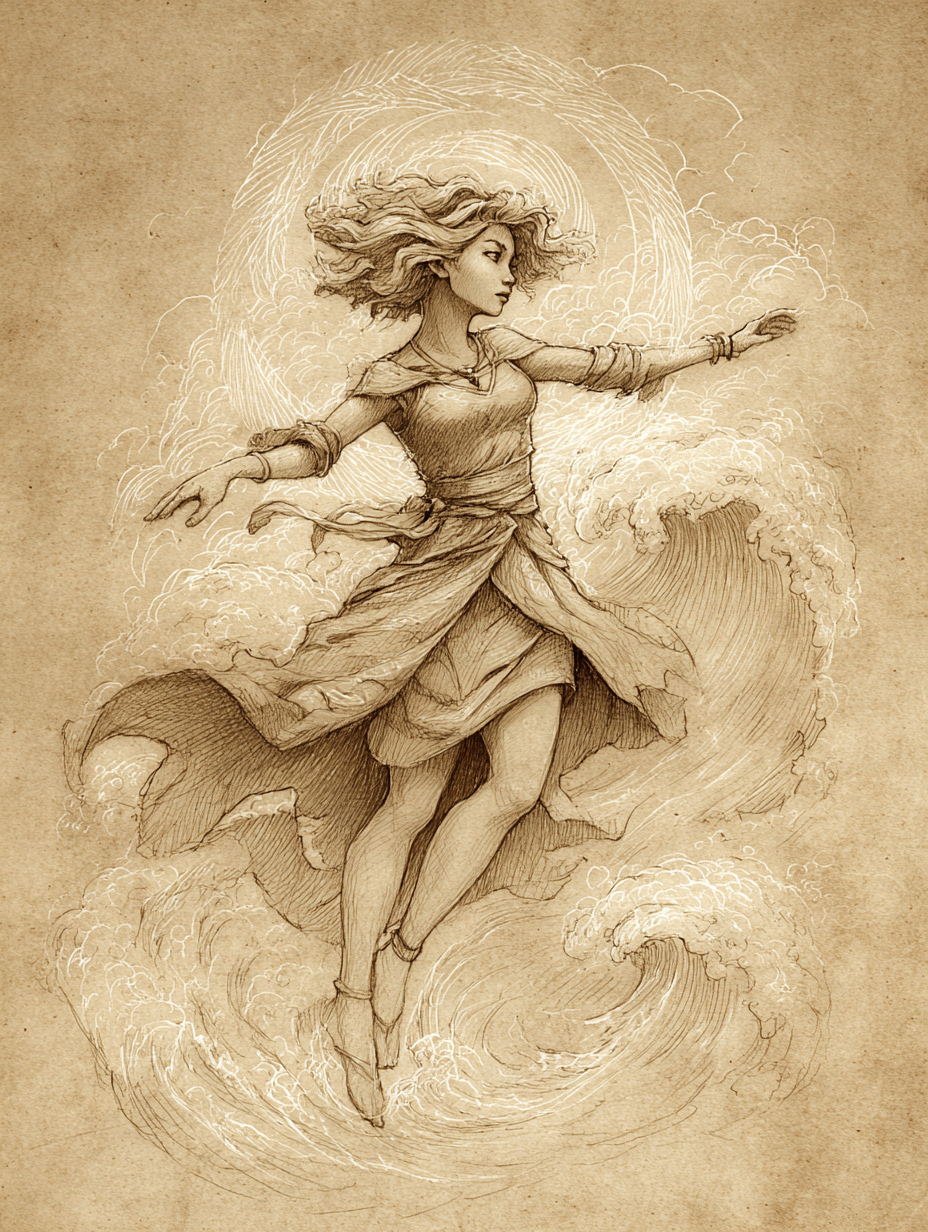
Divine Title: Tarsaralei, Lady of the Tempest Heart, Queen of Storm and Tide
Alignment: Chaotic Good
Portfolio: Sea, storms, wind, water, weather, destructive force, remorse, survival at the edge
Favored Weapon: None
Domains: Air, Chaos, Charm, Destruction, Good, Liberation, Luck, Travel, Water, Weather
Primary Worshippers: Sailors, fishers, islanders, navigators, lighthouse keepers, storm-guides, coastal healers, wreck rescuers, and most Troll clans
Major Order: The Tempest Wardens, also called the Stormcallers or the Remorseful Tide
Common Symbols: Storm spirals, wave crests, shell charms, lighthouse flames, rain over open sea, manticores praised in death
Sacred Sites: Harbor temples, cliff shrines, lighthouse chapels, sea caves, storm shelters, island sanctuaries, flood markers
Sacred Virtues: Courage, adaptability, honesty after harm, rescue, atonement, awe before nature, resilience
Alignment: Chaotic Good
Portfolio: Sea, storms, wind, water, weather, destructive force, remorse, survival at the edge
Favored Weapon: None
Domains: Air, Chaos, Charm, Destruction, Good, Liberation, Luck, Travel, Water, Weather
Primary Worshippers: Sailors, fishers, islanders, navigators, lighthouse keepers, storm-guides, coastal healers, wreck rescuers, and most Troll clans
Major Order: The Tempest Wardens, also called the Stormcallers or the Remorseful Tide
Common Symbols: Storm spirals, wave crests, shell charms, lighthouse flames, rain over open sea, manticores praised in death
Sacred Sites: Harbor temples, cliff shrines, lighthouse chapels, sea caves, storm shelters, island sanctuaries, flood markers
Sacred Virtues: Courage, adaptability, honesty after harm, rescue, atonement, awe before nature, resilience
Children


Comments