
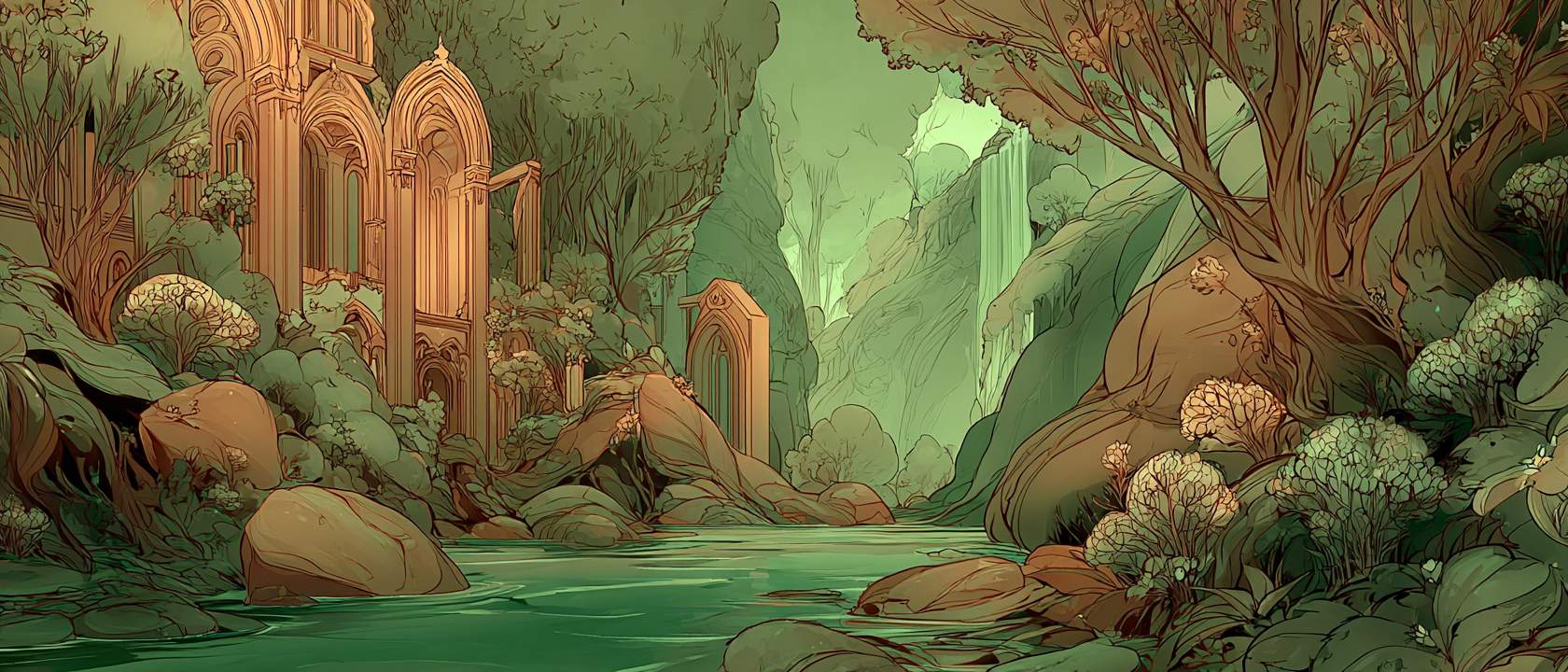
Saurians
There are two stories told about the Saurians. The first is convenient. “They were shaped by Shirtheri. All hunters come from her.” Druids nod. Scholars write it down. The wild goddess does not deny it. Why would she? The River has no tongue left to argue.
The second story is not spoken aloud. Before the Fall, before the Titan was chained within the Great Seat, there was Miselys, the River Mother. She was not storm or sea, but current. She was the steady hand of water against corruption. Where her flow passed, rot slowed. Where her voice moved, life endured. When the Titan struck, she did not flee, and she was devoured.
Her waters recoiled from the spreading corruption. What remained carried the fading sparks of her will; endurance, survival, life. It found purchase in the wild things that lived in the waters and those creatures gained a will and sentience of their own.
They blink rarely. They waste little movement. When they stand still in reed or fog, they resemble driftwood more than flesh. Their swim is silent. Their breath is long. Their patience is older than most kingdoms.
They live in broods, tightly bound clutches of siblings raised communally. Eggs are laid near water whenever possible. Even in stagnant swamps, channels are carved by claw and spade to guide some trickle of current past nesting grounds. Hatchlings are immersed in shallow pools within hours of breaking shell. The act is older than memory.
To separate egg from water is unnatural. To poison a river is an unforgivable crime. The brood is not merely family. It is continuity.
Hatchlings imprint not only upon scent and sound, but upon the rhythm of water nearby. Their first lullaby is current against mudbank.
They practice ritual consumption of their dead. Flesh strengthens the brood. Bones are carved into tools and charms. Ash, if any remains, is given to the water. Before the rite, the body is washed and anointed in silence.
To be buried in dry earth is tragedy. To return through one’s kin is honor. This is not savagery. It is the refusal to stagnate.
In the Rite of Flow, the initiate must navigate a dangerous stretch of current alone. Rapids, submerged ruin-stones, predator-infested bends. They must emerge downstream carrying a token claimed from the river’s depth: a smoothed shard of stone, a relic fragment, a bone bleached clean by water.
In hidden marsh sanctuaries, elders perform water rites older than their clans. They kneel at sacred pools and murmur phrases whose meanings have blurred. Often, nothing happens. Sometimes, pale blooms rise from the surface. Milky white flowers pushing through black water where no seed was planted.
Meanwhile, the wider world insists the Saurians belong to Shirtheri. The wild goddess does not contest the claim. Her domain overlaps enough to make the lie comfortable.
The River Mother has no voice to object.
They guard watersheds as fiercely as territory. They cull invasive beasts. They guide migrating herds. Some even broker uneasy truces with frontier settlers who respect the flow of the river.
Their Wisdom is not softness. It is restraint. They are hunters, yes. But first, they are keepers of balance.
Their scales are darker, often slick with marshwater. They strike from mud and shadow, venom seeping from fang. Where prey overbreeds, they cull. Where corruption festers, they bleed it out with tooth and claw.
To outsiders, they seem savage. To the brood, they are necessary. A river that never floods grows stagnant.
There, where broken aqueducts still whisper with residual magic, some Saurians change. Their scales thicken like stone smoothed by centuries of current. Their eyes sharpen with calculation. Their minds hold fragments they cannot name.
The Zhar’keth do not merely dwell in ruins, they guard them. Ruin Lore may be memory surfacing through blood. Some Zhar’keth stand vigil in collapsed temples half-submerged, as if awaiting a voice long silent.
Larger, heavier, their forms seem shaped by stagnant pools where current died. Many serve Zhar’keth chieftains, bound by strength and clear command. Whether they are twisted guardians or a divergent branch of the same origin is debated among scholars who rarely survive long enough to ask twice.
Where water ceases to move, distortion grows. Some Sylkrath whisper that restoring flow might restore the Gorrath as well. Few have tested this theory.
The Saurians see kingdoms as temporary.
They are not expansionists. They are territorial. They do not seek conquest, only continuity. Trespassers are warned once, sometimes twice. After that, the reeds close.
Those who learn river etiquette may find wary allies in the Sylkrath. Those who poison streams or dam sacred channels will find the Vasskari waiting beneath black water.
They are pragmatic, patient, and unburdened by vanity. Their speech is sparse. Their loyalty to brood runs deep. They do not fear death as others do. They fear stagnation. They fear corruption of water and kin.
A Saurian may leave their marsh to:
Hunt a source of tainted water upstream
Investigate signs of Ruinscale awakening
Repay a life-debt incurred during a flood
Seek knowledge of the River Mother’s forgotten name
They do not crave glory, they crave balance.
And when the cities of Ior crumble, when banners rot and stone sinks into silt, the Saurians will still be there. Watching the current, waiting for the waters to rise again.
The Sylkrath are long-limbed and lean, built more like herons than crocodiles. Their scales are matte rather than glossy, textured like moss-covered bark. Coloration tends toward muted river hues; reed-green, silt-brown, soft amber, algae-grey.
Their snouts are narrow. Their teeth smaller but precise. Their eyes burn gold or amber, reflective in low light. Small frilled ridges trace their necks like reeds stirred by wind.
Their tails are flexible and whip-like rather than thick. When they stand, they do not hunch. They hold themselves upright, balanced, observant.
A Sylkrath at rest seems contemplative.
A Sylkrath in motion vanishes between reeds.
Adornment tends toward woven reeds, river-stone beads, bone charms polished smooth by water. Many bear faint white scar-lines across their scales from ritual immersion in mineral-rich pools.
They look like something that grew from the marsh itself.
The Vasskari are heavier and lower to the ground than Sylkrath. Their torsos are broader, shoulders thick with muscle. Their scales carry a slick sheen, almost oily in appearance. Deep greens, blackened jade, tar-dark brown, bruised purple tones.
Their snouts are shorter and wider. Their teeth longer. Fangs protrude visibly even when their jaws are closed.
Many possess faint bioluminescent speckling along the jawline or throat, a subtle venom-glow visible only in deep shadow.
Their tails are thick and powerful, used as blunt instruments. Their claws curve inward slightly, better for gripping and dragging prey beneath water.
They wear fewer adornments. What they do wear tends to be trophies: teeth, claws, carved bone tokens of successful hunts.
Where the Sylkrath resemble marsh wind, the Vasskari resemble floodwater.
When they smile, it is never gentle.
The Zhar’keth are visibly altered.
Their scales are thicker, ridged, and often patterned like cracked stone or dried riverbed. Coloration leans toward pale granite, slate-grey, riverstone blue, faded ivory. Some bear crystalline growths along spine or brow, small, translucent protrusions that catch light unnaturally. Their eyes are sharper, pupils narrower, gaze calculating.
Their posture is straighter than other Saurians, almost regal. Their movements are slower but deliberate, economical.
Scars along their bodies resemble carved glyphs rather than wounds. In certain light, faint patterns shimmer beneath their scales like submerged inscriptions.
Their tails are heavier and more rigid, often used to anchor their stance.
They look less like beasts of the swamp and more like guardians carved from drowned temples.
When a Zhar’keth stands within ruins, it can be difficult to tell where stone ends and flesh begins.
The Gorrath are unmistakable.
They are larger by a head or more than other Saurians, with elongated crocodilian skulls and crushing jaws. Their torsos are barrel-thick. Their limbs heavy and corded.
Scales are rough and plate-like, layered in thick osteoderms. Colors trend toward murky olive, swamp-brown, blackened green. Some have barnacle-like ridges along shoulders and spine.
Their tails are massive, nearly as thick as a human torso at the base. When they move, the ground seems to feel it. Their eyes are smaller relative to their skulls. Their expressions harder to read.
Many bear ritual brands or carved sigils pressed into their scales by Zhar’keth handlers. Armor on a Gorrath appears minimal, they need little.
Where other Saurians resemble current, the Gorrath resemble something that settled at the bottom and grew monstrous.
The second story is not spoken aloud. Before the Fall, before the Titan was chained within the Great Seat, there was Miselys, the River Mother. She was not storm or sea, but current. She was the steady hand of water against corruption. Where her flow passed, rot slowed. Where her voice moved, life endured. When the Titan struck, she did not flee, and she was devoured.
Her waters recoiled from the spreading corruption. What remained carried the fading sparks of her will; endurance, survival, life. It found purchase in the wild things that lived in the waters and those creatures gained a will and sentience of their own.
Form and Bearing
A Saurian stands broad-shouldered and heavy with muscle, their bodies built for endurance rather than speed. Scales range from moss-dark greens and riverstone greys to the pale silt-hues of delta marshes. Their tails sweep low and strong behind them, balancing their stance like a rooted tree in floodwater.They blink rarely. They waste little movement. When they stand still in reed or fog, they resemble driftwood more than flesh. Their swim is silent. Their breath is long. Their patience is older than most kingdoms.
The Brood and the Riverbank
Saurian society flows as rivers do: in channels, in clusters, in branching paths that always return to source.They live in broods, tightly bound clutches of siblings raised communally. Eggs are laid near water whenever possible. Even in stagnant swamps, channels are carved by claw and spade to guide some trickle of current past nesting grounds. Hatchlings are immersed in shallow pools within hours of breaking shell. The act is older than memory.
To separate egg from water is unnatural. To poison a river is an unforgivable crime. The brood is not merely family. It is continuity.
Hatchlings imprint not only upon scent and sound, but upon the rhythm of water nearby. Their first lullaby is current against mudbank.
The Logic of the Current
Outsiders see only fang and hunger. They misunderstand. The Saurians follow river logic. Nothing is wasted. Nothing is hoarded beyond use. Everything returns.They practice ritual consumption of their dead. Flesh strengthens the brood. Bones are carved into tools and charms. Ash, if any remains, is given to the water. Before the rite, the body is washed and anointed in silence.
To be buried in dry earth is tragedy. To return through one’s kin is honor. This is not savagery. It is the refusal to stagnate.
The Rite of Flow
When a Saurian comes of age, they complete a ritual of strength.In the Rite of Flow, the initiate must navigate a dangerous stretch of current alone. Rapids, submerged ruin-stones, predator-infested bends. They must emerge downstream carrying a token claimed from the river’s depth: a smoothed shard of stone, a relic fragment, a bone bleached clean by water.
Faith Without a Name
Few Saurians speak the name Miselys. Most do not know it. Yet echoes remain.In hidden marsh sanctuaries, elders perform water rites older than their clans. They kneel at sacred pools and murmur phrases whose meanings have blurred. Often, nothing happens. Sometimes, pale blooms rise from the surface. Milky white flowers pushing through black water where no seed was planted.
Meanwhile, the wider world insists the Saurians belong to Shirtheri. The wild goddess does not contest the claim. Her domain overlaps enough to make the lie comfortable.
The River Mother has no voice to object.
The Lineages of the Current
Though united by origin, the Saurians have diverged along the waterways of Ior.Sylkrath – Reedward Guardians
The Sylkrath are the quietest of their kind. Lean and amber-eyed, they move like wind over reeds. Among them, the old rites are strongest. Pale blooms appear more often near their sacred pools.They guard watersheds as fiercely as territory. They cull invasive beasts. They guide migrating herds. Some even broker uneasy truces with frontier settlers who respect the flow of the river.
Their Wisdom is not softness. It is restraint. They are hunters, yes. But first, they are keepers of balance.
Vasskari – Bayou Predators
The Vasskari are the river when it floods.Their scales are darker, often slick with marshwater. They strike from mud and shadow, venom seeping from fang. Where prey overbreeds, they cull. Where corruption festers, they bleed it out with tooth and claw.
To outsiders, they seem savage. To the brood, they are necessary. A river that never floods grows stagnant.
Zhar’keth – Ruinscales of the Drowned Cities
In ancient river-cities drowned during the Fall, something stirs.There, where broken aqueducts still whisper with residual magic, some Saurians change. Their scales thicken like stone smoothed by centuries of current. Their eyes sharpen with calculation. Their minds hold fragments they cannot name.
The Zhar’keth do not merely dwell in ruins, they guard them. Ruin Lore may be memory surfacing through blood. Some Zhar’keth stand vigil in collapsed temples half-submerged, as if awaiting a voice long silent.
Gorrath – Crocfolk of the Stagnant Deep
The Gorrath are kin, though altered.Larger, heavier, their forms seem shaped by stagnant pools where current died. Many serve Zhar’keth chieftains, bound by strength and clear command. Whether they are twisted guardians or a divergent branch of the same origin is debated among scholars who rarely survive long enough to ask twice.
Where water ceases to move, distortion grows. Some Sylkrath whisper that restoring flow might restore the Gorrath as well. Few have tested this theory.
Relations with the Younger Races
The kingdoms of Kresla see Saurians as primitive.The Saurians see kingdoms as temporary.
They are not expansionists. They are territorial. They do not seek conquest, only continuity. Trespassers are warned once, sometimes twice. After that, the reeds close.
Those who learn river etiquette may find wary allies in the Sylkrath. Those who poison streams or dam sacred channels will find the Vasskari waiting beneath black water.
Playing a Saurian
To play a Saurian is not to play a beast.They are pragmatic, patient, and unburdened by vanity. Their speech is sparse. Their loyalty to brood runs deep. They do not fear death as others do. They fear stagnation. They fear corruption of water and kin.
A Saurian may leave their marsh to:
They do not crave glory, they crave balance.
And when the cities of Ior crumble, when banners rot and stone sinks into silt, the Saurians will still be there. Watching the current, waiting for the waters to rise again.
The Saurian Lineages
Sylkrath – Reedward Guardians
The Sylkrath are long-limbed and lean, built more like herons than crocodiles. Their scales are matte rather than glossy, textured like moss-covered bark. Coloration tends toward muted river hues; reed-green, silt-brown, soft amber, algae-grey.
Their snouts are narrow. Their teeth smaller but precise. Their eyes burn gold or amber, reflective in low light. Small frilled ridges trace their necks like reeds stirred by wind.
Their tails are flexible and whip-like rather than thick. When they stand, they do not hunch. They hold themselves upright, balanced, observant.
A Sylkrath at rest seems contemplative.
A Sylkrath in motion vanishes between reeds.
Adornment tends toward woven reeds, river-stone beads, bone charms polished smooth by water. Many bear faint white scar-lines across their scales from ritual immersion in mineral-rich pools.
They look like something that grew from the marsh itself.
Vasskari – Bayou Predators
The Vasskari are heavier and lower to the ground than Sylkrath. Their torsos are broader, shoulders thick with muscle. Their scales carry a slick sheen, almost oily in appearance. Deep greens, blackened jade, tar-dark brown, bruised purple tones.
Their snouts are shorter and wider. Their teeth longer. Fangs protrude visibly even when their jaws are closed.
Many possess faint bioluminescent speckling along the jawline or throat, a subtle venom-glow visible only in deep shadow.
Their tails are thick and powerful, used as blunt instruments. Their claws curve inward slightly, better for gripping and dragging prey beneath water.
They wear fewer adornments. What they do wear tends to be trophies: teeth, claws, carved bone tokens of successful hunts.
Where the Sylkrath resemble marsh wind, the Vasskari resemble floodwater.
When they smile, it is never gentle.
Zhar’keth – Ruinscales
The Zhar’keth are visibly altered.
Their scales are thicker, ridged, and often patterned like cracked stone or dried riverbed. Coloration leans toward pale granite, slate-grey, riverstone blue, faded ivory. Some bear crystalline growths along spine or brow, small, translucent protrusions that catch light unnaturally. Their eyes are sharper, pupils narrower, gaze calculating.
Their posture is straighter than other Saurians, almost regal. Their movements are slower but deliberate, economical.
Scars along their bodies resemble carved glyphs rather than wounds. In certain light, faint patterns shimmer beneath their scales like submerged inscriptions.
Their tails are heavier and more rigid, often used to anchor their stance.
They look less like beasts of the swamp and more like guardians carved from drowned temples.
When a Zhar’keth stands within ruins, it can be difficult to tell where stone ends and flesh begins.
Gorrath – Crocfolk
The Gorrath are unmistakable.
They are larger by a head or more than other Saurians, with elongated crocodilian skulls and crushing jaws. Their torsos are barrel-thick. Their limbs heavy and corded.
Scales are rough and plate-like, layered in thick osteoderms. Colors trend toward murky olive, swamp-brown, blackened green. Some have barnacle-like ridges along shoulders and spine.
Their tails are massive, nearly as thick as a human torso at the base. When they move, the ground seems to feel it. Their eyes are smaller relative to their skulls. Their expressions harder to read.
Many bear ritual brands or carved sigils pressed into their scales by Zhar’keth handlers. Armor on a Gorrath appears minimal, they need little.
Where other Saurians resemble current, the Gorrath resemble something that settled at the bottom and grew monstrous.
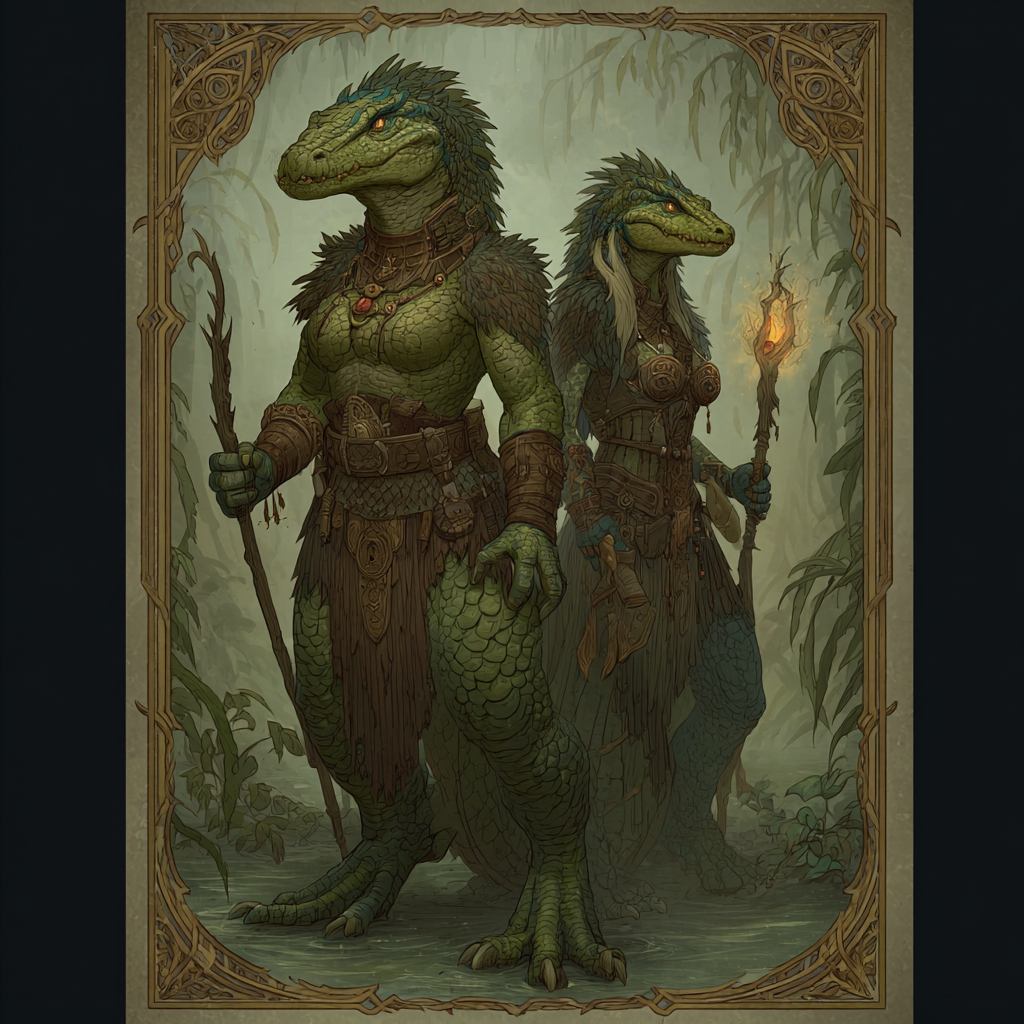
Sylkrath
The Sylkrath are the watchers of reed and root. Leaner than other Saurians, with moss-dark scales and amber eyes, they serve as wardens of marsh territories. They speak softly, move carefully, and rarely raise their voices.To them, the swamp is not merely territory but inheritance.
They guide prey populations, cull invasive threats, and sometimes broker wary peace with nearby human settlements. Among the Saurians, they are considered thoughtful, sometimes overly cautious. Among outsiders, they are the most approachable.
Common Classes: Hunter, Ranger, Druid
Sylkrath – Pathfinder 1e Racial Traits
+2 Strength, +2 Constitution, –2 Intelligence
+2 Wisdom
Medium Humanoid (Reptilian)
Base Speed 30 ft., Swim 30 ft.
Natural Armor +1
Bite (1d4)
Hold Breath (4 × Con rounds)
Swamp Stride: +2 racial bonus on Stealth and Survival in marsh or swamp terrain
Hunter’s Pragmatism: +2 racial bonus on Survival and Perception in natural terrain
Vasskari
The Vasskari are the sharp edge of the brood. Their scales are darker, sometimes near-black, patterned like oil-slick water. Quick of limb and quicker of temper, they are ambush hunters who strike from mud and shadow.They are not cruel.
But they are efficient.
Vasskari clans are more insular and more suspicious of outsiders. They are the most likely to raid trespassers and the least interested in diplomacy. Among Saurians, they are respected for strength and feared for impatience.
Common Classes: Rogue, Barbarian, Fighter
Vasskari – Pathfinder 1e Racial Traits
+2 Strength, +2 Constitution, –2 Intelligence
+2 Dexterity
Medium Humanoid (Reptilian)
Base Speed 30 ft., Swim 30 ft.
Natural Armor +1
Bite (1d4)
Venomous Bite (1/day): Injury poison, Fort DC 10 + 1/2 HD + Con mod; 1d3 Con damage (1 round frequency, 2 rounds)
Hold Breath (4 × Con rounds)
Swamp Stride
Tail Lash: Secondary slam (1d4 +2 racial bonus to CMB for trip attempts
Zhar’keth
The Zhar’keth are a newer evolution.In ancient ruins where residual magic pools like stagnant water, some Saurian broods have changed. Their scales grow thicker, harder, sometimes patterned like stone. Their eyes sharpen with calculation. They speak more, question more, remember more.
They are not scholars in the human sense.
But they understand ruins in a way others do not.
Zhar’keth clans often dwell within collapsed temples or sunken cities, accompanied by hulking Crocfolk thralls. Whether the change is magical adaptation, dormant heritage, or the subtle influence of reshaped ley lines remains unknown. The Zhar’keth do not explain themselves.
They guard.
Common Classes: Oracle, Fighter (Tactician), Warpriest
Zhar’keth – Pathfinder 1e Racial Traits
+2 Strength, +2 Constitution, –2 Intelligence
+2 Intelligence
Medium Humanoid (Reptilian)
Base Speed 30 ft., Swim 30 ft.
Natural Armor +2
Bite (1d4)
Hold Breath
Ruin Lore: +2 racial bonus on Knowledge (Arcana) and Knowledge (Dungeoneering)
Armored Adaptation: Reduce armor check penalty by 1; +1 dodge bonus to AC while wearing armor
Gorrath
The Gorrath are not truly a variant so much as a divergence. Larger, more bestial, with elongated jaws and heavier tails, they are often found in service to Zhar’keth broods. Whether this is domination, symbiosis, or cultural submission varies by region.Gorrath are simple but not mindless. They revere strength and clarity of command. A powerful Zhar’keth chieftain can command fierce loyalty from them.
Gorrath – Pathfinder 1e Racial Traits (Monstrous Option)
Large Humanoid (Reptilian)
+4 Strength, +2 Constitution, –2 Intelligence, –2 Charisma
Base Speed 30 ft., Swim 40 ft.
Natural Armor +3
Bite (1d6) with Grab
Stench (as troglodyte, 10 ft., Fort negates)
Aquatic Stride: No movement penalty in water
(Level adjustment or GM approval recommended)


Comments