
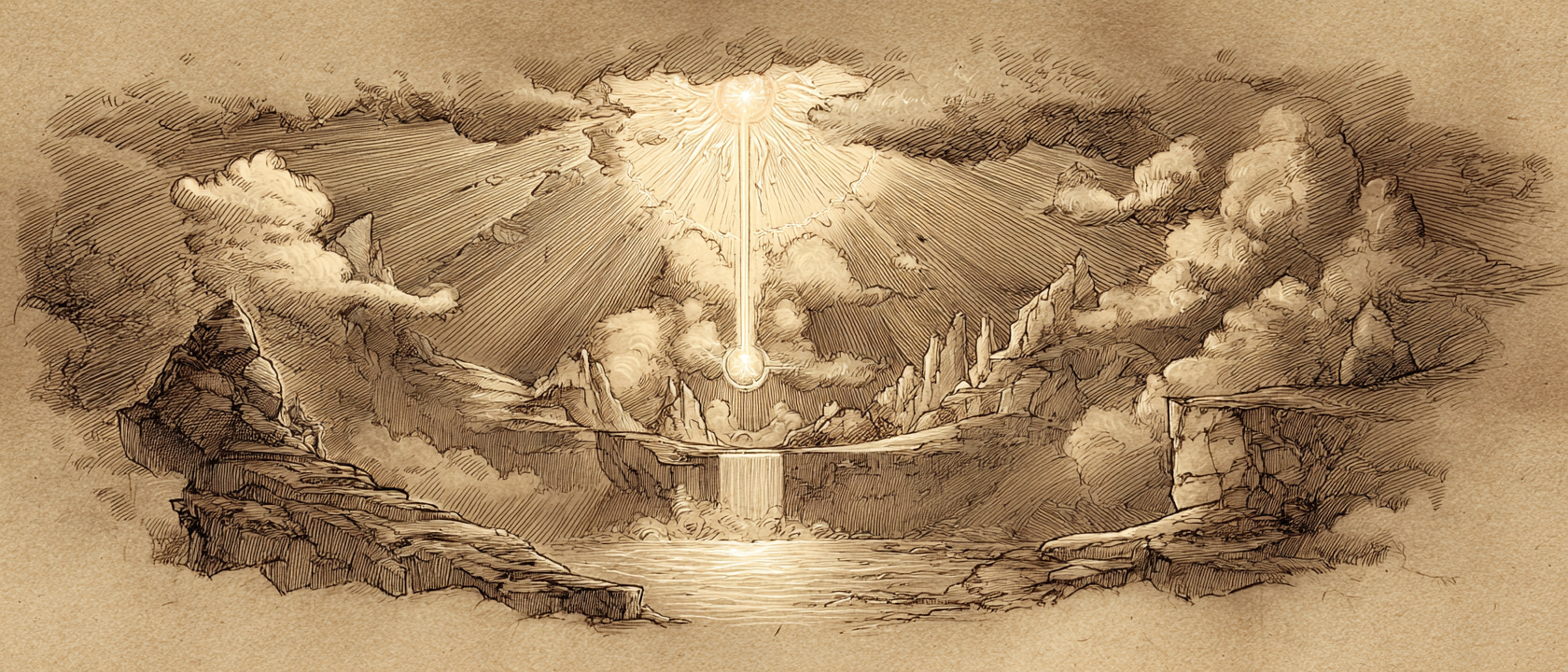
Kazan, Lord of the Deep Forge
Before there is victory, there must be iron. Before there is shelter, there must be stone. Before a people can endure, something must hold.
That is Kazan’s dominion.
He is the eldest child of Eanna and Aldanoc, lord of the earth and the deep places, patron of craftsmen, builders, defenders, and all those who understand that survival is not made only by courage, but by structure. He strengthens the halls beneath the mountains. He gives weight to the oath and purpose to the hammer. He is the god who teaches that loyalty is not sentiment, but labor carried over time. In the old stories, his presence is heard first as a ringing in the dark: hammer on anvil, measured and patient, as if the bones of the world itself were being set true.
Kazan is not a god of brilliance, nor one of easy inspiration. He does not belong to sudden flame or fleeting triumph. He belongs to the beam that does not crack, the gate that does not give, the soldier who does not abandon his post, the ruler who remembers that crowns are burdens before they are honors. Where others stir hearts, Kazan binds what would otherwise come loose.
That is why his faithful revere him not only as a maker, but as a keeper. The world after the Fall is full of fractures. Continents were torn apart. Old roads vanished. Deep places were broken open. Ley lines split. Kingdoms failed. Oaths failed with them. Kazan stands against that long unraveling. To follow him is to resist collapse in all its forms, whether it comes as treachery, cowardice, poor workmanship, neglect, or the slow rot of duty abandoned.
His worship is strongest among dwarves, saurians, masons, engineers, miners, soldiers, rulers, and smiths, but it is not confined to them. Any soul who understands what it means to bear weight for others may find something of themselves in Kazan. He is loved by those who build first and speak later. By those who keep promises after the witnesses have gone home. By those who know that when a wall falls, it does not matter how noble the speeches were.
Kazan’s primary order is called the Stone Oathkeepers. In some lands they are known instead as the Order of the Unbroken Pillar or Kazan’s Hammer, though none of these names fully capture how they see themselves.
They are not merely priests. They are masons of covenant. Smiths of duty. The ones who make a place defensible and a people dependable.
A village that receives them may first know them as practical folk. They repair a bridge. Shore up a watchtower. Inspect the grain store walls. Teach the militia how not to panic in close quarters. Rebuke a local lord for a broken promise. Reforge the hinges on the old gate. Then, only after all that, perhaps they hold a rite. This is very much in Kazan’s spirit. Under his gaze, piety that does not strengthen anything is suspect.
The saying most often associated with the order is simple:
Stand. Hold. Endure.
Not because these are the only virtues they value, but because in hard years they are the ones upon which all other virtues depend. Beauty needs shelter. Mercy needs walls. Wisdom needs a hall in which to be remembered. Even joy needs a roof that will not cave in before winter ends.
The Stone Oathkeepers are therefore not conquerors by nature. They do not hunger for expansion. Their work is defensive in the deepest sense of the word. They protect holds, forges, roads, vaults, homes, lineages, treaties, and memory. They train others to do the same. When people speak of the orders that rebuilt the world after the great breaking, Kazan’s servants are always counted among them.
Kazan’s faith does not concern itself much with pretty abstractions. Its teachings are usually expressed in the language of labor, bond, and endurance.
A wall is holy if it keeps faith with those who sleep behind it.
A weapon is holy if it is forged honestly and lifted for rightful cause.
A vow is holy if it remains true when keeping it becomes costly.
This gives the faith a stern reputation, but not an unfeeling one. Kazan’s followers do not worship hardness for its own sake. They worship reliability. There is a difference, and they care very much about it.
To them, strength is not domination. It is support. The pillar does not stand to admire its own height. It stands because the roof would fall without it.
Likewise, duty is not servility. It is chosen bond. The willing acceptance of obligation in service to something larger and more lasting than appetite or mood. For that reason, oathbreaking is one of the gravest sins in Kazan’s faith. A liar damages more than their own soul. They weaken trust, and trust is one of the hidden materials by which communities are built.
Craft, too, is sacred. Not as hobby or vanity, but as discipline made visible. A properly laid foundation is an act of reverence. A tunnel shored against collapse is an offering. A suit of armor fitted well enough to save a life is prayer hammered into steel.
The Oathkeepers are ordered, but not ornate. Their hierarchy exists because someone must be responsible for the keeping of things.
At the head of the order stands the High Forgemaster, followed by Forgemasters, then Oathwardens, then the sworn body of Hammer-Brothers and Hammer-Sisters, with Apprentices or initiates forming the base.
This structure is strict, though not inflexible. Authority is earned as much by proven steadiness as by title. A master smith who has kept a frontier hold standing through three winters may command more instinctive reverence than a richly housed temple official from a safer place. Among Kazan’s faithful, competence is one of the clearest signs of grace.
The order is strongly dwarven and saurian in character, but never exclusively so. Mixed-blooded folk often find a place here if they are willing to prove themselves over time, and there are even disciplined minotaurs and Dragonshards who have sworn the Stone Oath and been accepted. The Oathkeepers are not naive, and trust is never granted cheaply, but Kazan is not a god of blood purity. He is a god of tested loyalty.
Most members are not great miracle workers. They are engineers, armorers, magistrates, tunnel-fighters, disciplined warriors, keepers of records, and builders of things meant to last. That suits the order well. It has always trusted the hand that can mend more quickly than the tongue that can proclaim.
A temple of Kazan rarely feels like a retreat from work. More often it feels like work raised to sacred form.
His great sanctuaries are forge-temples built into mountains, cavern networks, old holds, or stonefasts sunk into the earth like nails. They smell of mineral dust, smoke, oil, iron, and heat. The chambers are broad, load-bearing, and severe. Columns dominate the architecture. So do anvils, runes, workshops, braziers, defensive galleries, storerooms, and halls built for assembly rather than spectacle. Even beauty, where it appears, is structural.
Most contain a Pillar Altar, a massive stone column or carved upright before which oaths are sworn and renewed. Some are plain and ancient, worn smooth by generations of hands. Others are inscribed with names, laws, lineages, and broken histories bound back together through vow and labor. To touch one is to feel that speech ought to carry consequence.
The eternal forges maintained in these places are especially sacred. Their blue-white ghostly flames are said in some traditions to echo Korveth’s lost legacy, and whether that is literally true or not, Kazan’s faithful treat such fire as something between inheritance and burden. It must be kept. It must be governed. It must not be squandered.
In smaller communities, his shrines are simpler. A standing stone beside a forge. A hammer laid beneath a household lintel. A mine chapel. A defensive hall with an oath ring set into the floor. Kazan does not require grandeur. He requires soundness.
There are vows, and then there are vows sworn before Kazan.
These are not entered lightly.
The Stone Oath may bind a warrior to a lord, a lord to a people, a clan to a hold, a husband to a marriage, a company to a charge, or an individual to Kazan’s service directly. Such vows are treated as more than symbolic. They are regarded almost as architecture. Once spoken properly, they become part of the moral structure of the world around them.
This is why the Oathkeepers are often called to witness important pledges even by those outside the faith. Their presence grants gravity, and gravity is one of the few things no one can counterfeit for long.
If an oath is broken, the matter is not brushed aside. It may be judged, recorded, mourned, and in some cases answered through penance or formal reforging. But there is no cheap forgiveness here. Kazan’s faith understands that trust is harder to mend than iron. A blade may be reheated. A bond must be proven again under strain.
Though outsiders sometimes think of Kazan’s order as a stern military priesthood, that view is too narrow.
Their deepest calling is not to fight. It is to make fighting survivable and rebuilding possible.
They repair Titan-scarred ground where they can. Reinforce ruined halls. Stabilize cracked roads. Shore up tunnels that should have fallen years ago. Raise outposts over dangerous faults. Teach local communities how to maintain wells, walls, mills, and defensible storehouses. In some regions, they are the difference between a settlement remaining inhabited or being abandoned to weather and fear.
This labor is considered holy in itself. The Oathkeepers do not believe the sacred and the practical are separate realms. A properly weighted arch can be an act of faith. So can a repaired bridge or a retaining wall that saves spring plantings from flood. They would find it strange that anyone might think otherwise.
Every order has a place where it becomes most itself.
For the Stone Oathkeepers, that place is the holdfast at the brink. The final defensible hall. The narrow pass. The underground station where families gather with what they can carry while something old and hateful moves below. The gate that cannot be allowed to fail.
Kazan’s faithful are not swift in the manner of the Windstriders or far-ranging in the manner of the Lunar Wardens. Their strength lies elsewhere. They are the last wall and often the first labor that made such a wall possible at all.
They know how to fight in tunnels, on stairs, in breachways, in mineworks, and behind half-built barricades. They know what can be collapsed safely and what must be saved at all cost. They know how fear moves through enclosed places. They know how long food lasts when rationed honestly. These are not glorious arts, but they are among the reasons civilization survives the things that would like to swallow it.
The current head of the order is High Forgemaster Thrain Stoneveil, a grizzled dwarf whose reputation reaches far beyond the forge-temples.
He is said to be as fair as bedrock and nearly as difficult to move. His beard is braided through with iron rings, and one of his eyes has been replaced by a glowing crystal shard gifted by a Dragonshard ally, a detail that would seem too theatrical for a Kazanite if it were not attached to a man so plainly uninterested in drama. He is known for blunt judgment, exacting standards, and for personally overseeing the reforging of broken oaths where lesser leaders might have chosen easier condemnation.
Much of his authority comes not from mystique, but from the sense that he can be relied upon to mean exactly what he says. Among Kazan’s faithful, that is nearly the highest praise possible.
The Stone Oathkeepers remember the Titan War as a time when the deep places mattered more than ever. While the surface burned and cities vanished, holds were sealed, tunnels defended, supply lines maintained, and the first patterns of survival carved into a dying age. After the Fall, when continents split and nations failed, Kazan’s order helped bind survivors into something like community again. Not through speeches. Through labor, oath, and infrastructure.
That history still shapes the order’s alliances.
They work especially well with the Mothers of the Ardent Dawn, whose sanctuaries require walls, roads, stores, and defended foundations. They respect the Lunar Wardens, though the two orders have long argued over whether it is better to range outward against the dark or make certain the bastion behind you cannot fall. They understand the Red Road Pilgrims more easily than one might expect, for both faiths know that character is tested by hardship. They are less instinctively comfortable with the Windstriders, whose looseness can strike them as irresponsibility even when it is not.
With minotaurs and Dragonshards, their stance remains cautious and case by case. Oath matters more to them than origin, but they do not mistake hopeful possibility for proof.
Kazan’s order has its own old arguments.
The Iron Oath holds that vows must be treated with uncompromising severity and that betrayal is too dangerous to meet with softness. Better to confront the crack before the wall fails.
The Living Pillar replies that a pillar exists to bear life, not merely to punish weakness. Its members emphasize Kazan as the steadying elder among his siblings, the one who holds rather than merely judges, and so they are more open to restoration where restoration is honestly sought.
Neither side is frivolous. Both claim the same god. The tension between them gives the order much of its moral weight.
The Oathkeepers dress like people who expect sparks, dust, long labor, and sudden violence to be part of the same day. Forge-black, stone-grey, rust-red, muted bronze, and iron-white dominate their clothing. Plate is often worn over workmanlike tunics, and aprons are not uncommon even in sacred contexts. A Kazanite may look as much like a veteran mason or smith as a priest.
Their favored weapon is the warhammer.
No symbol could suit Kazan better. The hammer shapes. The hammer tests. The hammer drives, breaks, and binds. In one hand it is tool. In another, judgment. That doubleness lies close to the heart of Kazan’s worship. The same steady strength that builds the hall must sometimes defend it.
Kazan’s miracles are seldom delicate.
They are felt in the settling of stone, the strengthening of armor, the strange certainty that a structure should have failed by now and yet still stands. In battle, his favor may come as weight where weight is needed, as shields that hold one blow longer than they should, as traitors checked by the very promises they mocked, as shattered things restored not to what they were, but to something harder and wiser.
Yet most of his faithful do not live by wonders so dramatic. They live by quieter mercies. Good iron. Honest joints. A company that does not break formation. A roof that survives the storm. A comrade who can be trusted to return when he says he will.
Kazan is not the god people usually sing to first.
He is the one they thank years later, when the hall still stands.
That is Kazan’s dominion.
He is the eldest child of Eanna and Aldanoc, lord of the earth and the deep places, patron of craftsmen, builders, defenders, and all those who understand that survival is not made only by courage, but by structure. He strengthens the halls beneath the mountains. He gives weight to the oath and purpose to the hammer. He is the god who teaches that loyalty is not sentiment, but labor carried over time. In the old stories, his presence is heard first as a ringing in the dark: hammer on anvil, measured and patient, as if the bones of the world itself were being set true.
Kazan is not a god of brilliance, nor one of easy inspiration. He does not belong to sudden flame or fleeting triumph. He belongs to the beam that does not crack, the gate that does not give, the soldier who does not abandon his post, the ruler who remembers that crowns are burdens before they are honors. Where others stir hearts, Kazan binds what would otherwise come loose.
That is why his faithful revere him not only as a maker, but as a keeper. The world after the Fall is full of fractures. Continents were torn apart. Old roads vanished. Deep places were broken open. Ley lines split. Kingdoms failed. Oaths failed with them. Kazan stands against that long unraveling. To follow him is to resist collapse in all its forms, whether it comes as treachery, cowardice, poor workmanship, neglect, or the slow rot of duty abandoned.
His worship is strongest among dwarves, saurians, masons, engineers, miners, soldiers, rulers, and smiths, but it is not confined to them. Any soul who understands what it means to bear weight for others may find something of themselves in Kazan. He is loved by those who build first and speak later. By those who keep promises after the witnesses have gone home. By those who know that when a wall falls, it does not matter how noble the speeches were.
The Stone Oathkeepers
Kazan’s primary order is called the Stone Oathkeepers. In some lands they are known instead as the Order of the Unbroken Pillar or Kazan’s Hammer, though none of these names fully capture how they see themselves.
They are not merely priests. They are masons of covenant. Smiths of duty. The ones who make a place defensible and a people dependable.
A village that receives them may first know them as practical folk. They repair a bridge. Shore up a watchtower. Inspect the grain store walls. Teach the militia how not to panic in close quarters. Rebuke a local lord for a broken promise. Reforge the hinges on the old gate. Then, only after all that, perhaps they hold a rite. This is very much in Kazan’s spirit. Under his gaze, piety that does not strengthen anything is suspect.
The saying most often associated with the order is simple:
Stand. Hold. Endure.
Not because these are the only virtues they value, but because in hard years they are the ones upon which all other virtues depend. Beauty needs shelter. Mercy needs walls. Wisdom needs a hall in which to be remembered. Even joy needs a roof that will not cave in before winter ends.
The Stone Oathkeepers are therefore not conquerors by nature. They do not hunger for expansion. Their work is defensive in the deepest sense of the word. They protect holds, forges, roads, vaults, homes, lineages, treaties, and memory. They train others to do the same. When people speak of the orders that rebuilt the world after the great breaking, Kazan’s servants are always counted among them.
What Kazan Teaches
Kazan’s faith does not concern itself much with pretty abstractions. Its teachings are usually expressed in the language of labor, bond, and endurance.
A wall is holy if it keeps faith with those who sleep behind it.
A weapon is holy if it is forged honestly and lifted for rightful cause.
A vow is holy if it remains true when keeping it becomes costly.
This gives the faith a stern reputation, but not an unfeeling one. Kazan’s followers do not worship hardness for its own sake. They worship reliability. There is a difference, and they care very much about it.
To them, strength is not domination. It is support. The pillar does not stand to admire its own height. It stands because the roof would fall without it.
Likewise, duty is not servility. It is chosen bond. The willing acceptance of obligation in service to something larger and more lasting than appetite or mood. For that reason, oathbreaking is one of the gravest sins in Kazan’s faith. A liar damages more than their own soul. They weaken trust, and trust is one of the hidden materials by which communities are built.
Craft, too, is sacred. Not as hobby or vanity, but as discipline made visible. A properly laid foundation is an act of reverence. A tunnel shored against collapse is an offering. A suit of armor fitted well enough to save a life is prayer hammered into steel.
The Order and Its Shape
The Oathkeepers are ordered, but not ornate. Their hierarchy exists because someone must be responsible for the keeping of things.
At the head of the order stands the High Forgemaster, followed by Forgemasters, then Oathwardens, then the sworn body of Hammer-Brothers and Hammer-Sisters, with Apprentices or initiates forming the base.
This structure is strict, though not inflexible. Authority is earned as much by proven steadiness as by title. A master smith who has kept a frontier hold standing through three winters may command more instinctive reverence than a richly housed temple official from a safer place. Among Kazan’s faithful, competence is one of the clearest signs of grace.
The order is strongly dwarven and saurian in character, but never exclusively so. Mixed-blooded folk often find a place here if they are willing to prove themselves over time, and there are even disciplined minotaurs and Dragonshards who have sworn the Stone Oath and been accepted. The Oathkeepers are not naive, and trust is never granted cheaply, but Kazan is not a god of blood purity. He is a god of tested loyalty.
Most members are not great miracle workers. They are engineers, armorers, magistrates, tunnel-fighters, disciplined warriors, keepers of records, and builders of things meant to last. That suits the order well. It has always trusted the hand that can mend more quickly than the tongue that can proclaim.
Forge-Temples and Pillar Altars
A temple of Kazan rarely feels like a retreat from work. More often it feels like work raised to sacred form.
His great sanctuaries are forge-temples built into mountains, cavern networks, old holds, or stonefasts sunk into the earth like nails. They smell of mineral dust, smoke, oil, iron, and heat. The chambers are broad, load-bearing, and severe. Columns dominate the architecture. So do anvils, runes, workshops, braziers, defensive galleries, storerooms, and halls built for assembly rather than spectacle. Even beauty, where it appears, is structural.
Most contain a Pillar Altar, a massive stone column or carved upright before which oaths are sworn and renewed. Some are plain and ancient, worn smooth by generations of hands. Others are inscribed with names, laws, lineages, and broken histories bound back together through vow and labor. To touch one is to feel that speech ought to carry consequence.
The eternal forges maintained in these places are especially sacred. Their blue-white ghostly flames are said in some traditions to echo Korveth’s lost legacy, and whether that is literally true or not, Kazan’s faithful treat such fire as something between inheritance and burden. It must be kept. It must be governed. It must not be squandered.
In smaller communities, his shrines are simpler. A standing stone beside a forge. A hammer laid beneath a household lintel. A mine chapel. A defensive hall with an oath ring set into the floor. Kazan does not require grandeur. He requires soundness.
The Stone Oath
There are vows, and then there are vows sworn before Kazan.
These are not entered lightly.
The Stone Oath may bind a warrior to a lord, a lord to a people, a clan to a hold, a husband to a marriage, a company to a charge, or an individual to Kazan’s service directly. Such vows are treated as more than symbolic. They are regarded almost as architecture. Once spoken properly, they become part of the moral structure of the world around them.
This is why the Oathkeepers are often called to witness important pledges even by those outside the faith. Their presence grants gravity, and gravity is one of the few things no one can counterfeit for long.
If an oath is broken, the matter is not brushed aside. It may be judged, recorded, mourned, and in some cases answered through penance or formal reforging. But there is no cheap forgiveness here. Kazan’s faith understands that trust is harder to mend than iron. A blade may be reheated. A bond must be proven again under strain.
Builders and Fighters
Though outsiders sometimes think of Kazan’s order as a stern military priesthood, that view is too narrow.
Their deepest calling is not to fight. It is to make fighting survivable and rebuilding possible.
They repair Titan-scarred ground where they can. Reinforce ruined halls. Stabilize cracked roads. Shore up tunnels that should have fallen years ago. Raise outposts over dangerous faults. Teach local communities how to maintain wells, walls, mills, and defensible storehouses. In some regions, they are the difference between a settlement remaining inhabited or being abandoned to weather and fear.
This labor is considered holy in itself. The Oathkeepers do not believe the sacred and the practical are separate realms. A properly weighted arch can be an act of faith. So can a repaired bridge or a retaining wall that saves spring plantings from flood. They would find it strange that anyone might think otherwise.
The Last Wall
Every order has a place where it becomes most itself.
For the Stone Oathkeepers, that place is the holdfast at the brink. The final defensible hall. The narrow pass. The underground station where families gather with what they can carry while something old and hateful moves below. The gate that cannot be allowed to fail.
Kazan’s faithful are not swift in the manner of the Windstriders or far-ranging in the manner of the Lunar Wardens. Their strength lies elsewhere. They are the last wall and often the first labor that made such a wall possible at all.
They know how to fight in tunnels, on stairs, in breachways, in mineworks, and behind half-built barricades. They know what can be collapsed safely and what must be saved at all cost. They know how fear moves through enclosed places. They know how long food lasts when rationed honestly. These are not glorious arts, but they are among the reasons civilization survives the things that would like to swallow it.
High Forgemaster Thrain Stoneveil
The current head of the order is High Forgemaster Thrain Stoneveil, a grizzled dwarf whose reputation reaches far beyond the forge-temples.
He is said to be as fair as bedrock and nearly as difficult to move. His beard is braided through with iron rings, and one of his eyes has been replaced by a glowing crystal shard gifted by a Dragonshard ally, a detail that would seem too theatrical for a Kazanite if it were not attached to a man so plainly uninterested in drama. He is known for blunt judgment, exacting standards, and for personally overseeing the reforging of broken oaths where lesser leaders might have chosen easier condemnation.
Much of his authority comes not from mystique, but from the sense that he can be relied upon to mean exactly what he says. Among Kazan’s faithful, that is nearly the highest praise possible.
Old Grudges and Present Alliances
The Stone Oathkeepers remember the Titan War as a time when the deep places mattered more than ever. While the surface burned and cities vanished, holds were sealed, tunnels defended, supply lines maintained, and the first patterns of survival carved into a dying age. After the Fall, when continents split and nations failed, Kazan’s order helped bind survivors into something like community again. Not through speeches. Through labor, oath, and infrastructure.
That history still shapes the order’s alliances.
They work especially well with the Mothers of the Ardent Dawn, whose sanctuaries require walls, roads, stores, and defended foundations. They respect the Lunar Wardens, though the two orders have long argued over whether it is better to range outward against the dark or make certain the bastion behind you cannot fall. They understand the Red Road Pilgrims more easily than one might expect, for both faiths know that character is tested by hardship. They are less instinctively comfortable with the Windstriders, whose looseness can strike them as irresponsibility even when it is not.
With minotaurs and Dragonshards, their stance remains cautious and case by case. Oath matters more to them than origin, but they do not mistake hopeful possibility for proof.
Divisions Within the Faith
Kazan’s order has its own old arguments.
The Iron Oath holds that vows must be treated with uncompromising severity and that betrayal is too dangerous to meet with softness. Better to confront the crack before the wall fails.
The Living Pillar replies that a pillar exists to bear life, not merely to punish weakness. Its members emphasize Kazan as the steadying elder among his siblings, the one who holds rather than merely judges, and so they are more open to restoration where restoration is honestly sought.
Neither side is frivolous. Both claim the same god. The tension between them gives the order much of its moral weight.
Vestments and the Hammer
The Oathkeepers dress like people who expect sparks, dust, long labor, and sudden violence to be part of the same day. Forge-black, stone-grey, rust-red, muted bronze, and iron-white dominate their clothing. Plate is often worn over workmanlike tunics, and aprons are not uncommon even in sacred contexts. A Kazanite may look as much like a veteran mason or smith as a priest.
Their favored weapon is the warhammer.
No symbol could suit Kazan better. The hammer shapes. The hammer tests. The hammer drives, breaks, and binds. In one hand it is tool. In another, judgment. That doubleness lies close to the heart of Kazan’s worship. The same steady strength that builds the hall must sometimes defend it.
The Grace of Kazan
Kazan’s miracles are seldom delicate.
They are felt in the settling of stone, the strengthening of armor, the strange certainty that a structure should have failed by now and yet still stands. In battle, his favor may come as weight where weight is needed, as shields that hold one blow longer than they should, as traitors checked by the very promises they mocked, as shattered things restored not to what they were, but to something harder and wiser.
Yet most of his faithful do not live by wonders so dramatic. They live by quieter mercies. Good iron. Honest joints. A company that does not break formation. A roof that survives the storm. A comrade who can be trusted to return when he says he will.
Kazan is not the god people usually sing to first.
He is the one they thank years later, when the hall still stands.
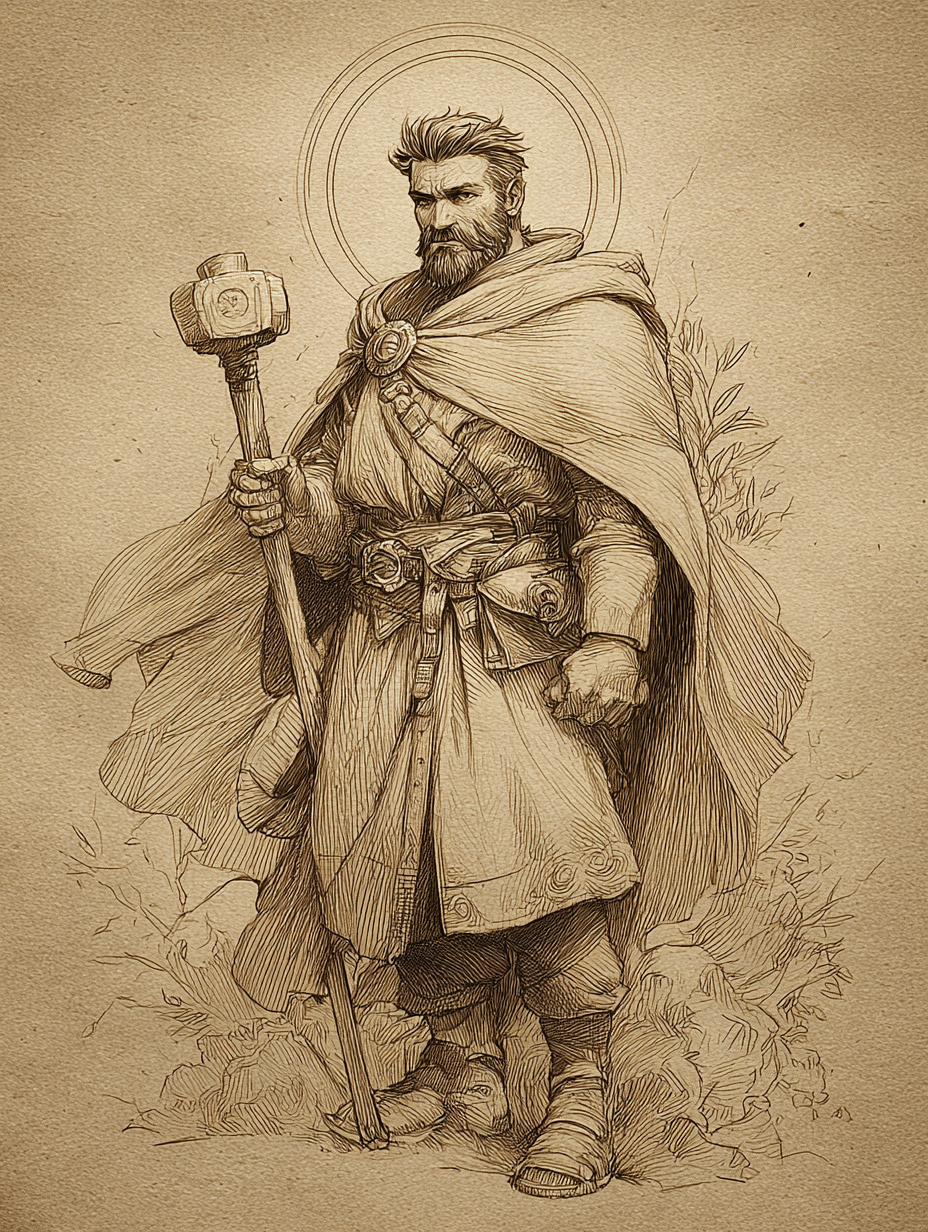
Divine Title: Kazan, Lord of the Deep Forge, the Stalwart Pillar, Keeper of the Stone Oath
Alignment: Lawful Good
Portfolio: Earth, craft, oaths, duty, defense, endurance, communal order
Favored Weapon: Warhammer
Domains: Artifice, Community, Earth, Fire, Good, Knowledge, Law, Protection, Rune, Strength, War
Primary Worshippers: Dwarves, saurians, smiths, engineers, miners, soldiers, masons, rulers, oath-bound folk
Major Order: The Stone Oathkeepers, also called the Order of the Unbroken Pillar or Kazan’s Hammer
Common Symbols: Pillars, anvils, warhammers, oath-rings, runic columns, eternal forge-flame
Sacred Sites: Forge-temples, mountain holds, underground sanctuaries, pillar altars, mining chapels, defensive halls
Sacred Virtues: Duty, loyalty, sound workmanship, endurance, fairness, discipline, communal responsibility
Alignment: Lawful Good
Portfolio: Earth, craft, oaths, duty, defense, endurance, communal order
Favored Weapon: Warhammer
Domains: Artifice, Community, Earth, Fire, Good, Knowledge, Law, Protection, Rune, Strength, War
Primary Worshippers: Dwarves, saurians, smiths, engineers, miners, soldiers, masons, rulers, oath-bound folk
Major Order: The Stone Oathkeepers, also called the Order of the Unbroken Pillar or Kazan’s Hammer
Common Symbols: Pillars, anvils, warhammers, oath-rings, runic columns, eternal forge-flame
Sacred Sites: Forge-temples, mountain holds, underground sanctuaries, pillar altars, mining chapels, defensive halls
Sacred Virtues: Duty, loyalty, sound workmanship, endurance, fairness, discipline, communal responsibility
Children


Comments