
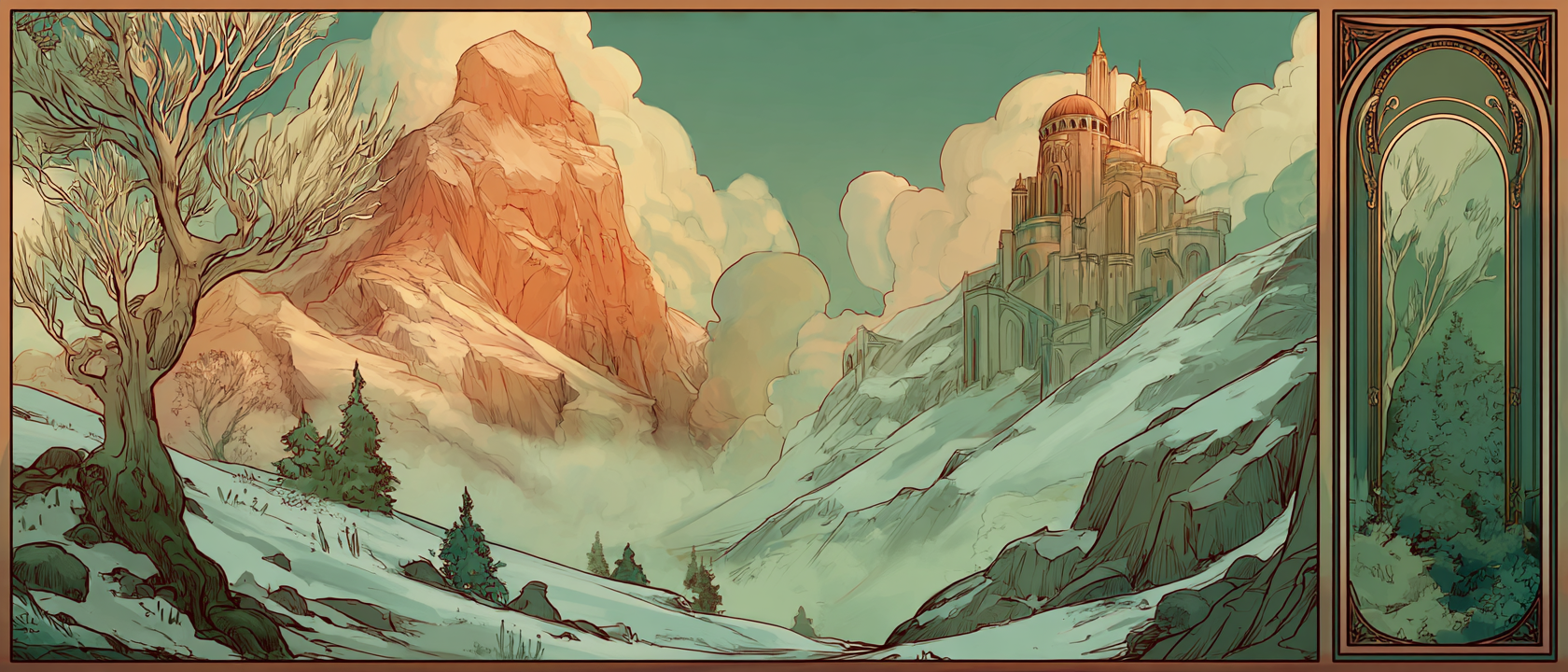
Dwarven Holds
Vorak-Throng
The Eternal ForgeFar from the broken lands of Kresla, beneath the oldest and most stable mountains of the central Heartland continent, lies Vorak-Throng, the Eternal Forge.
It is said that when the world was young and the mountains still remembered the shaping hands of Kazan, the first dwarves carved their halls here. Not upon the surface, where wind and storm erode all things, but deep; deeper than any river-root, deeper than the bones of fallen empires.
Vorak-Throng does not sprawl outward; it descends.
A colossal vertical hold, its levels spiral downward through vast cylindrical caverns linked by rune-carved ramps and stone bridges suspended over chasms of firelight. Grand forge-halls roar with steady flame. Processional stairways descend to vaulted temples where hammer-strikes ring in rhythmic prayer. Entire districts cling to the inner walls of the mountain like a living mosaic of stone and iron.
At its deepest guarded heart lies the first Heart of the Mountain, the one discovered by the Copper King after his fateful union with the elemental spirit of copper.
It pulses still.
No dwarf claims to understand what the Heart truly is. They know only that its beat is steady and strong. It warms the deepest halls. It hums in the anvils. It drives ancient bellows that require no visible hand. And far below, in sealed vaults where Gilded guardians keep watch, its presence repels things that should not be named.
The Heart is sealed within layers of lead, rune-stone, and anvils blessed in Kazan’s name. The elite Heart Wardens, drawn from ancient bloodlines, tend to its mysteries. They do not speak of their rites. Many die young. Their eyes, upon death, are reclaimed and forged into heirloom weapons that carry a faint warmth long after the forge cools.
“May the eyes of the ancestors watch over you.”
In Vorak-Throng, that blessing carries weight.
Twelve to eighteen thousand dwarves dwell within the Eternal Forge. It is the largest gathering of Kazan’s children left in the world. Deep clans guard the lower vaults. Stone-variant diplomats depart from its upper gates to walk among humans and elves. Gilded berserkers, their skin faintly metallic and their eyes aglow like polished ore, serve in the lowest watch-circles where the mountain groans.
The Bonding Rite is most sacred here. Initiates fast and ingest alchemical compounds under the watch of the temple-smiths. When they emerge, their eyes glitter like gemstone facets, and their names are struck upon the Anvil of Echoes so the Heart itself may hear them.
Vorak-Throng survived the Fall better than any other hold. Its depth shielded it. Its wards endured. But even here, there are signs of unease.
At irregular intervals, the Heart surges.
Its pulse quickens. The anvils tremble. Lantern-light flickers. The Wardens say nothing, yet messengers travel swiftly to distant holds when such things occur.
Some whisper that the first Heart is not alone in its beating.
And that it may be answering something far away.
The hold descends in titanic tiers, ring upon ring of carved galleries and suspended bridges spiraling downward toward the Deep Vaults. From the upper gates where envoys and pilgrims arrive, one may walk for hours along sloping ramps engraved with genealogies before ever reaching the Great Forges.
Each level has its function.
The High Rings house embassies, markets, and the Hall of Measures, where alloys are tested against ancient standards said to predate the Fall. Further below are the Forge Wards, where eternal fires burn with a steadiness that seems almost… attentive. Deeper still lie the Reliquary Vaults, chambers containing weapons forged from the reclaimed eye-gems of ancestors, each blade etched with the name of the dwarf whose sight now guides its edge.
And at the axis of all things: the Heart.
The original.
Its pulse resonates faintly through the stone, not loud, not thunderous, but constant. In certain corridors, the rhythm can be felt beneath the palm if pressed flat against the wall. In the Grand Anvil Temple, priests of Kazan time their hammer-strikes to its beat.
The Procession of Listening
Once each decade, Vorak-Throng conducts the Procession of Listening. Clans descend in silence from the High Rings to the lower sanctums, carrying unlit lanterns. At the threshold of the Deep Vault, they extinguish all flame.For a full hour, they stand in darkness.
No prayer. No chant.
Only the pulse.
The dwarves say it is not they who listen.
It is the Heart.
Those who emerge sometimes report dreams in the weeks that follow, of ancient halls now lost, of copper fire and collapsing skies, of a crowned king standing before a molten light.
The Wardens neither confirm nor deny such accounts.
Cultural Character
Vorak-Throng’s dwarves are deliberate and unhurried. Their humor is dry and quiet. Their disputes are long but rarely violent; grudges here last generations, but so do reconciliations.The Gilded serve in the Deep Watches, their metallic skin catching forge-light like living armor. The Stone, subtler in manifestation, often serve as historians and envoys. Both are respected equally, for endurance takes many forms.
Children here are raised with the phrase: “Endure, and shape.”
It is the purest expression of Kazan’s will.
Present Unease
In recent years, certain smiths claim their metal “rings wrong” on occasion, a slight discordance when struck. The Heart has surged irregularly twice in a century. Pilgrims from Kumush Zallari and Tharok-Dum arrive more frequently, bearing quiet questions.Vorak-Throng answers as it always has:
With patience.
But deep in the Vault, the Wardens have doubled their rotations.
Tharok-Dum
The Granite VeilIn the mist-shrouded highlands bordering the Silver Mist Hills of Kresla stands Tharok-Dum, the Granite Veil. Unlike Vorak-Throng’s immeasurable depth or Kumush Zallari’s volcanic brilliance, Tharok-Dum is a fortress of watchfulness.
Its main gate emerges from a sheer granite cliff face overlooking broken valleys and overgrown ruins, remnants of older kingdoms swallowed by the Fall. Independent farmsteads dot the lowlands, and cautious trade passes along narrow roads that wind toward the mountains.
Tharok-Dum watches them all.
Within its cliffside walls dwell nearly eighteen hundred dwarves, miners, masons, smiths, and crossbow-armed rangers who patrol the high passes. The hold is governed by a council of clan elders beneath High Warden Torva Stoneveil, a pragmatic dwarf marked with simple anvil tattoos and a voice as steady as quarried granite.
Beneath the central forge-hall lies a Heart of the Mountain. It's pulse is weak but steady.
Sealed in a lead-lined vault, the Heart’s pulse provides faint warmth to the forges and seems to repel burrowing vermin and shadow-forms that linger from the Fall’s elemental devastation. Yet proximity carries risk. The Veil Wardens rotate through heavy-padded watch shifts near the vault. Those who linger too long grow pale. Bones become brittle. A malaise settles into the marrow.
The dwarves call it veil sickness.
They endure it without complaint.
Tharok-Dum exports fine granite, iron tools, and a rare alloy known as veil-steel, forged with trace resonance from the Heart’s presence, making it subtly more durable than common iron. They import grain, wool, and small quantities of black powder used sparingly in quarry blasts or to defend the high passes from raiders.
Each evening, hammer-chants echo through the Grand Anvil Temple, where the Heart’s pulse reverberates faintly like distant thunder. Kazan is honored not as a conqueror, but as a patient builder, one who shapes endurance from unyielding stone.
Tharok-Dum maintains “veil oaths” with nearby surface settlements, sworn pacts of mutual aid. During Veil Night, upper vents are opened and the faint glow from deep within the hold filters into the mountain mist, casting the valleys in a ghostly silver haze. Surface folk gather to trade stories and goods, though few are permitted within the deeper halls.
Recently, a cave-in revealed a strange vein pulsing in faint rhythm, not with their own Heart alone, but as though answering another.
Some believe it may link to distant holds underground.
Others fear what such a connection might awaken.
For Tharok-Dum stands not only against raiders and bandit kings, but it stands against what stirs beneath.
Tharok-Dum is a hold of thresholds.
It stands between mountain and valley, between dwarven stone and the uncertain lands of Kresla. Its gate is carved directly into a vertical granite escarpment, reinforced with ironwood doors banded in rune-etched steel.
Above the gate, a carved lintel reads: “Stone endures. So do we.”
Architecture of Defense
Unlike Vorak-Throng’s spiraling grandeur, Tharok-Dum’s design is angular and martial. Narrow corridors can be sealed by counterweighted slabs. Murder-holes overlook ascent paths. Ballistae and heavy crossbows line the upper battlements, manned by rangers known as the Veilguard.These rangers are distinctive among dwarves, lightly armored by dwarven standards, trained in mountain tracking and long-range marksmanship. They know the valleys’ farmers by name. They also know which bandit clans have begun to gather strength.
The dwarves of Tharok-Dum believe in watchfulness not as paranoia, but as stewardship.
The Veil Wardens
The Heart here is faint, a steady ember rather than a blazing furnace. It rests beneath the central forge-hall in a vault lined with lead and dense stone.The Veil Wardens serve in rotating watches near it.
Overexposure brings veil sickness: pallor, fatigue, brittleness in bone. Yet those who suffer it are treated with honor. Their names are recorded in the Hall of Quiet Endurance. Families speak of their sacrifice not with sorrow, but pride.
Some Wardens claim they hear whispers when near the vault, not voices, but impressions. The sense of pressure. The sense of something held at bay.
None speculate publicly.
Veil Night
Once each year, upper mountain vents are opened at dusk. The faint glow from the Heart filters into the valley mist, casting the lowlands in silver haze. Surface folk gather below, bringing grain, wool, and stories. The dwarves share tools and granite blocks shaped with exquisite precision.For one night, stone and soil stand together.
Unique Craft: Veil-Steel
Veil-steel is forged only in Tharok-Dum. The alloy is not magical in any understood sense, yet it holds an unusual resilience. Blades chip less easily. Shields crack more slowly. The dwarves attribute this to careful alloying techniques and the subtle influence of proximity to the Heart.They refuse to experiment beyond tradition.
“Curiosity built cities,” High Warden Torva Stoneveil once said. “Recklessness buried them.”
Present Tension
A newly uncovered vein pulses faintly in synchrony with distant rhythms. Survey teams report tremors too regular to be random. Some argue for excavation.Others remember the Copper King’s tale. Tharok-Dum stands at a crossroads, between prudence and revelation.
Vordak-Zul
The Emberdeep EnclaveIn the fractured eastern highlands of Kresla, where golden plains turned to dust and rivers collapsed into ravines during the Fall, lies Vordak-Zul, the Emberdeep Enclave.
It is less a grand hold, and more a scarred wound in the stone.
Hidden fissures in canyon walls conceal narrow entrances. Tunnels snake beneath dried riverbeds where drowned cities once stood. The dwarves here are fewer than a thousand, hardy prospectors, younger clans, and those who fled older holds seeking something new.
They possess no living Heart.
Their Heart was destroyed when the mountains split and the earth convulsed.
In its absence, they mine what they call ember veins, glowing residual ore left behind where ley-lines ruptured and distant Hearts once pulsed. These veins flare unpredictably. They provide bursts of extraordinary heat for the forge, but prolonged exposure causes ember fever.
Veins glow beneath the skin. Eyes burn brighter than polished gems. Madness whispers at the edges of thought.
Foreman Grimnir Emberhand leads Vordak-Zul with pragmatic fervor. His creed is simple: “Kazan builds with what the stone gives.”
Here, black powder is more common than in other holds. Clockwork drills grind through canyon rock. Ember-forges flare dangerously hot. Experimental rune-batteries flicker to life in dim workshops where alchemists test fragments of salvaged schematics attributed to the Copper King’s era.
Sometimes they work.
Sometimes they explode.
Ember tales are told each night, songs of the Age of Wonders and warnings against hubris. Annual Ember Dives send teams into the deepest fractures to harvest glowing ore. Survivors return to chants and raised mugs.
Recently, an ember surge rippled through the deepest shafts.
It pulsed in measured rhythm.
Some claim it answered something distant. If stabilized, the surge might birth something new. If mishandled, it could shatter the canyon walls and bury Vordak-Zul beneath its own ambition.
And still, the dwarves of Emberdeep dig.
Ember Culture
Here, innovation is not taboo. It is survival.Clockwork drills grind through canyon strata. Alchemical bellows pump with explosive force. Rune-batteries flicker to life in workshops thick with metallic scent.
Black powder is common, though still respected. Quarry blasts echo across the ravines. Defensive charges line hidden approaches.
Children grow up with soot beneath their nails.
Ember Fever
Exposure to ember veins causes visible changes. Glowing tracery beneath the skin. Heat in the blood. Intensified temperament. In later stages, hallucinations and erratic behavior.Those who endure without succumbing are celebrated. Ember tattoos are inked over glowing veins, turning affliction into artistry.
Those who fall to madness are not cast out. They are given the Deep Vigil; a final descent into unstable shafts to guard against encroaching threats.
Few return.
The Forge Without a Heart
Vordak-Zul’s central forge is an amalgam of salvage and invention. Copper King schematics, incomplete and half-understood, are preserved in a reinforced chamber known as the Ash Archive.Attempts to “stabilize” ember surges have grown more ambitious. Recently, a deep surge pulsed in measured rhythm for nearly a full minute.
Some claim it was answering something.
Others fear it was calling.
Relations
Vordak-Zul trades ember ore to Kumush Zallari and Tharok-Dum, though both holds express caution. Pilgrims occasionally travel to Vorak-Throng seeking lost knowledge, but the Eternal Forge rarely provides more than general counsel.The Ember Dive
Once each year, teams descend into the deepest fractures to harvest unstable veins. Before they depart, hammers strike thrice upon ember-anvils and the hold chants: “Build with what the stone gives.”It is both prayer and defiance.


Comments